
This interview originally appeared in the Watercolor Honor Society’s Fall 2025 newsletter.
It was my pleasure to interview the great Mary Jansen. She is a new member of the Watercolor Honor Society, and her painting Emerald City received a WHS Board of Directors award at Watercolor USA 2025.
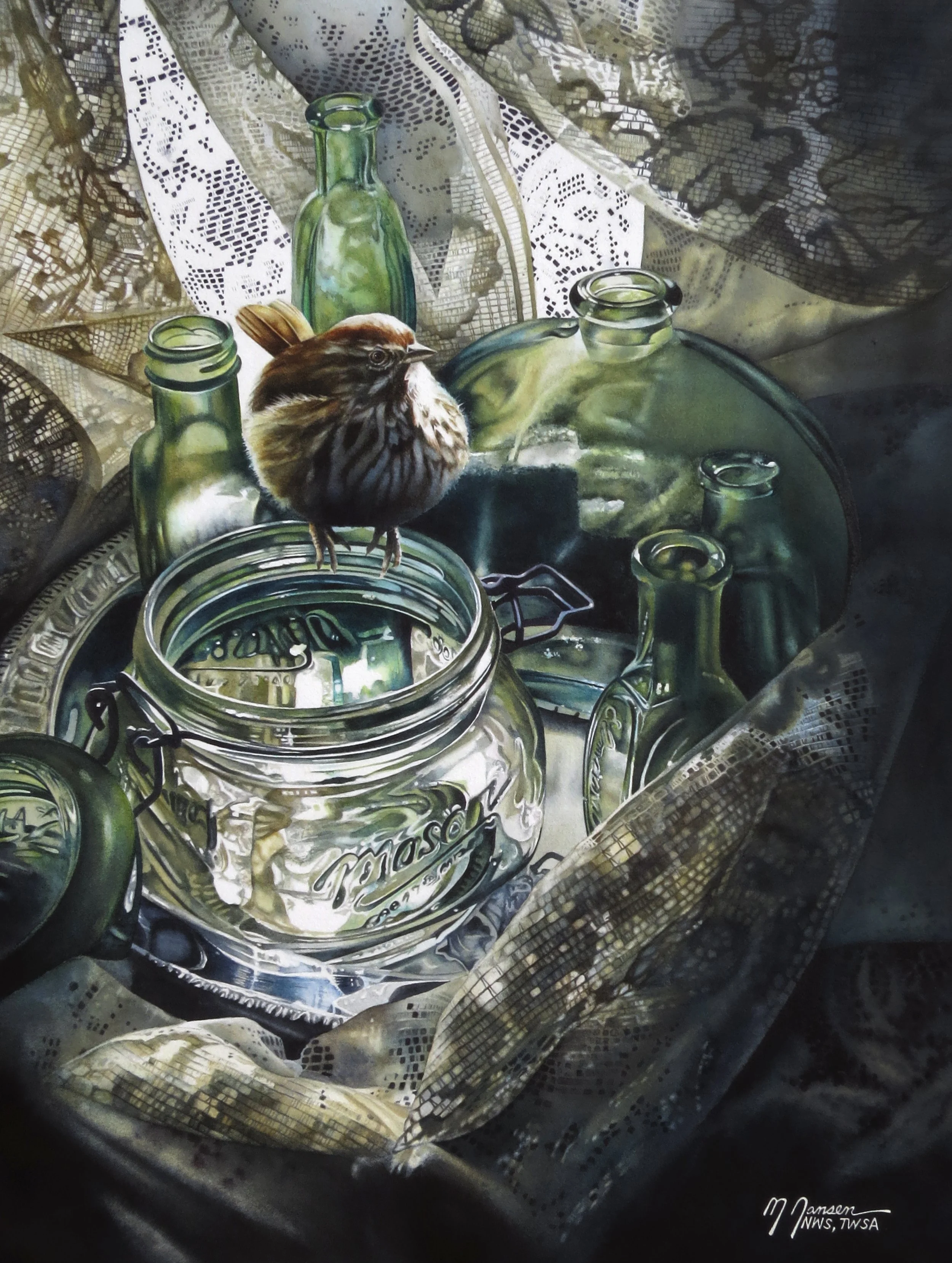
Emerald City
You grew up in northern California, and after working as a graphic artist, you're currently a full-time watercolorist in Portland, Oregon. Could you tell us a little more about your artistic background?
My first serious introduction to watercolor was at the California College of Arts and Crafts in Oakland, CA. I majored in Graphic Design, but felt it important to incorporate fine arts into my curriculum. Practicality led me to graduate with a BFA in Graphic Design, but I always knew in my heart that I would eventually drift back to watercolor full time.
What can watercolor do for you that other mediums can't?
There is something about this medium—where the tangible meets the spiritual—that beckons me. Watercolors can be complex or whimsical or disciplined. The medium allows for a vast diversity of approaches, and I am continually amazed by my watercolor peers and their unique applications and hope to grow and expand through their influence. For this reason, I feel I have little creative reserve to venture into any other mediums...but that may change too someday.
During the 00s, you created quite a few miniature paintings. Can you talk about the appeal of working on this scale?
I was very involved in miniature painting for quite some time. My mini-paintings ranged in size from 4" x 7" to 1" x 1". Working so small is a contemplative process, and I felt it relaxed my mind, much as a good meditation might. All of my pieces were done in watercolor of course, and the brushes I used were very small. Some declared they were the width of a gnat's eyelash, and their observations were not far off! I competed and won multiple awards and signatures before I felt compelled to move forward in my exploration of this medium.
Please describe an average painting day (or week, month, whatever you like).
I have four muses that dominate my life. They are: Studio Muse, Garden Muse, Kitchen Muse and Writing Muse. They all bicker amongst themselves for my time, but the Studio and Garden muses are the strongest and dominate my thoughts. They have a mutual understanding: the summer months belong to the Garden Muse, and the winter months are owned by the Studio Muse. During the winter, I gather and process images and ideas collected throughout the year and set them to compositions.
How many major paintings do you produce during an average year?
I may have five different paintings going at the same time but am lucky to bring three of them to finality by the time spring planting begins. I also spend time organizing teaching notes and thinking of ways to inspire my students and enhance their skills.
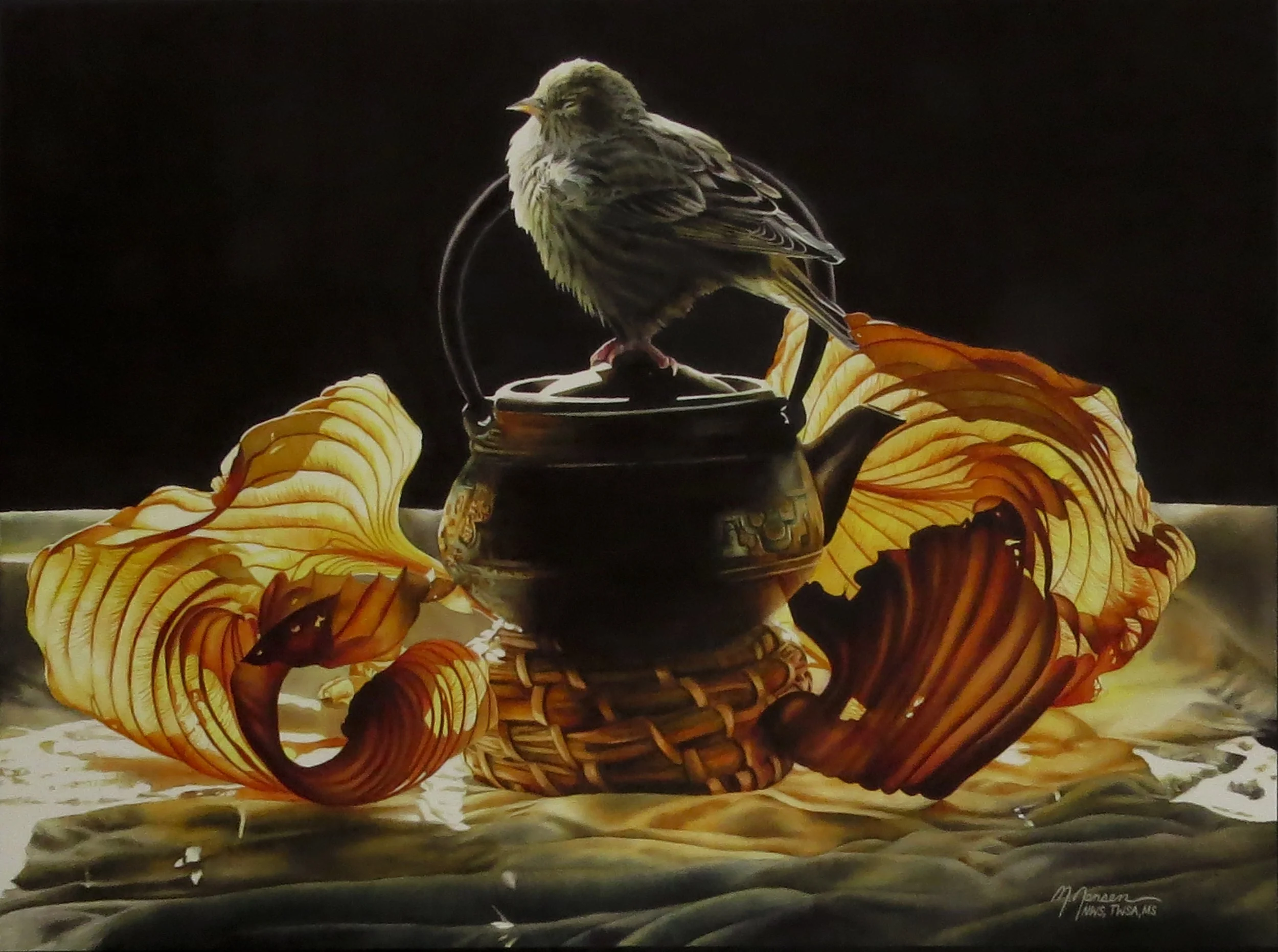
Heiwa
Birds are popular subjects for painters, but your birds are not decorative co-stars or shown in straightforward scenes from nature. They infiltrate the human sphere and interact with manufactured objects such as containers and lace under dramatic, almost Baroque lighting. Your admiration of these creatures is evident in every picture you paint, and you portray them as beautiful and sentient focal points. As I studied your portfolio, I wrote things like, "I want wild birds to be part of my life like this. I want to see a pelican on my windowsill," and "I think she is the David Lynch of bird painters." All of this is to say: why birds?
I believe birds are intrinsically beautiful and fascinating creatures. But I also believe they can serve as conduits to a spiritual realm. This may all be a part of my imagination, of course, but after spending years observing birds' unique personalities and antics, I have come to love and respect them for their inherent and seemingly otherworldly attributes. I will never incorporate a bird into a composition to merely serve as a place holder. Nor will I attempt to "Disney-fy" a bird for fear of crossing over to an anthropocentric ideology. My hope is that when a viewer observes the birds in my paintings, they will celebrate the birds' unique personas and attributes. And maybe the viewer will also come away with a sense of mystery and transcendence.
Are you a birder, and if so, do you have any good birding stories?
Why yes, I am! I've had countless interactions with birds, and I have thousands of reference photos that I use exclusively for my work. There was one incident, however, that moved me to tears. My father passed away in 2019, and in his eulogy I compared his free soul to that of a Brown Creeper—a feisty bird with an insatiable appetite for exploration. This active bird perpetually pokes and prods for invertebrates between the bark furrows on one tree and then alights on another and begins the process all over again. How like my dad and his zest for learning and exploring! Having completed my eulogy, I went outside for a breather, when suddenly I felt a light thump on the back of my head. When I turned around to investigate, the only creature present was a Brown Creeper making its way up the side of a tree. I was a blubbering mess the rest of the day. But I was also happy and grateful for that sweet interaction. My dad had a wicked sense of humor!
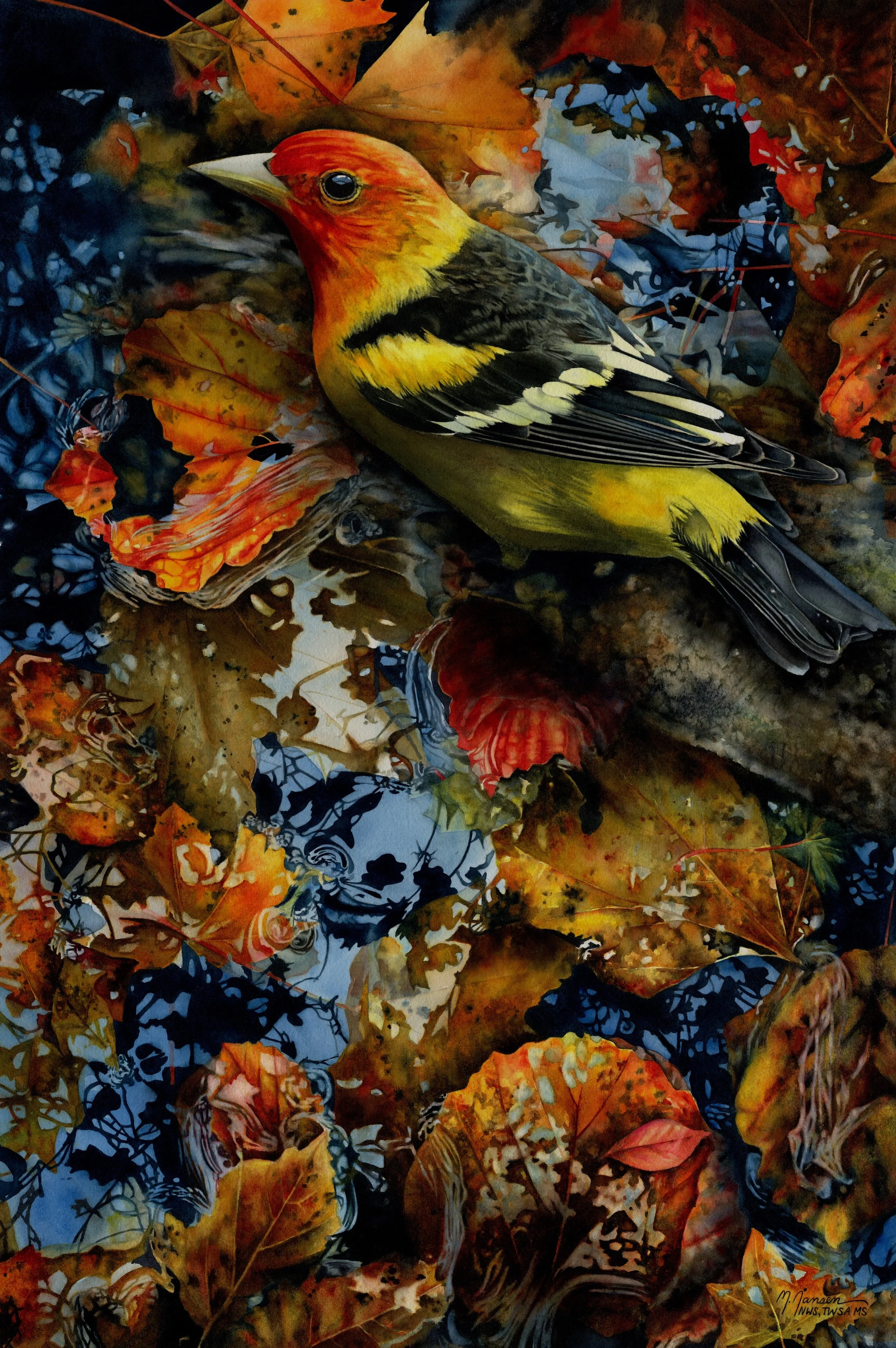
Phoenix Rising
You've enjoyed spectacular success with your paintings, which have been honored with TWSA's Skyledge Award in 2024 and this year's Women In Watercolor's Best of Show, among many others. Are you confident when you begin a painting?
No. I can plan and draw in every detail and still feel apprehensive and insecure when laying down initial washes. Watercolors are like little children: unpredictable and likely to disrupt into a heated tantrum at any time. Granted, some pigments are better-behaved than others, but I don't necessarily choose those colors. I love the way certain pigments, such as Daniel Smith's Cascade Green, take on a life of their own. Others, such as the DS Quinacridones, contribute to gorgeous transparent glows. There are moments when, while painting, one needs to let go and allow for a change in flow. To strong-arm these paints into submission is only asking for trouble.
Do you feel pressured to top yourself with each new project?
I don't try to out perform previous paintings, but I do venture to find means of making bigger impacts with future works. I think about this all the time. What could I do better? How might I deliver the message in a more poignant way? Deeper contrast? Subtler value variations? Do I have enough coffee to get me through the next long painting session? All important considerations. Sometimes a piece does not meet my expectations at all. I will pursue an idea or thought that deviates from the original plan, and it will ultimately end up a mess. I will take these works and put them away in a dark closet for months to "marinate." When I bring them out again, I am able to see them with fresh eyes and can often salvage them.
It's easy to imagine you living a Snow White-like existence, with birds constantly flying around you, perching on your fingers, and helping you with chores. But I assume that your imagery is not the result of you and your camera waiting around for a Common Yellowthroat to land on a dramatically-lit jar of lemons. After an idea for a new watercolor lands in your mind, does it evolve much before you start to paint? Do you build a picture around the bird or the still life?
Ideas and epiphanies land in the most ridiculous of times. I'll be pulling weeds or processing tomatoes when an idea strikes, and I'll have to abandon my task to write it down. I will then take that idea and build a still life around it. Having thousands of my own bird photos from which to choose, I don't have too many limitations when it comes to setting up my painting. I select subject matter that is consistent with the angle of light in the painting set up. The bird also needs to sit well within its environment and evoke a certain emotion or atmosphere. This is where the composition of a painting becomes tricky. For it's not only placement but lighting and movement and mood that are central considerations before even getting the brush wet. In fact, it's not the application that takes so much time but the concepts that are all time consuming. That being said, I also make certain that the birds in my paintings are anatomically correct and that they sit comfortably within their surroundings. For this reason, I make sure that I have several reference photos of my birds so I can accurately render the subject matter. Too many times, I have seen distorted birds flung into a painting without much consideration for their believability. Unless a viewer can truly feel the weight, gesture, and proper stance of the bird, the composition fails to deliver.
How difficult is it to integrate your bird references with your still life setups? You do this so convincingly.
Having taken too many set up reference photos, I will proceed to narrow down and incorporate elements using Photoshop. I use PS merely to assess my composition and values and that's about it. The real magic happens when the painting begins. I will have my reference and greyscale photos to work from, but variations and adjustments inevitably will follow as I paint.
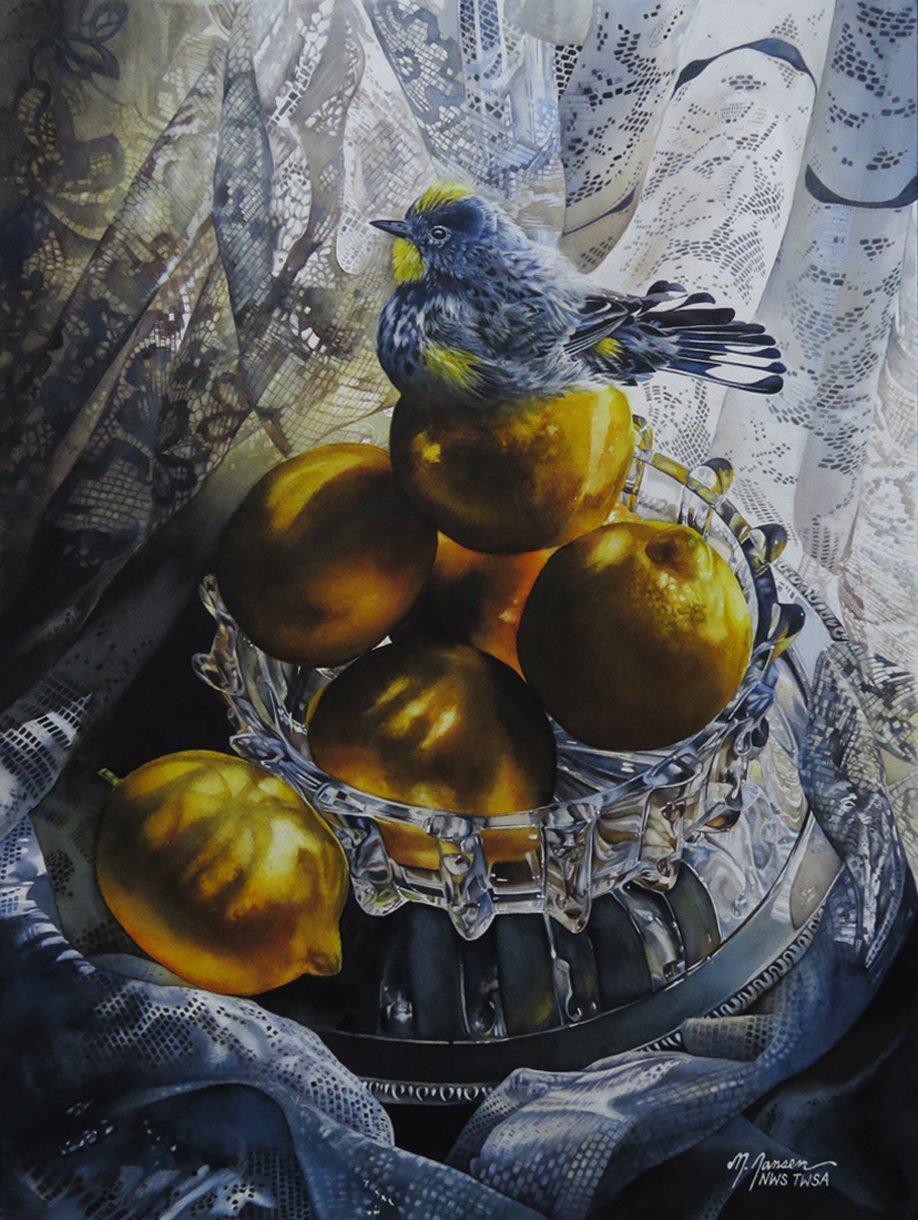
Challenging Brood
Can you explain your painting process? Do you complete one section at a time, skip around randomly and work on several areas at once, or build up colors over your entire sheet of paper glaze by glaze?
I generally begin painting with broad washes. This allows me to set the larger spaces and get a feel for blocked-in elements. I love the effect of multiple glazes, as the technique allows for beautiful illuminating light to fall on the subjects. Detail work is then incorporated and glazed and either brought forth or recessed. At this point my process is stop and go. I paint, stop and assess, paint some more, and assess again. Repetitive standing back for evaluation helps me to stay loyal to my targeted mission.
When you're painting, do you save certain fun parts as rewards for getting through difficult sections?
Yeah...sometimes I do. When I finally get to painting the eye of the bird, it feels as though life has been blown into my work, and the painting ignites with living energy.
I often think that all animals are perfect—they're certainly better than us—and your birds possess a special kind of gravitas that underlines this idea in my mind. Your birds also manage to convey serenity and even a sense of humor. How do viewers react to your paintings?
I get all kinds of feedback on my work—and I welcome it all, of course! The best comments are those that come from collectors and viewers who express how the painting made them feel. They get it. They understand the work involved in putting together a piece full of ambience and emotion. And then there are those who, though well meaning, say, "It looks so REAL!" And I simultaneously laugh and cry on the inside. Not everyone has the means to perceive art at a deeper level. Paintings are meant to be experienced. A good piece has agency and power to move and change another. The mission of the artist is to keep trying and to educate and to draw more people into a richer way of perceiving.
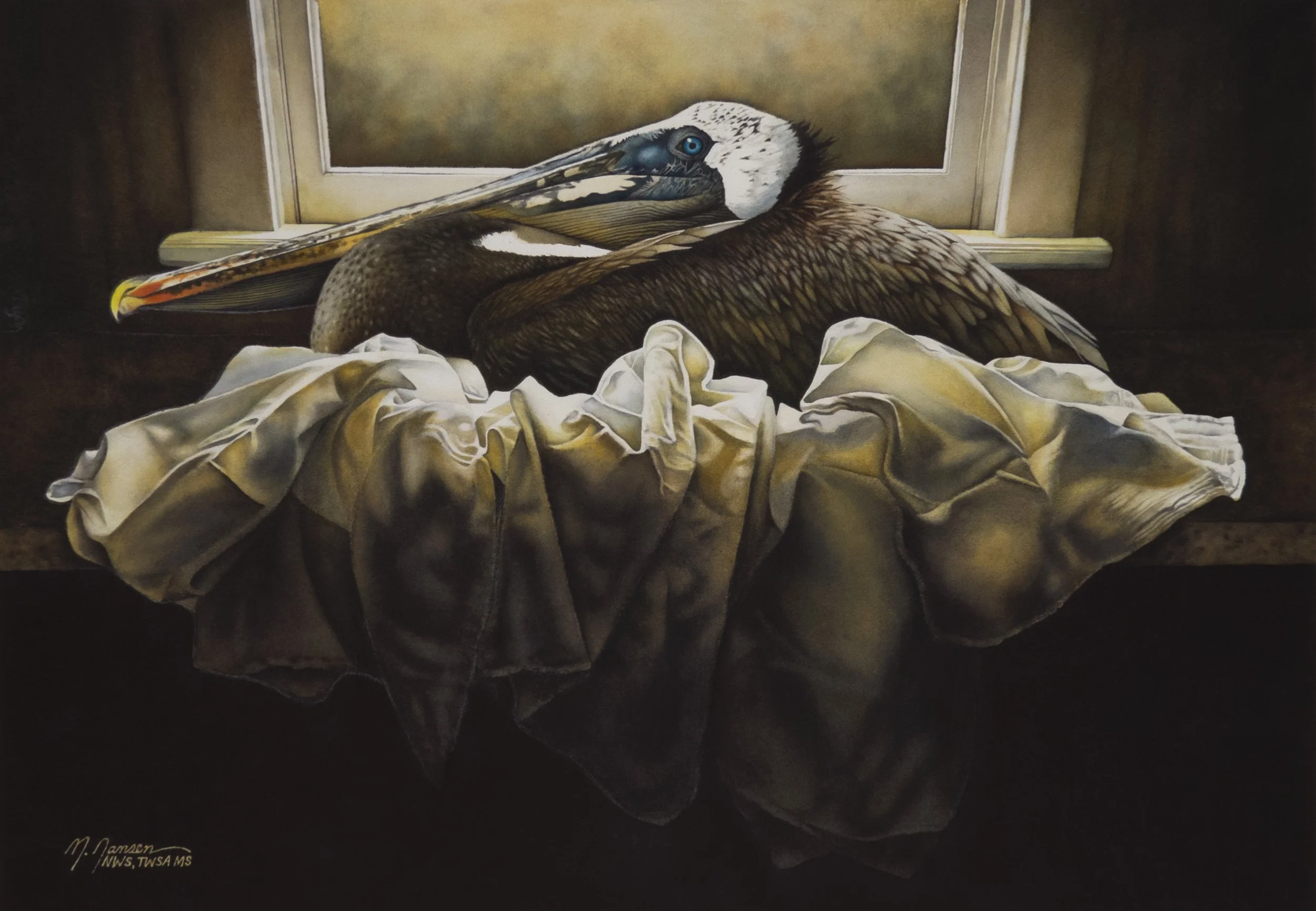
Presence
I'm curious about your painting Presence. It haunts me! Is there a story behind it?
Presence was an emotional piece to create. It is about finding that still, sacred sliver of ultimate peace between the past and the future. In this state, you cannot be bothered by the atrocities of the world and how they will affect you, nor can you experience guilt for decisions made in the past. It is a place that holds no judgement or fear or anticipation—only being. I chose a Brown Pelican for my subject matter because I have always felt these birds possess a certain deep wisdom. You can see it in their eyes. The lighting in Presence is intentionally ethereal and translucent, and it gives the bird a sense of mystery. Why is it placed before a window? Why is it resting on a convoluted fabric? Why not? In this state, the idiosyncrasies of life become the norm.
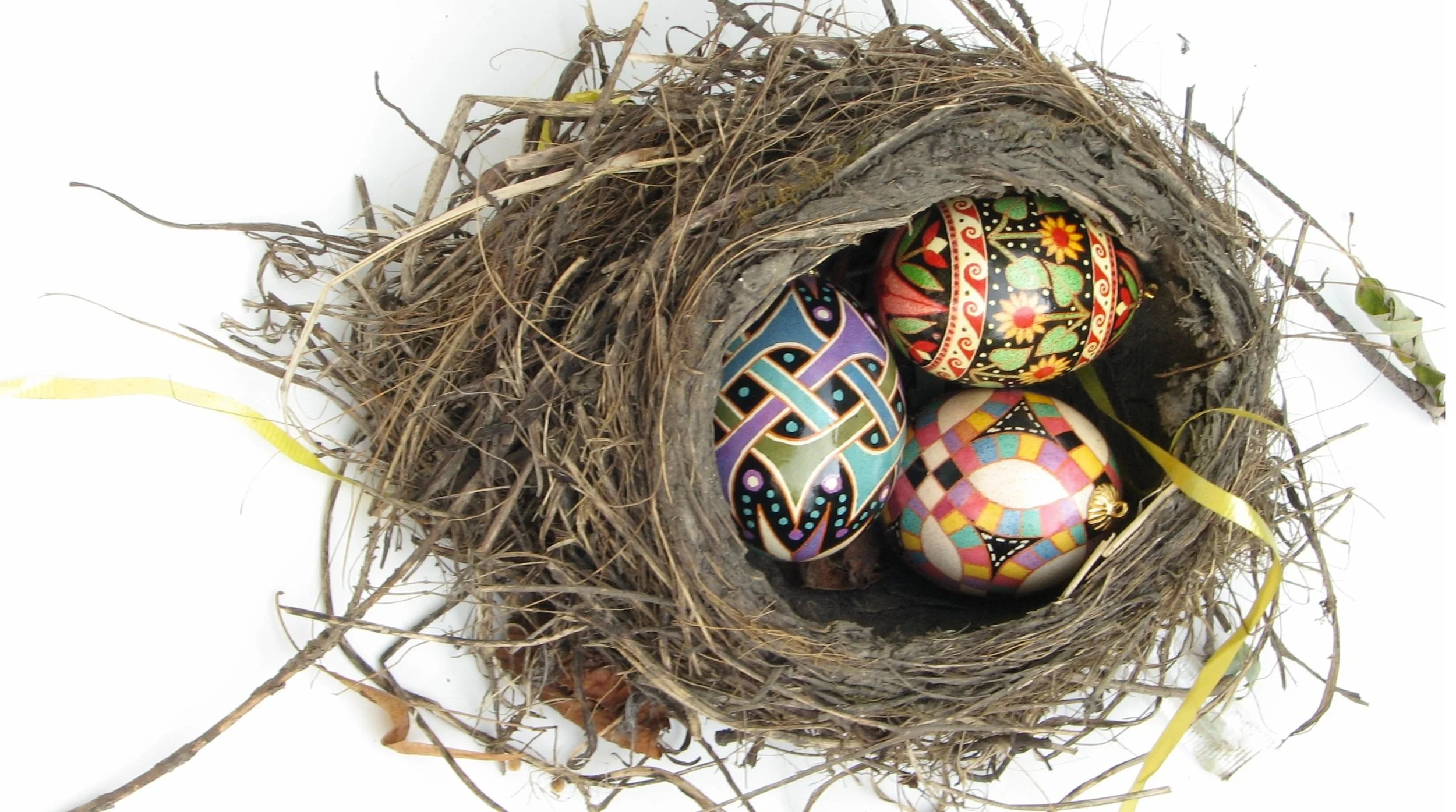
Easter eggs
Do your paintings contain any Easter eggs?
Funny you should ask! When I need some down time, I'll often pull out my Pysanky dyes and work on a Ukrainian Easter egg. The process is meditative and remarkably relaxing! I will often say a prayer while working on one and then give it away to whomever needs a little boost in their life. I have placed some of my pieces in abandoned robins' nests and had thought of incorporating them in a painting. But that composition hasn't yet come to fruition. Perhaps some day.
Rapid-fire Materials Questions!
What paper do you prefer to work on?
I use Arches 140lb cold press. If I need more saturation, I may jump to 300lb. But for the most part, 140lb suits my needs. I like the stubbly texture of Arches better than other brands.
What size are the majority of your paintings?
Most of my paintings are sheets...about 22" x 25" or so depending on the layout.
Are you loyal to certain brands of paint?
I tend to lean toward DS paints. But Holbein blues, especially Compose and Peacock, are fabulous! Winsor & Newton are familiar standbys, and I use them, too. They have the best Burnt Sienna in my opinion. I have tried some honey-based brands, but they tend to be opaque and dry up in the tube easily. It's nice to have a variety of brands from which to choose. Artists are fussy that way.
How about brushes?
I'll use brushes that my cat doesn't pilfer and hide away. My serious brushes are kept locked in a box. I've had good luck with some less expensive brands, too. I love the wet and super-soft application of the Dream Catcher series. And da Vinci Cosmotops are lovely and juicy as well.
What kind of palette do you use?
I love to segregate my colors into three to four small palette trays. This way I can maneuver the palette more easily in my workspace. I use a lot of colors, and some of them just don't get along. So it's important to place those colors in their separate corners and not have to worry about them picking a fight on my painting and churning it all to mud.
Do you work at an easel or on a table?
I work flat on the table.
What kind of lighting setup do you have?
I have an overhead LED cool sunlight lamp that puts out a LOT of light...maybe too much. And I have a swivel drafting lamp that I use most of the time. If I need to check my colors for accuracy or take a photo, I pull out my fancy Neewer panel lights and adjust the amperage and temperature color.
Do you always work transparently, or does opaque white come into play?
I always work with transparent pigments. I feel as though opaque paints limit the playful interaction of paints on the surface of the paper. That's not to say the opaques don't have their place. If there is a need for some saturated drama, I will use them too...just sparingly.
Do you use masking fluid, and if so, what brand do you like?
There are many areas in my work that require distinct edges, so I will use masking to help me delineate those places. I like WN's masking fluid and Fineliner masking pen. Some other brands tend to leave a blue stain on the paper.
Do you have favorite colors that play nicely together in your paintings?
My favorite colors...oh there are so many! But I tend to use the DS Quins in my work as well as WN Burnt Sienna. Holbein Royal Blue is a big winner. It mixes beautifully with Burnt Sienna for a rich, warm gray. I tend to stay away from granular pigments unless I'm working on a landscape. But my still lifes consist of mostly transparent colors, both staining and liftable.
You can learn more about Mary and her work at her website, Mary Jansen Watercolors.