• Work
  • Writing
  • About
  • Contact
  • Purchase
Kelly Eddington Watercolors

it's all in the details

  • Work
  • Writing
  • About
  • Contact
  • Purchase

Laurin McCracken Interview part 1

“I just kept going.”

Laurin McCracken is a living watercolor legend, and the Watercolor Honor Society will present him with its Lifetime Achievement award at Watercolor USA 2026. Laurin served as a WHS board member for twelve years and was president for four of them. He is currently an emeritus board member, and he continues to provide the WHS with his wisdom, guidance, and prestige. The recipient of countless honors over the course of two blockbuster careers, Laurin epitomizes the American dream. The artist graciously sat down for a wide-ranging conversation about his life.

This five-part interview originally appeared in the Watercolor Honor Society’s spring 2026 newsletter.

I’m With You, Red Ryder

In preparing for this interview, I read dozens of Laurin McCracken articles, but none of them delved into your backstory. Could you tell us about your childhood, family, and places you’ve lived? 

[Note: Laurin is a born storyteller. I didn’t cut in with lots of questions during this part of the interview, but please know that I was nodding appreciatively throughout, frequently saying things like, “Wow,” and occasionally lifting my jaw off the floor. —K.E.]

I was born in Meridian, Mississippi, where my mother’s father and his brothers owned a chain of furniture stores. None of them had any education, but they were really good businessmen. Then they lost the stores during the Great Depression. So my grandfather became an accountant for the largest laundry in Meridian, and my grandmother ran the drapery and fabric department of a department store called Marks Rothenberg. I grew up very much in the lower-middle class in terms of education, but I also had an exposure to the upper-middle class.

My dad was a blue collar guy. His father died in a hunting accident when my dad was in the eighth grade and his brother was in the sixth grade. They had to drop out of school to support their mother. My dad was a voracious reader and nobody's dummy, and over the years, he became the parts manager for an automobile dealership. And every time somebody would offer him twenty-five cents more per hour, we'd move. So we moved at least every two years, and about every third move, we'd end up back in Meridian, Mississippi.

Laurin, age 4.

Can you talk about your childhood experiences with art, and have you always been able to draw realistically? 

I've always drawn with a certain degree of realism, and I've always felt that my hand is not properly positioned if it doesn't have some instrument in it.

Somewhere in our family’s archives is a horse pulling a cart with a man sitting in the driver's seat, and the sky is just a blue line across the top of the drawing. And there's a little sun with rays coming out of it. That's something I made when I was maybe four years old, and I would love to have that, but I can’t find it. I do have some drawings from when I was ten and some oils that I did when I was twelve.

Did education become important to your family as you grew up?

I have a younger brother and a younger sister. Our family was committed to paying for four years of college for us. If we wanted to go on beyond that, we had to find a way to finance it. My dad had passed away by this time, and my mother was a high school English teacher. We existed on $4,000 a year. Somehow my mother and my grandparents scrimped enough money together, and I attended Auburn in Alabama where I studied architecture. Auburn was the only school I applied to. I didn't have a backup school. I just thought you applied to the school and you got in. How naive can you be?
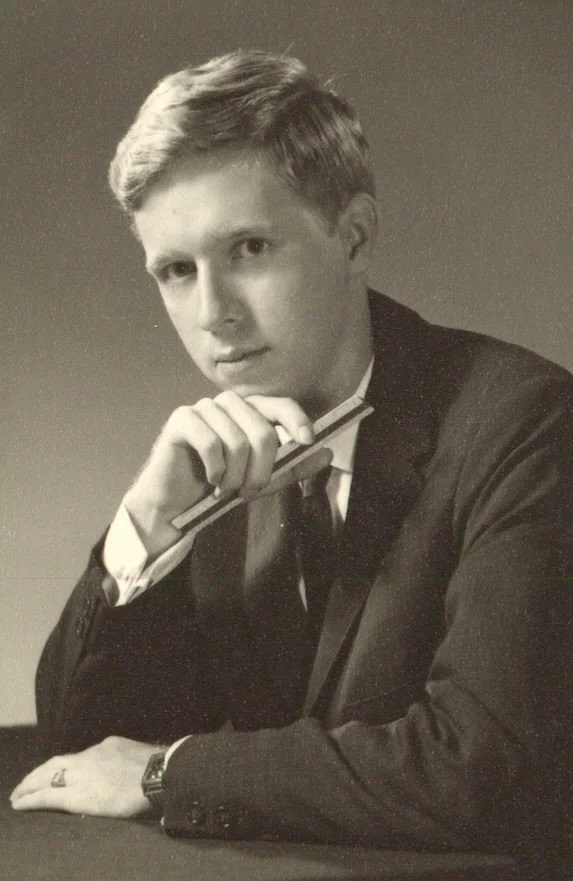
Third year architecture student.

I had four sterling years at Auburn: straight A’s, head of the ROTC military and architecture honoraries. I worked my butt off because I had no other qualifications, but I figured that if I worked harder than anybody else in my class, I could at least maintain, and I did better than that.

Tell me about the army.

I went into advanced ROTC because I could get fifty dollars a month, and that would pay for my art and architectural supplies. So I ended up in the army. Later I got into Rice University in Houston on a scholarship. Lucky, lucky guy. Once again, I didn’t want to embarrass either this institution or myself by not being at least a middle-level achiever, if not the top achiever. I was thrown into a class at Rice with designers who went on to lead big architectural firms throughout the United States, so I had to find my niche. After Rice, during the height of the Vietnam War, the army sent me to Germany for three years.

While I was there, I visited museums and saw a lot of Dutch still life paintings. I reveled in the clarity of the objects in those huge paintings, and how those artists told complex stories through their seemingly straightforward subjects. 

After my time in Germany, I received a two year scholarship to Princeton, where I had the most incredible experiences you can imagine. By this time, I’d gotten married and had a three year old. I assumed that once I had finished my schooling, I would just go back to Meridian, Mississippi and work for [local architect] Mr. Clopton and eventually take over his three man office.
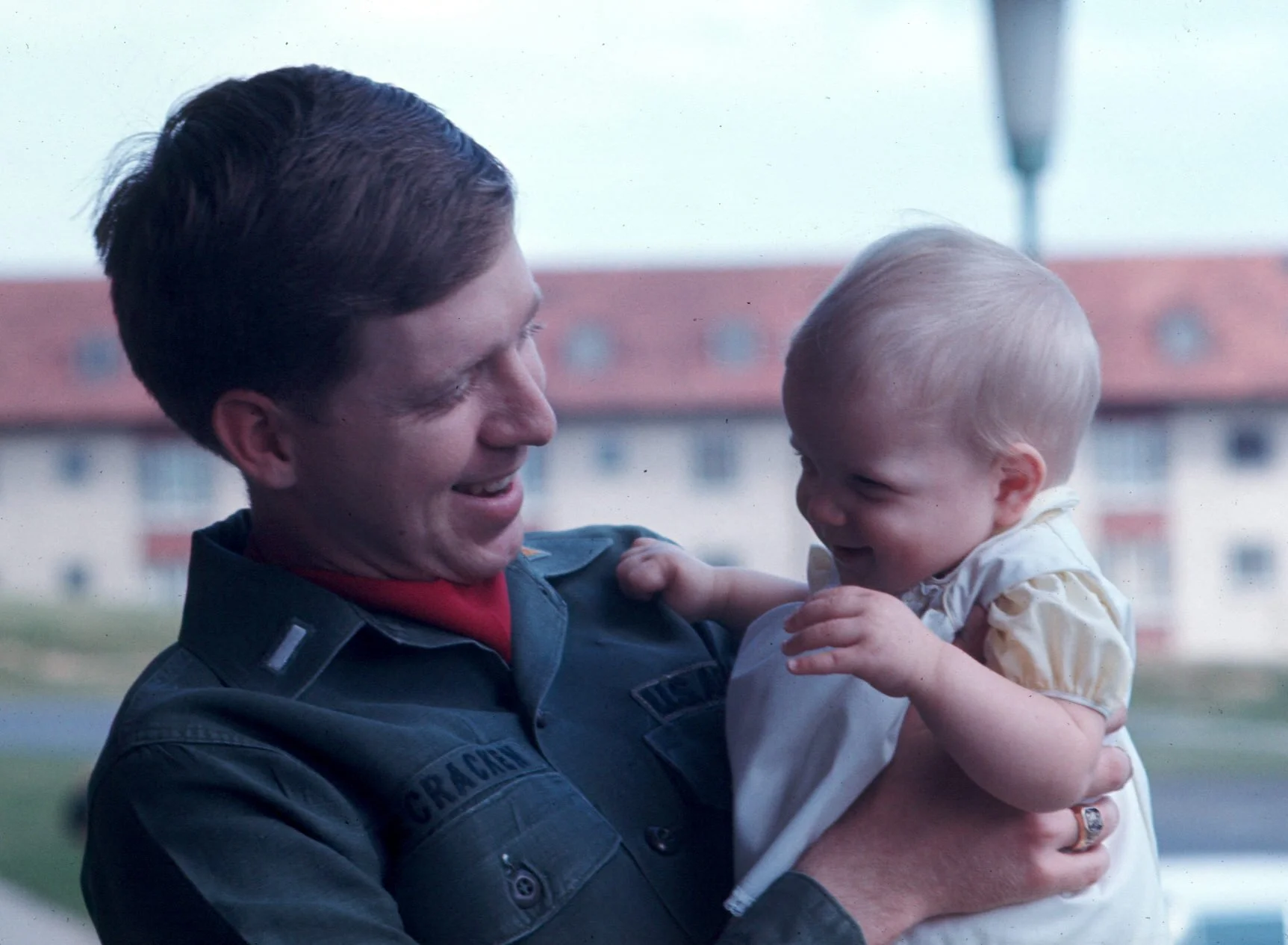
Laurin in Germany with daughter Leslie.

But my first job out of Princeton was in midtown Manhattan, where I joined the New York office of the largest firm in the United States at the time. I was part of a small team who designed Manhattan Community College, which is a million square feet. It's five blocks long.

Then I just kept going. A few jobs later, I became a partner in the continuation of the office of Mies van der Rohe.

Okay, wow!

There I was, just a poor boy polio victim from Mississippi, right in the middle of all this.

Wait. You had polio?

Yes. I was in sixth grade, and the miracle of it is that two days after I was infected, my family physician had come back from the first polio conference ever held in the United States. He examined me, and he looked at my mother and said, “I can’t believe this, but Laurin has polio.” So he picked up the phone and called across the state to Vicksburg, where the Sisters of Charity hospital was. That was the only place where they treated polio in the state of Mississippi. So the next morning, I was screaming in the back seat as my parents drove me to Vicksburg. The nuns immediately let me in, and four months later, I walked out.
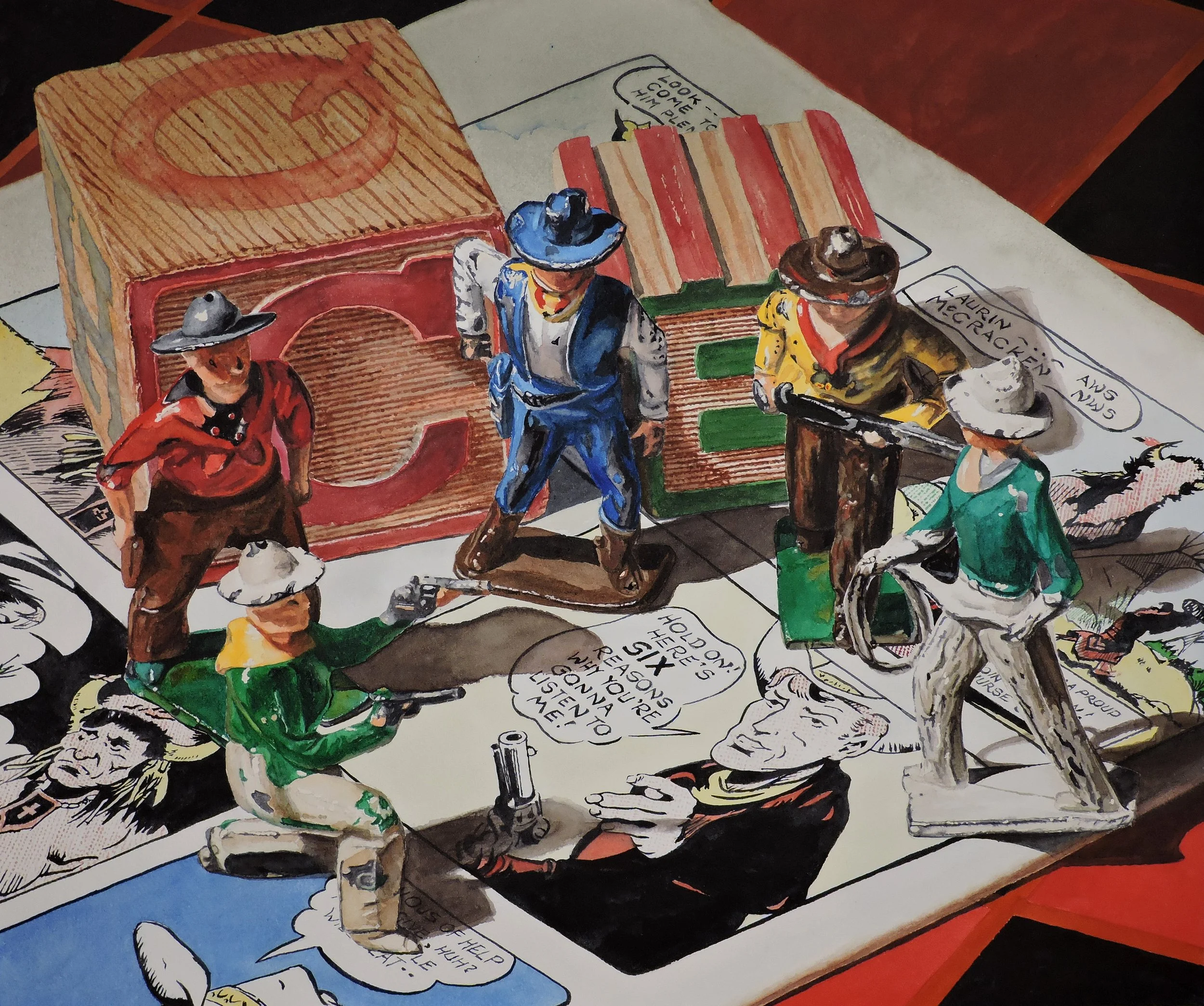
Six Reasons

Amazing. Oh my gosh.

When I was in quarantine, the nurses told my mother that any toys I brought in with me would eventually have to be destroyed because they didn't know how contagious or non-contagious polio was. We didn't have money for toys in the first place, much less those that had to be destroyed, but my mother, sweet and smart lady that she was, bought a ream of typing paper, two #2 pencils, and a sharpener for me. I was in a small room by myself with a big window on one side. When my mother came to visit, we communicated through the glass. If I looked through that glass window into the next room, which was a great big bay, I saw fifteen iron lungs with people in them.

My cousins and I used to have a rainy day game where we drew cowboys and Indians, so that's what I did when I was in quarantine. My cousins got together and wrote to all of our cowboy movie heroes saying, “Our cousin Laurin has polio. Would you send him a picture?” So by the time I got out of there, I had a whole wall of pictures from Roy Rogers and other stars. All of them were signed to me. And of course, all of them were burned when I left.

Oh no!

Too bad.

You went on to have a distinguished 40-year professional career as the head of marketing for architectural and engineering firms, and you traveled extensively for your work. 

I accumulated 6 million miles on American Airlines. 

This allowed you to see great art in the museums of the world, and eventually you took your first formal watercolor class at age 60. Could you describe some of the beginning projects Gwen Bragg had you work on at the Art League in Alexandria, Virginia? 

I was working in Washington, DC, just down the street from the Torpedo Factory. Torpedoes were manufactured there during the first and second world wars. It sat idle for a number of years, and then it was converted to an art center. I would go there quite often, and I would see these fabulous watercolors.

I attended a six-week Sunday evening class. Gwen Bragg created little five-by-six paintings, and her mix of beginners and intermediates duplicated them. There's waves, there's sky, and it was all very well thought out. The first words out of her mouth were, “If you've never taken a class from me, then you're a beginner.” And I said, “Miss Bragg, I want you to take a look at my drawings. I think I'm competent enough to paint with your intermediate group.” And she said, “You've never taken a class from me, but how about this? You can do both groups’ projects.” Years later, I went with her and a group of ladies to Greece for a week to do plein air painting, and when she looked at what I was doing, she said, “Now the student is teaching the teacher.”

Present-day Laurin.
Sunday 05.10.26
Posted by Kelly Eddington
 

Laurin McCracken Interview part 2

“Talk about an opportunity.”

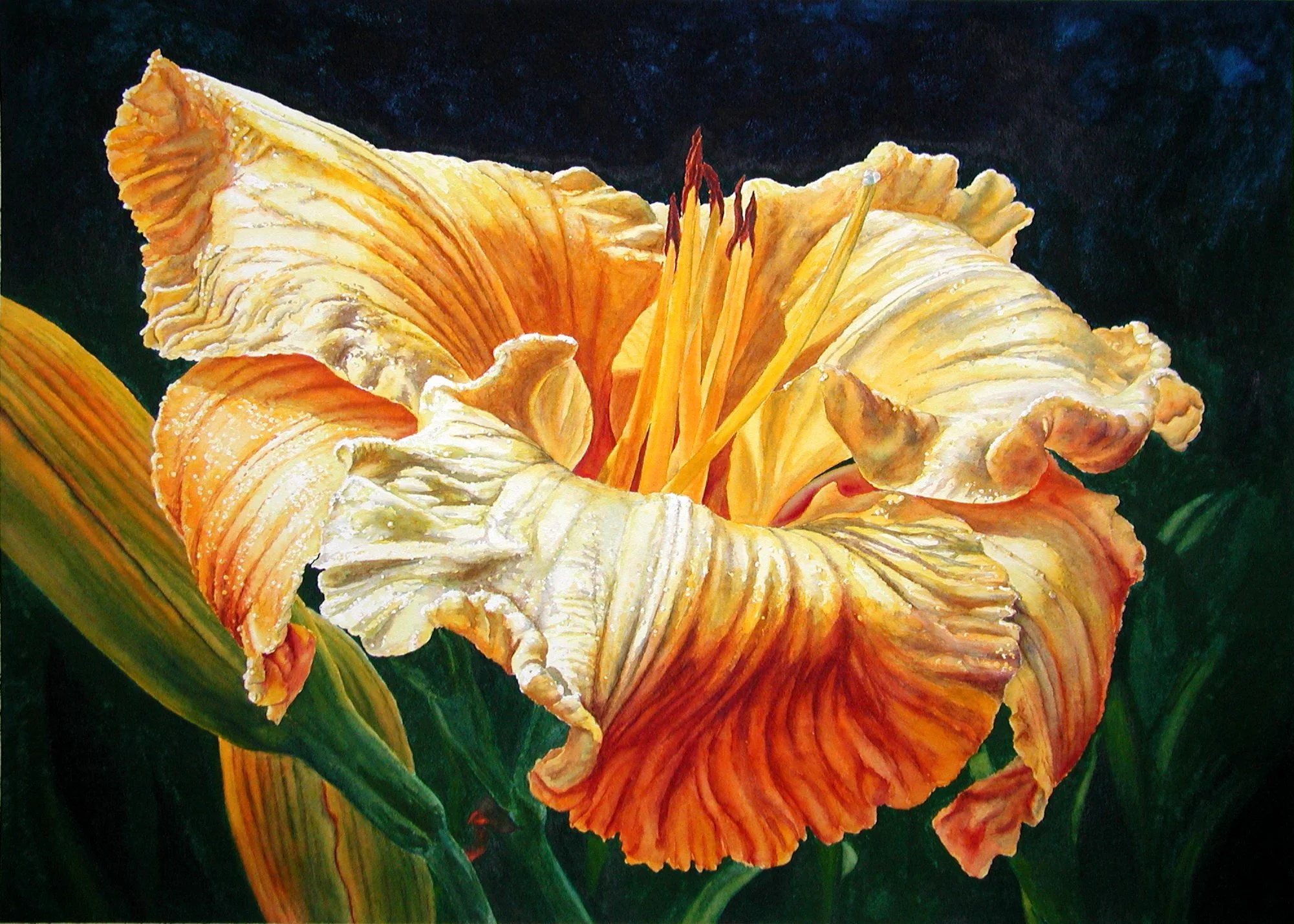
Yellow Day Lily

You’ve said the elements that go into making good architecture also apply to good paintings. Did you have to un-learn anything from your architectural training in order to work with watercolors?

No, because none of that involved brushes and water. It was all drawing, so everything from my architectural training was directly applicable to watercolor. The architectural drawings I did were very precise, so the only way I can paint is very precise. I’ve tried to paint loose, and my head just doesn't work that way. My doctors tell me that at some point my hand might start to tremor as I age, so maybe one day I'll become a cubist.

Your earliest still life watercolors featured flowers. Later you wanted to incorporate silver and crystal into your paintings but couldn’t find any instruction on how to paint these with watercolor. How long did it take to teach yourself?

Well, I know this sounds really weird, but it didn't take any time. I could just envision it. In Gwen Bragg’s class, when she’d show us that day’s subject, I drew it in a third of the time of anybody else. And then she would say, “Well, Laurin, here's how to wet your brush, and here's how to fade that edge.” And I could just do it, no questions asked. I also realized that the major myth in watercolor is that if you make a mistake, you can't correct it. There's nothing further from the truth. Once I found out that I could correct anything I did, I was free. I don't have to correct many things, but if I do something that is not right, I know how to fix it, so I'm just free and easy out there.

Given your background, were you tempted to paint city scenes or interiors a la Vermeer during those early days? 

No. I decided that I would pick a subject that would teach me to paint difficult things I was not familiar with. I'm very familiar with straight lines. I can create the most elaborate perspectives and the most complex pen and ink drawings. I decided that curves were my challenge, so that's why I picked florals. I figured that if I could master painting shadows on petals and leaves and things like that, I could master anything. 

You amassed a body of work before you began entering watercolor competitions, right?

I eventually discovered that not only were there watercolor societies, but those watercolor societies had competitions, and if you were going to show people how good you were, that was the route you had to take. I had no idea there were over 263 watercolor societies. 

I visit New Orleans every year or so, just to eat for a few days, and I became familiar with the work of Dean Mitchell. He showed his paintings at the Blaine Gallery there. I bought one of his books, and his bio said that he was a signature member of sixteen watercolor societies. Well, that must be the standard, I thought, and I started entering competitions. The Tennessee Watercolor Society seemed like a good place to start. I entered two florals, and they both got in the show, even though only one was supposed to, and they jointly won first prize. Over the next four years, I didn't do anything but enter competitions, so that's how I ended up with sixteen signature memberships. 

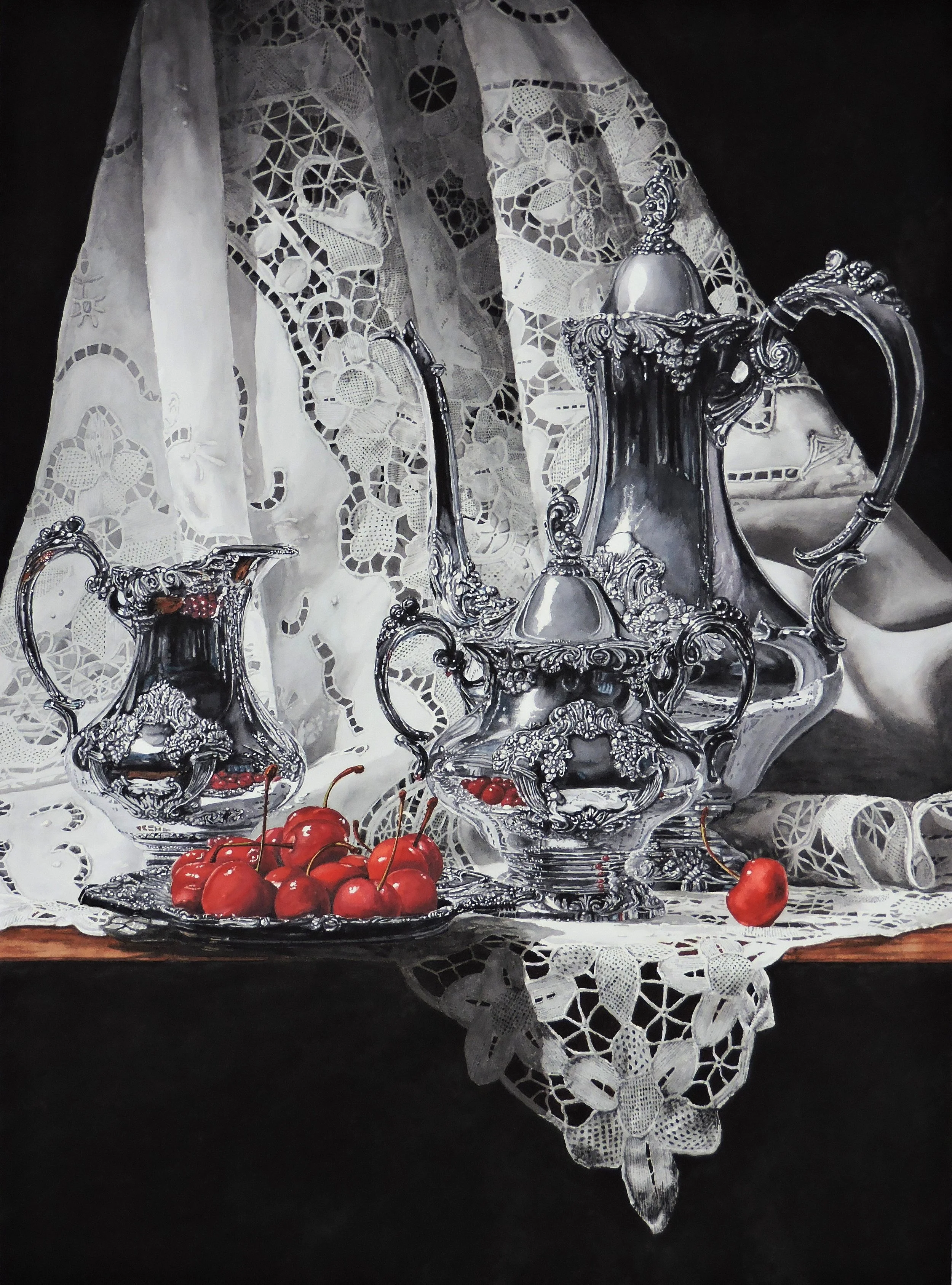
Silver Service with Magnolia

Noticing that there was no shortage of floral watercolorists, you felt the need to find a unique subject to paint. You landed on subject matter inspired by the Dutch artists you admired during your time in Germany. And you asked yourself, “Is that level of realism possible with watercolor?”

I was living in Mississippi at the time, and there was a lady friend. Everything involves the other sex, right? We hit it off. I moved down to live with her, and she had a rental house on her property. I used that as a studio. Her great grandparents and other relatives had come from Poland and places like that, and they had brought silver services, Chinese porcelains, and other beautiful objects. I started setting them up. I did one silver pot just to see if I could paint silver, and yeah, I could. And so the set ups became more and more complex. Then I started adding crystal because, you know, what can be more difficult than painting colors bouncing around in a cut crystal vase? And really, none of it was challenging. There's no two ways about it. I mean, I had to work hard at it, but it wasn't what I would call difficult.

You also began submitting your work to American Artist and Watercolor Artist magazines and landed on their covers. Did you enter paintings in the magazines’ various competitions, or did you pitch articles?

One of the things I did for all of those architectural firms was to represent them to the press. And twice a year I went to New York and met with the senior editors of Architectural Record and other publications and showed them the projects we had coming down the pike. I knew how to talk to editors. 

So I put together a portfolio of my florals and mailed them to Steve Doherty at American Artist. Of course, I didn't hear anything back. But three months later, I was in New York visiting those architectural magazine editors. It was coming up on lunchtime when I noticed that I was in the same building that housed American Artist magazine’s headquarters. So I walked over to the secretary there, and I said, “Would you ask Mr. Doherty if he has a minute to see me?” And she got flustered, dialed his number, and handed me the phone. Talk about an opportunity. So I said, “Mr. Doherty, this is Laurin McCracken. I just had meetings with—” And I name-dropped two of the top editors of those architectural magazines, right? I'm not stupid.

And he said, “Laurin, you're not going to believe this. I've got your portfolio in the middle of my desk, and I've been studying it. But right now I have a meeting. In fact, I'm late.” A moment later, he said, “I'm coming down.” Two seconds later, he walked out of the elevator and said, “I really am late, late, late for a meeting. But I want to follow up, yes. I want to talk to you about an article.” We shook hands and eventually ended up having a great telephone conversation. About two months later, I was back in New York. Steve and I went to lunch, and he reached into his coat pocket, pulled out a roll of paper, and handed it to me. I took the rubber band off. It was an eight page article on me, and it was the cover story of the magazine. 

That’s amazing.

And this is what I keep telling people: you’ve just got to show up. You can't do it by letter. If you really want to get in somebody's mind, you’ve got to get in their face. Otherwise you're going to be just another person in the deck of cards that they're working with.

Objects on a Quilt

I don’t think anyone can argue with your three basic things a painter needs: the ability to see in a fresh way, the realization that drawing is fundamental in all art, and the work involved to become a master of their craft. The last two things can be achieved with a certain amount of discipline, but the ability to see in a fresh way seems like something you either have or you don’t. Do you agree with this? 

I believe that I was born with all of those things in my head because they've come to me so easily. I certainly believe that everything but inspiration can be learned. The problem is that most people are not willing to work hard and spend enough time to master their craft. They want to do it once or twice and say they've learned it. Then it becomes The Wreck of the Hesperus, and they can't figure out why they can't get from A to Z. That's because they went from A to B to F to Z. 

One of my favorite quotes from you is this: "Watercolor is a dance that involves the artist, the paint, the brush, and the paper. The artist must lead in this dance and hope that the very active elements of this medium will participate and enhance the effort. I enjoy the dance." When I look at your work, I see an artist who is in total control of this dance. Do you ever experience “happy accidents” when you paint? Do you ever allow your dance partner to lead for a while?

Oh yeah, all the time. And they're little things. But I can spend all day on a drawing, put it on my painting table, and just immediately see three things that are wrong.

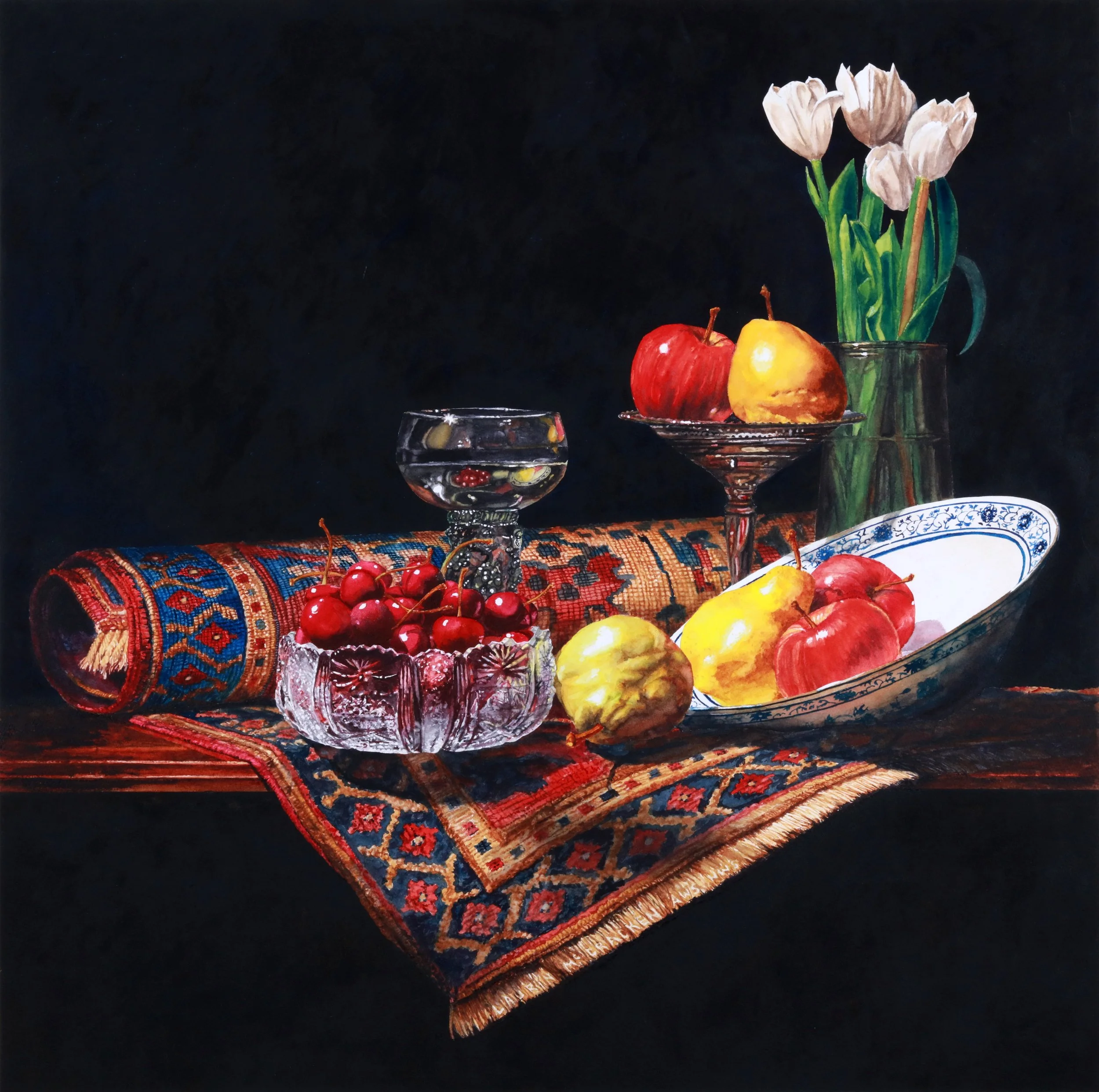
Still Life on Hand Tied Rug

You possess an enviable and some would say superhuman amount of energy. You show your paintings worldwide, and you’re a sought-after juror and workshop instructor. I’m still astonished that you managed to bring Fabriano in Acquarello to Fort Worth in 2024, and I’m sure you did the lion’s share of the work. Have you always been like this, or has your second career in art galvanized you in a special way?

I have always been the guy who brings people together. I had a little rock band in high school, and later on I formed a Glenn Miller-style dance band. When I was in marketing, I invited the fifteen best marketers in the United States to come to a Holiday Inn in Florida and talk about how we market architectural engineering services.

And now, about every other month, I invite a group of artist friends to come to my house, and we talk about issues unique to watercolor and critique each other’s work. I also have a Zoom group of a couple dozen artists who talk about what is happening in the art world today that's impacting either the business side of things or whatever is going on with us as a group. 

Sunday 05.10.26
Posted by Kelly Eddington
 

Laurin McCracken Interview part 3

“It’s about doing it in a better way.”

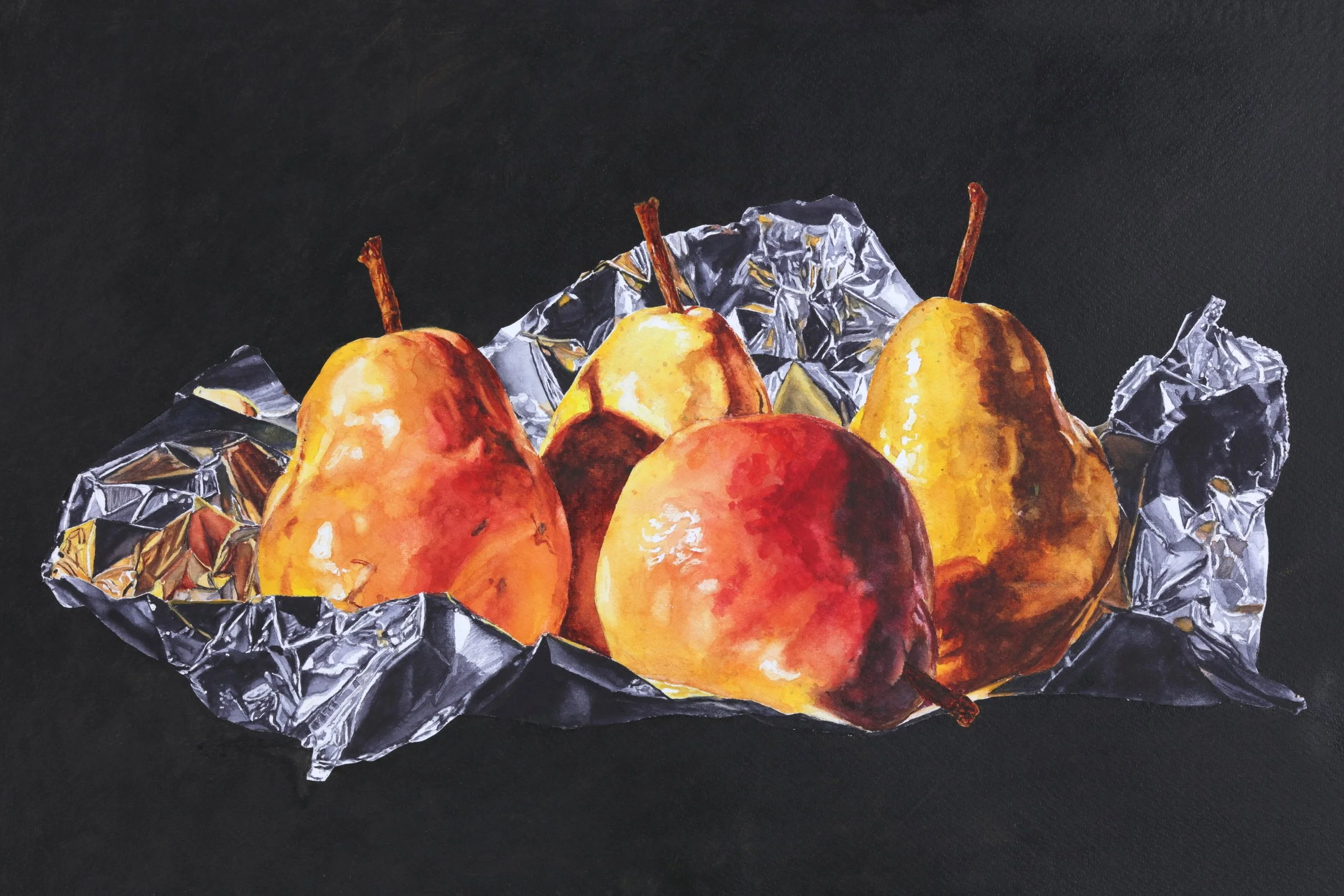
Four Pears on Foil

You work on the tiniest and most complex details in your paintings, moving slowly and methodically while living inside these tiny worlds. Your paintings can take more than a hundred hours to complete. Can I ask you some questions as we walk through your process?

Ask me anything.

First you set up your still life arrangements and take photos. How long does this process last?

Probably a couple of hours, I would say. This yields about 70 to 100 images, if I know what I'm looking for. If I go to somebody's house and they've got three or four things they want me to consider, I may come back with 300 or 400 images, but a lot of those are repeats or small adjustments.

In recent years, you’ve started incorporating modern items.

Oh yeah. That's what led me to work with aluminum foil. What could I paint that had today's product in it but also had a visual link to art history?

Your pieces of fruit wrapped in plastic bags are at once humble and breathtaking.

Exactly the same idea.

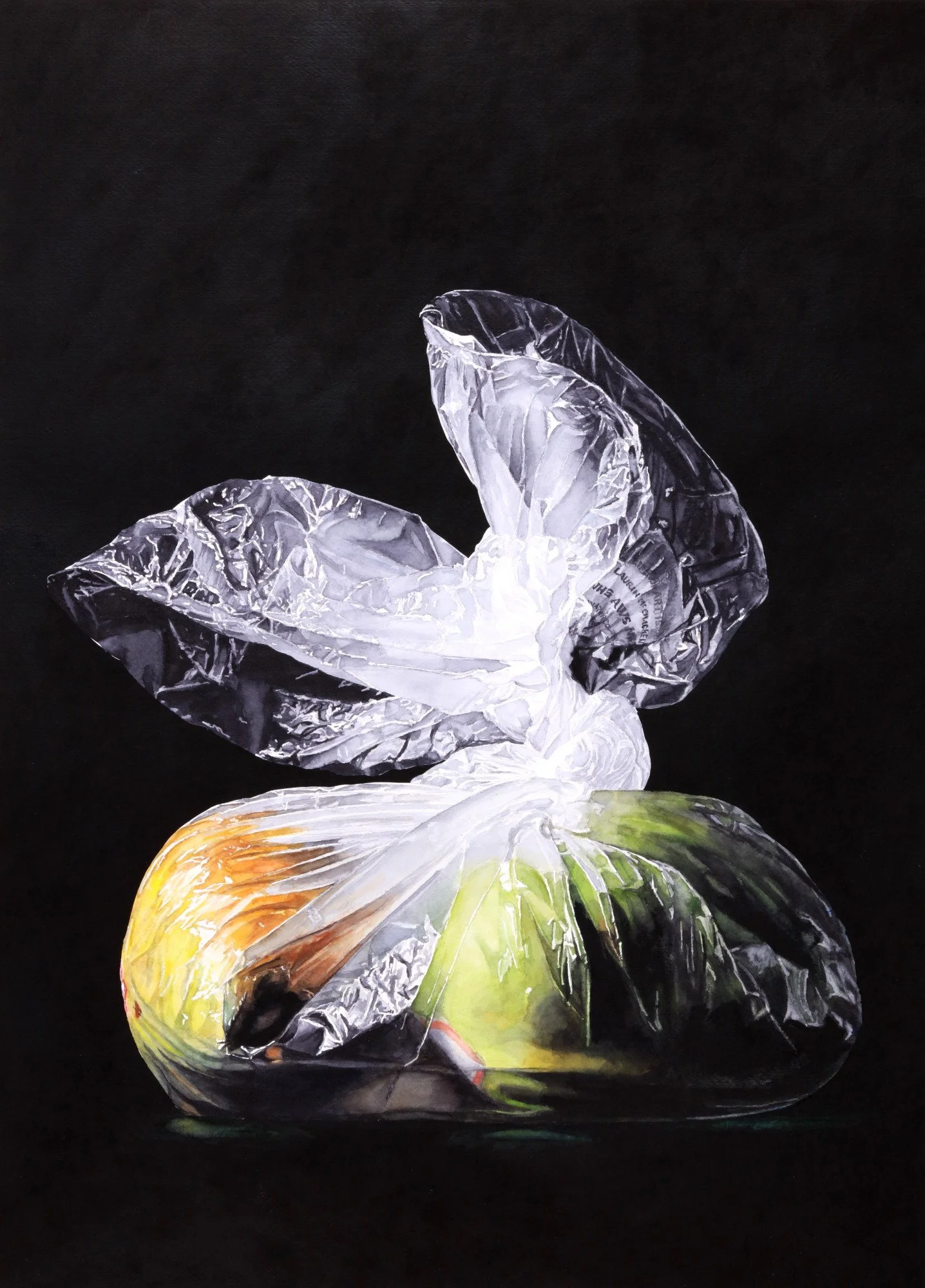
Pears in a Plastic Bag

After one lucky reference photo is selected, you use an LCD projector to trace the image onto your paper with a 2H mechanical pencil. When I first read that you work with a projector, I applauded. I feel like this is the equivalent of a movie star admitting to getting plastic surgery. Most of them do it, but they won’t own up to it. And I’m guessing lots of artists use projectors, but I’ve only heard of a few of us who openly acknowledge this. Would you like to speak on that?

Yes, and I have a good story. I did a step-by-step article for a watercolor magazine of one of my still lifes. In that article, I mentioned that I used a projector to create my paintings’ preliminary drawings. After it was published, the editor called me and said, “Laurin, your use of projectors has produced more letters to the editor than anything I've ever seen at the magazine.” And I asked, “Well, what are they saying?” She said, “The responses are about 50-50. Half of them are damning you, and half are saying, finally, somebody is willing to admit to this.” So the reason she was calling was not only to report that, but she also said that she had been talking with other artists in other mediums who use projectors. So she selected six of us to do an article for The Artist’s Magazine, and all of us told our projection stories. So for years, I walked around waving that article at people.

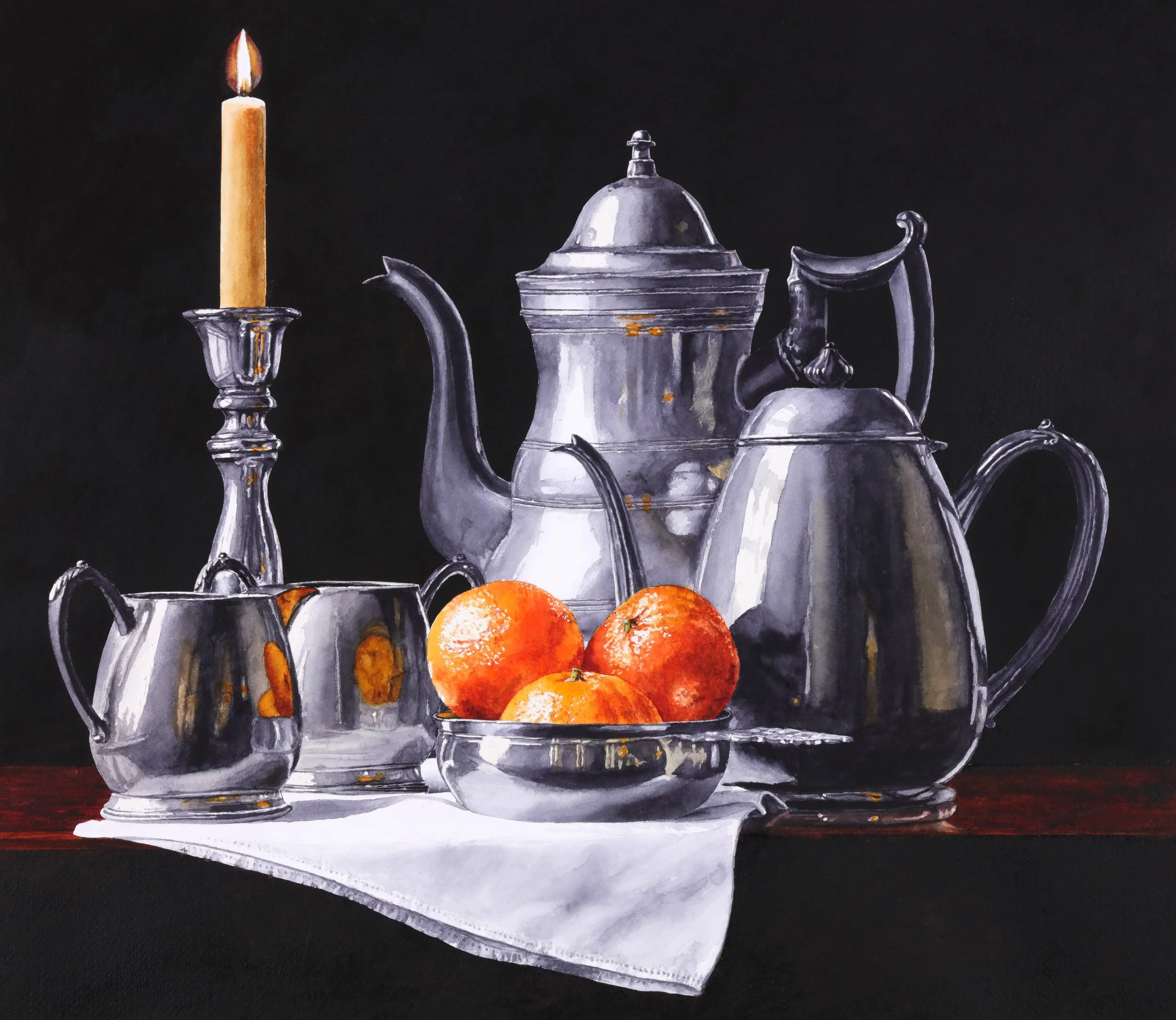
Clementines with Pewter

You begin painting the things that define the picture, such as clementines that will be seen reflected onto pewter objects in other parts of the painting. After that, do you have a system that tells you what objects to paint next?

I work left to right. Overriding that, I paint the most difficult thing first. And if there's something in there that I've never painted before, I’ll paint that first. Now, since I've done plenty of these foil things, I typically paint the objects that have multiple layers of color and work with wet-into-wet first. Then once they're absolutely dry, I can mask out that grouping and start on one edge of the foil and go around to the other. And I do the black background last.

You cover your entire painting surface with lightweight tracing paper to protect it from splatter. Then you cut out openings where you will be painting that day “much as a surgeon drapes a patient for an operation.” This is ingenious. When did you begin doing that?

In architecture, when you're working on a huge drawing, you mask it with tracing paper so you don't smear the areas you’ve spent two weeks on. The tracing paper is sort of translucent, so you can always relate what’s underneath it to what you're doing as a whole. I'm all about using any tool that will get me there, but it’s not about speed. It's about doing it in a better way that makes the job easier and makes the painting process more enjoyable.

What is your favorite part of the painting process?

Oh, I love the whole thing. There's no one part. It's such a progression from the time I'm considering an object to the point where the painting is finished.

Have you ever trashed a painting that just didn't work?

No. Since I've been painting seriously, I've never started a painting that I didn't finish and wasn't pleased with.

Do you work on multiple paintings at the same time?

I almost always have three or four in progress. I typically have two drawn, so when I'm painting one, I'm not thinking about the other. But you know, if I'm driving or something, I might start thinking about the second painting. So by the time I start that second painting, mentally I'm already into it.

You’ve said you like to work with warm water…?

This is another thing I’ve learned. One day I was painting in the dead of winter. The tap water was cold as could be, and my paint was just not behaving itself. And so I said, let me try something. I went back to the sink and let the water run until it was warm, filled my two containers, and took them back. Bingo. It was dead on. It's the second law of thermodynamics: things tend to go into solution faster the higher the temperature. 

Escoda created a set of three watercolor brushes selected by you (Versatil synthetic Kolinsky round brushes in sizes #4, #6, and #10). Do you use those brushes most of the time?

Brushes are the biggest issue out there. There are good paints, and we have lots of papers to choose from, but finding the right brushes is a real problem, and they're very personal.

I happen to like Escoda brushes because they are the only people who still make them by hand. My view is that an Escoda brush has a soul.

While I use the Versatil brushes, most of the time I paint with their Chronos range. I typically use #4, #6, #8, and #10 round brushes, and for big areas, I use larger flats. Like every other artist, I probably have 400 brushes, and people like to send me stuff. I'll put those on the shelf, because nothing's going to compete with what I already use, and I'm not going to relearn what I know on a free brush just for their benefit. 

In my workshops, if I see somebody who has potential, but they're struggling because they’re using the wrong brush, I have the ability to give them an Escoda Versatil or two and say, “Why don't you try these?” What a difference that makes.

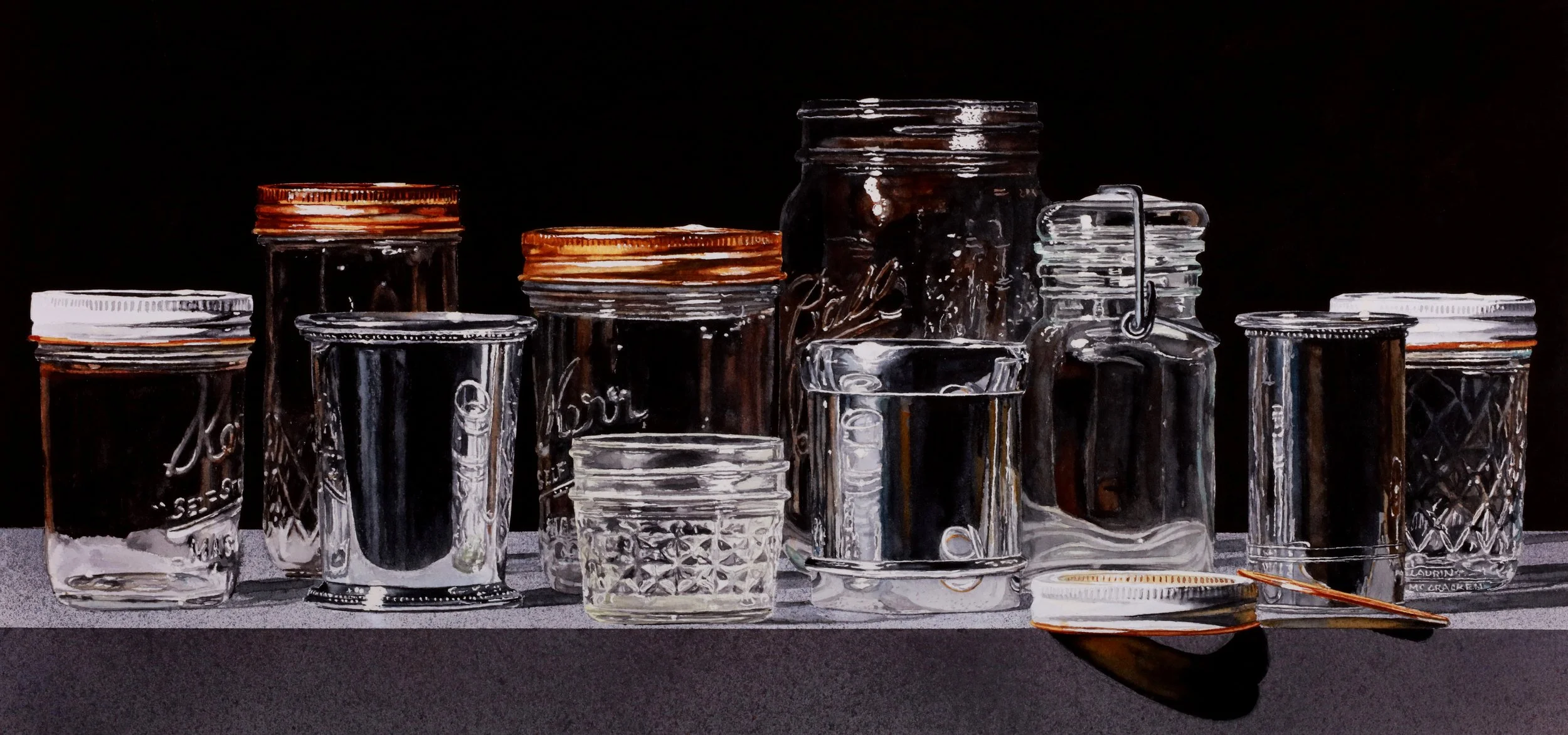
Glassware and Silver on Granite

What is an average painting day like for you?

Every now and then I’ll have an ideal day. By nine o'clock, I've had my coffee, I've looked at the emergency emails, and I'm in my studio. The water in my paint containers is warm and ready to paint with. I paint pretty continuously all morning without any interruptions except for changing my water, and I do that a lot. 

I’ll have a quick lunch for fifteen minutes. I mean, I eat for sustenance, and some days I don't eat lunch at all. I’ll just drink a glass of water and try to lie down for about fifteen or twenty minutes. And then I'll work for two or three hours in the afternoon. If I'm really into something that's very detailed, like a lace tablecloth, I may continue to work on that. But if it’s time to move on to a new section, I'll use the afternoon to get the painting ready for the next day. I don't ever start anything that's new and fresh in the afternoon, such as the next pear, for instance, or a new bit of foil. If I'm lost in an area of foil I’ve started, I can still continue, because my mind is already in that place. 

And then at 4:30 or so, I’ll stop and carefully clean the brushes I've used so they’re ready for the next day. I’ll make sure my materials are back where they're supposed to be. I’ll put the the #6 back where I keep the #6, so the next day I won't have to wonder where it is. The place I paint is very small, and it's like the cockpit of an airplane. I know where that X-Acto blade is. I don't have to look around. All I have to do is lean back and pick it up. Some people might think I'm crazy in this regard, but for me it's about being efficient and being able to move forward at a pace that is comfortable.

At 5:00, I’ll fix myself a scotch, get a small bowl of really fine mixed nuts, and sit and read for an hour and a half. And then I’ll fix my little dinner.

Sunday 05.10.26
Posted by Kelly Eddington
 

Laurin McCracken Interview part 4

“What to call it?”

Black, White, and Red

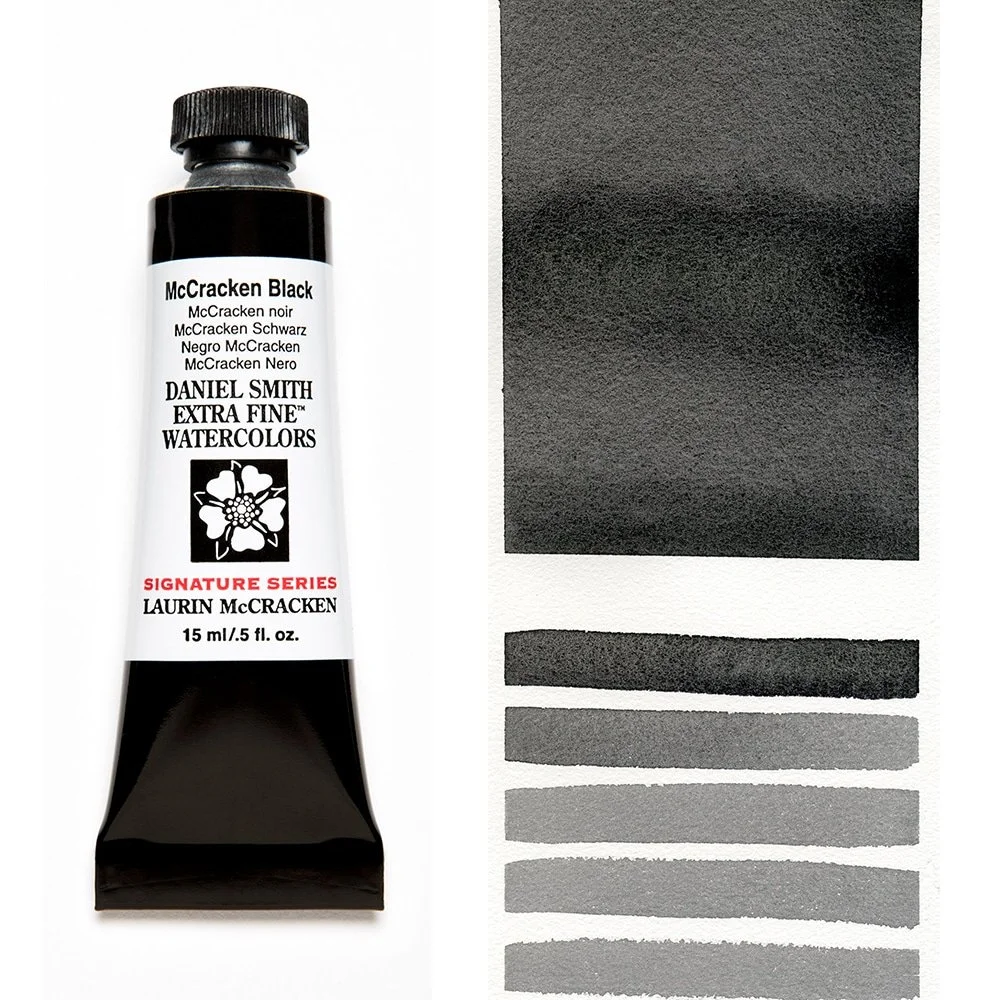
You’re famous for your deep, velvety black backgrounds. A twenty minute video exists of you mixing different Daniel Smith watercolors to create just the right black to suit your needs. 

https://www.youtube.com/watch?v=Ztc6Xjmsccc

A few years after making that video, you partnered with the people at Daniel Smith to create “McCracken Black.” What was that experience like? 

Oh, that was such a fun thing. Well, it evolved from a telephone call I got from [DS owner and CEO] John Cogley, and he's such a nice guy. He’s the calmest person I've ever met. And he called me and said, “Laurin, I just read somewhere that you mix your black. We make five blacks, and one of them might work.” I said, “Well, John, most blacks are made from dyes where the base is purple. What I found was that if I'm painting a silver picture, when I feather out that gray, it turns purple, and silver is not purple. I also found that your blacks are too opaque for me. I want to be able to layer things up.” I told him that I was using eight or nine different DS colors to mix a black that worked for me. 

About a month later, he called me and said, “I've been thinking about our conversation about black. How would you like to work with my two scientists? Let's develop a black that meets your criteria.” And you know, I'm levitating off the floor. So for the next four or five months, those guys went to work. They would bring out some paints, add more colors, or take other colors away. About every other week, they'd send me a little jar of it, I'd test it and tell them what I thought about it, and they'd change it. And it was so much fun.  

It’s almost like you were developing a perfume.
Exactly, exactly. And these guys are such experts, and they're nice people. It was such a pleasure. And finally, I approved their black. Later on they were in a marketing meeting. What to call it? So they phoned me and said they had narrowed it down to Laurin Black or McCracken Black. Did I like either one of those, and which one did I prefer? So I immediately said I liked the sound of McCracken Black. And that was the one they liked, too. Since then, they’ve told me a couple of times that it's one of the largest selling colors in the Dan Smith line internationally.

I was fascinated to learn that your black backgrounds begin with a colorful underpainting that echoes a color featured elsewhere in the picture. It’s often difficult to perceive this when your work is printed in magazines or shown in small reproductions online. In those formats, your backgrounds look like the darkest blacks imaginable. Can viewers pick up on your underpainting colors when they view your watercolors in real life?

Even the finest papers in the world, which I think are Fabriano Artistico, have spots where, after they’re run through that great big twenty-ton machine, the sizing doesn’t catch. In one of those small indentions, even in soft press paper, there's going to be a granule of sizing that didn't completely dissolve and is caught in the paper. Early on, when I painted my black backgrounds, I'd see white pin holes. So how do you find and correct those pinholes before you paint an area black? Because it's very difficult to correct them later. So my solution was to put a quick wash of whatever I had in excess on my palette, and that helped me find the pinholes. If it was just a little well, I’d fill it with the tip of my brush. And if it was a case of a little too much sizing, I’d wiggle the tip of my brush and dissolve it. No big deal. 

Then I found out that the blacks I painted over those pinhole-finding layers were sort of translucent. When I held the painting up, I could not necessarily see, but I could feel the underpainting through the black. I experimented with that. With a silver still life, I used a phthalo blue as that underpainting. And when I put black on top of it, the silver looked more metallic. But if I had a flower or two that I wanted to enrich in a field of glass and silver, and the underpainting was an Aussie red, those flowers would just glow. And you can walk into a show of my paintings and never see that, but you can feel it, and when I point it out to you, you say, “Aha!”

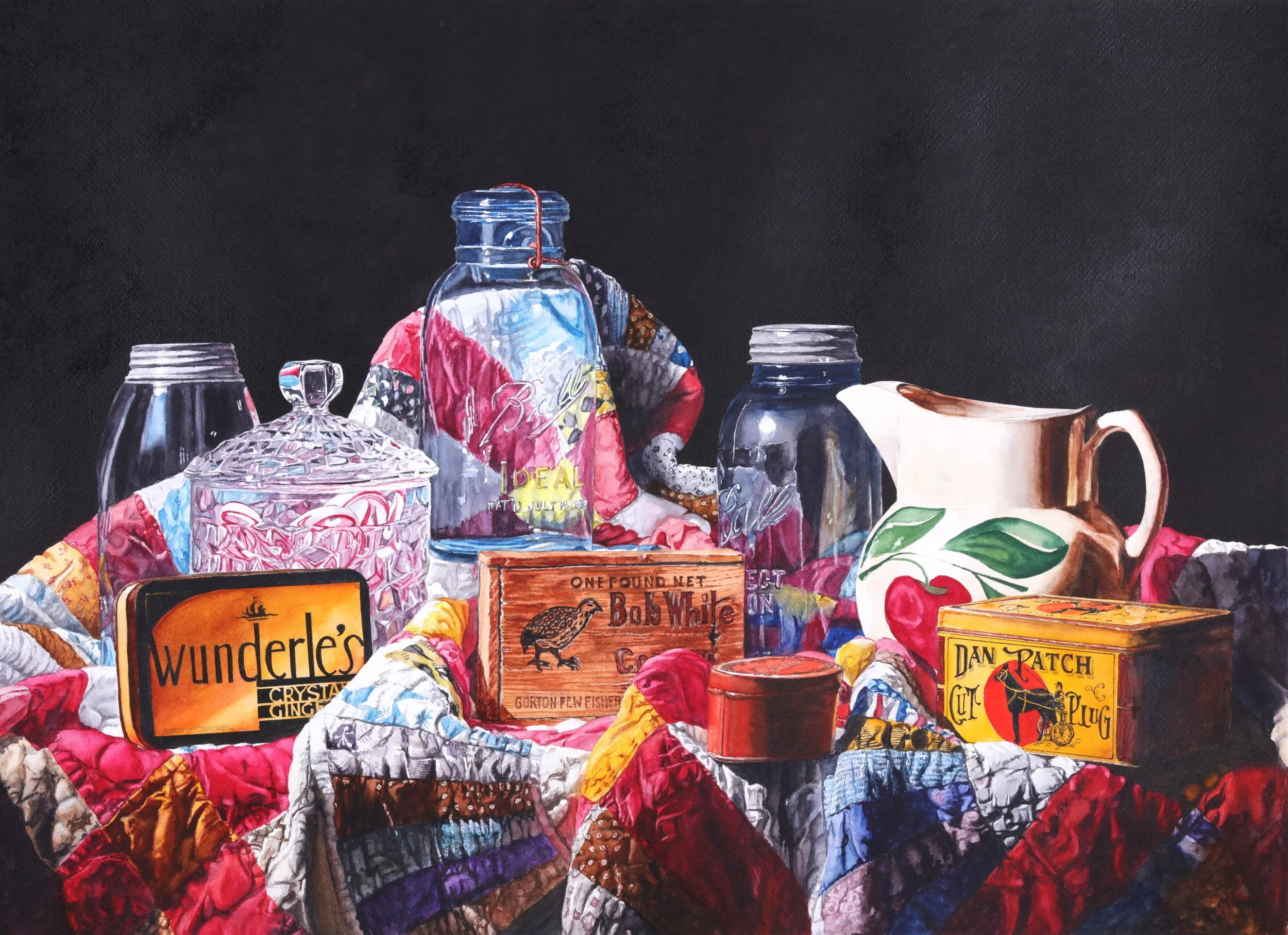
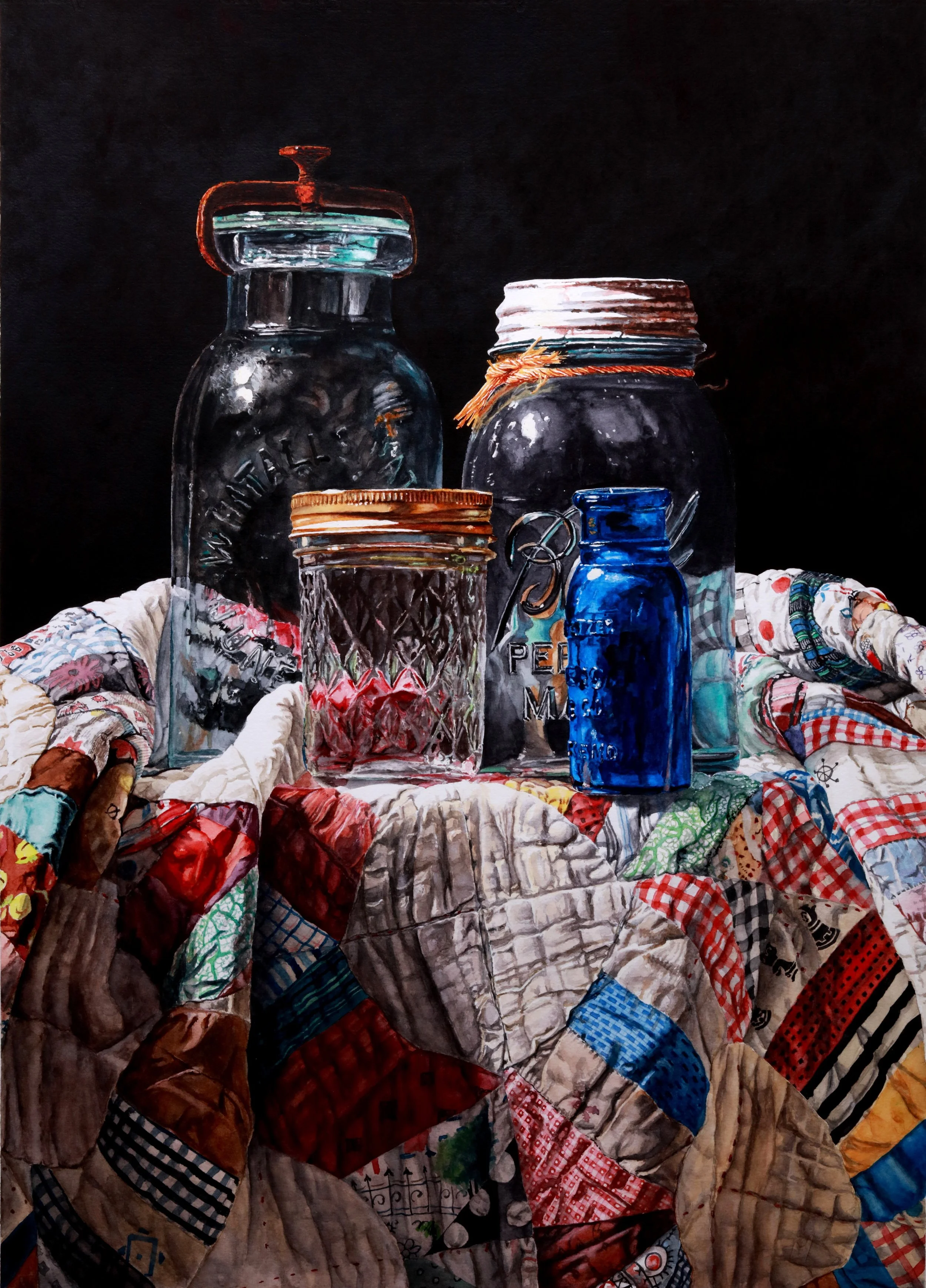
Jars on a Quilt

So many of us struggle to create flat, streak-free, dark backgrounds. Could you please explain your scumbling technique? Because when I watched you do this in the aforementioned video, your solution seemed positively revolutionary.

Scumbling helps you create a texture like velvet, and nobody's ever heard of scumbling. It’s a drawing technique from my architecture days. You use it to make gray backgrounds by moving the pencil in different directions every time you put it down on the paper. When people try to create a smooth gray background, most of them move the pencil in a single direction, but you can still see their pencil marks. And so what I’m trying to do with scumbling when I paint is to recreate that velvety texture where nothing lines up in the direction of the light. You know, it's tedious. It takes a lot of time. You have to be really patient, but it actually makes it easier to see the underpainting behind the black. 

What size of brush do you use with your scumbling technique? 

I use an old #10 round Kalinsky. Yet people try to do it with a hog brush or a stiff synthetic. No, you want a really soft brush.

Does this technique result in backgrounds that are considered transparent by a certain watercolor society whose annual exhibitions are held in Kenosha, Wisconsin?

Yes. I pretty consistently have had paintings that were good enough to be accepted for that show. Many times.

Sunday 05.10.26
Posted by Kelly Eddington
 

Laurin McCracken Interview part 5

“Some days it’s just so much fun to be me.”

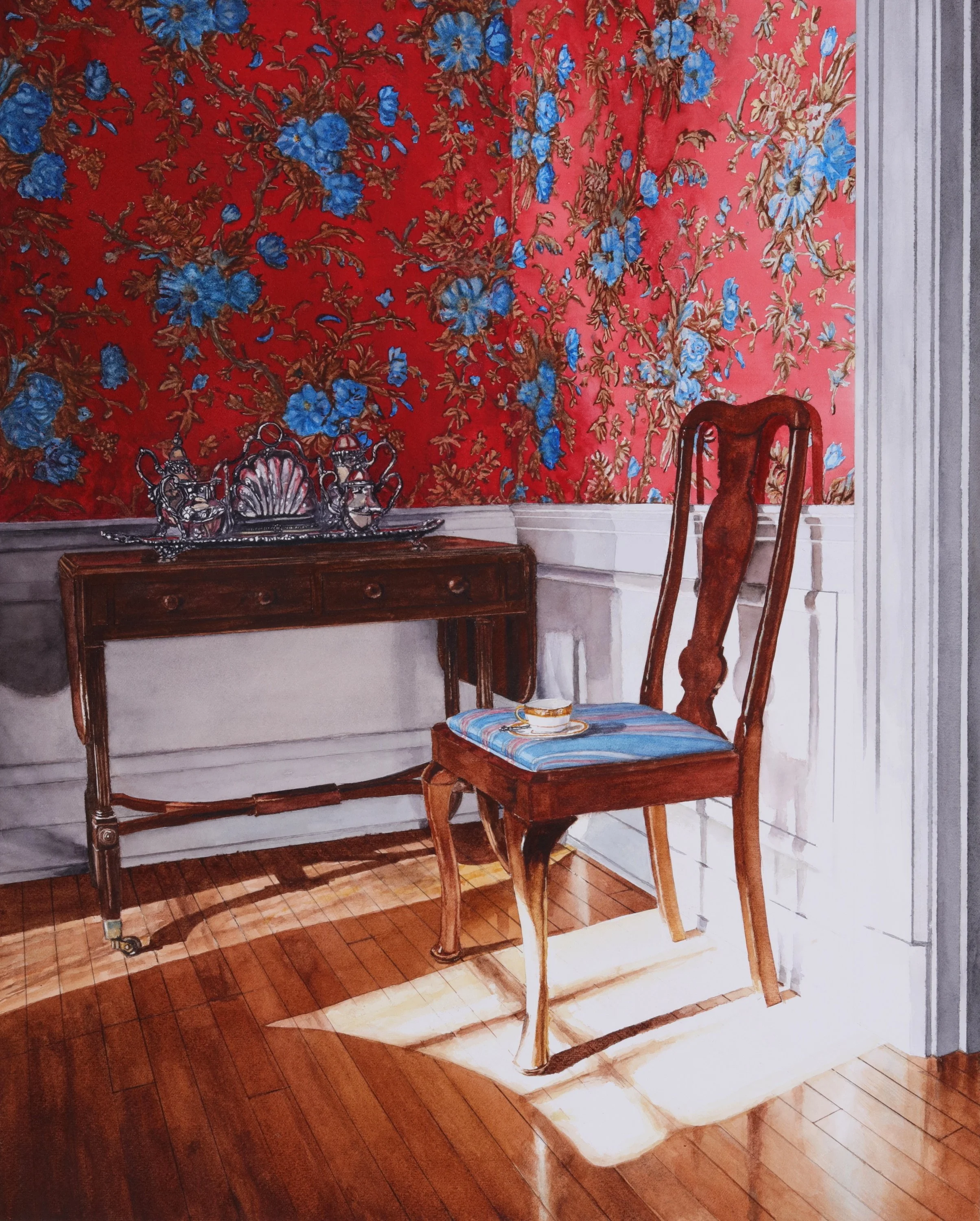
Chair

How has watercolor instruction and the community in general changed since you began painting? Would a 60 year-old Laurin have preferred to enter the world of watercolor in 2026?

Well, you know, that's hard to imagine, because everything happened for me at just the right time and in the right place. 

One of the things that I love about the watercolor community is that the artists are just so bloody generous. You’d think a guy like John Salminen, who is sort of the patriarch of of watercolor—

He's a silverback. 

Yeah, very good! He’s the silverback of all of us, although I'm a lot older. He's such a role model, and you might assume he’d be a crotchety guy. But he's just the sweetest big bear. If you see him at TWSA and say, “John, I really like that painting, but I have a question about the background. How did you handle that?” He'll say, “Well, I’ve got a minute here. Let me show you how to do that.” No other group of artists shares secrets like that. It’s really just watercolorists, and we do it universally. We do it in Pakistan, we do it in Italy, we do it in Belarus. We do it everywhere. And I think it's just magic, and that's one of the reasons why Fabriano in Acquarello has been so successful. You mix all of these people from so many different ethnicities and backgrounds and education levels, and it's a love fest. It's why you want to go to TWSA or Watercolor USA. Maybe you've got a picture in the show, or maybe you’ve won an award, but more than anything else, it’s about a group of compadres getting together and sharing ideas and just seeing each other's faces. 

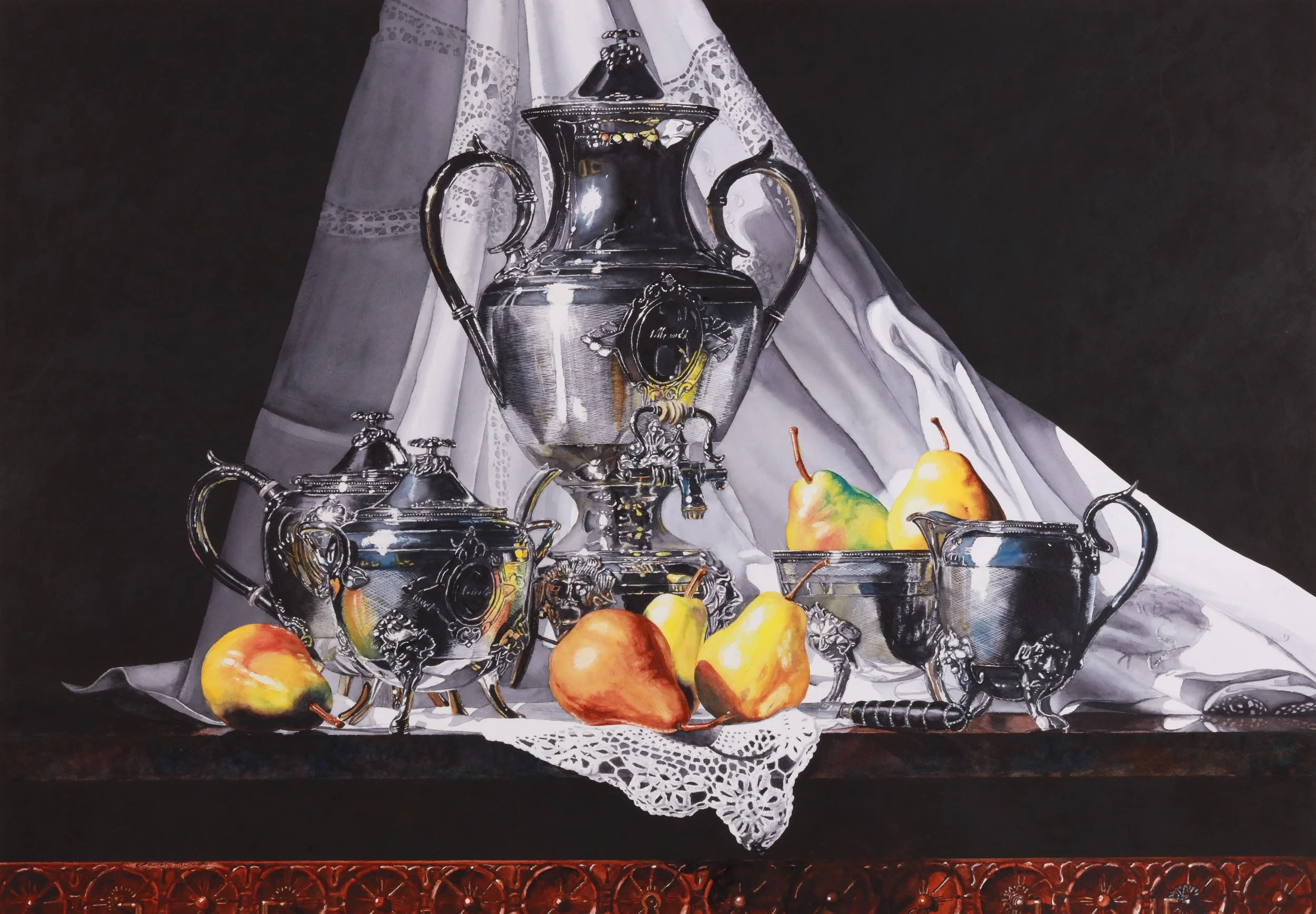
Still Life with Silver

Would you like to share your thoughts about the future of watercolor? 

It's golden. It's absolutely golden. 

The average woman who buys her first brush is in her late forties and early fifties. Her children are grown, and she’s got time and is looking for something to do. The average man purchases his first brush at 63. The last three to four years after Covid have seen the highest sales of watercolors and watercolor-related art materials in history.

So there are a lot of people who cry that watercolor is a lost art. Nobody's painting anymore. But the fact is, it's the other way around. More people are painting with watercolor now than ever before.

Your innovations were a giant step forward for watercolor realism, and your influence on watercolor still life painters is obvious and far-reaching. Are you flattered by your imitators? Or do you wish they’d find their own niche?

Yeah. I wish they would think before they paint. My best story is about someone I ran into who had taken one of my workshops. And she was eager to show me that she had copied a painting of mine, and my only thought was, you know, Why didn’t you take it to the next level? Why didn't you make a better Laurin McCracken and not just copy me? I didn't say that to her. I just said, “Oh, that's lovely,” and walked away.

How many paintings do you produce during a typical year?

Well, I only paint about ten paintings per year, and that’s only because some of them are quarter sheets. I've selected four shows I want to enter this year, so right this minute I'm working on four paintings for those shows. I'm always pleased just to get into a show, and if I win an award that's gravy on the mashed potatoes. I just need something to put in my CV every year. 

So it's worth doing, and it keeps my name out there. If you're going to be a professional, you can't not do things like that. And this is what I stress to people in my classes and to my contemporaries: you're not going to win if you don't enter, right? And if you enter and don't get accepted, what can you learn from that?

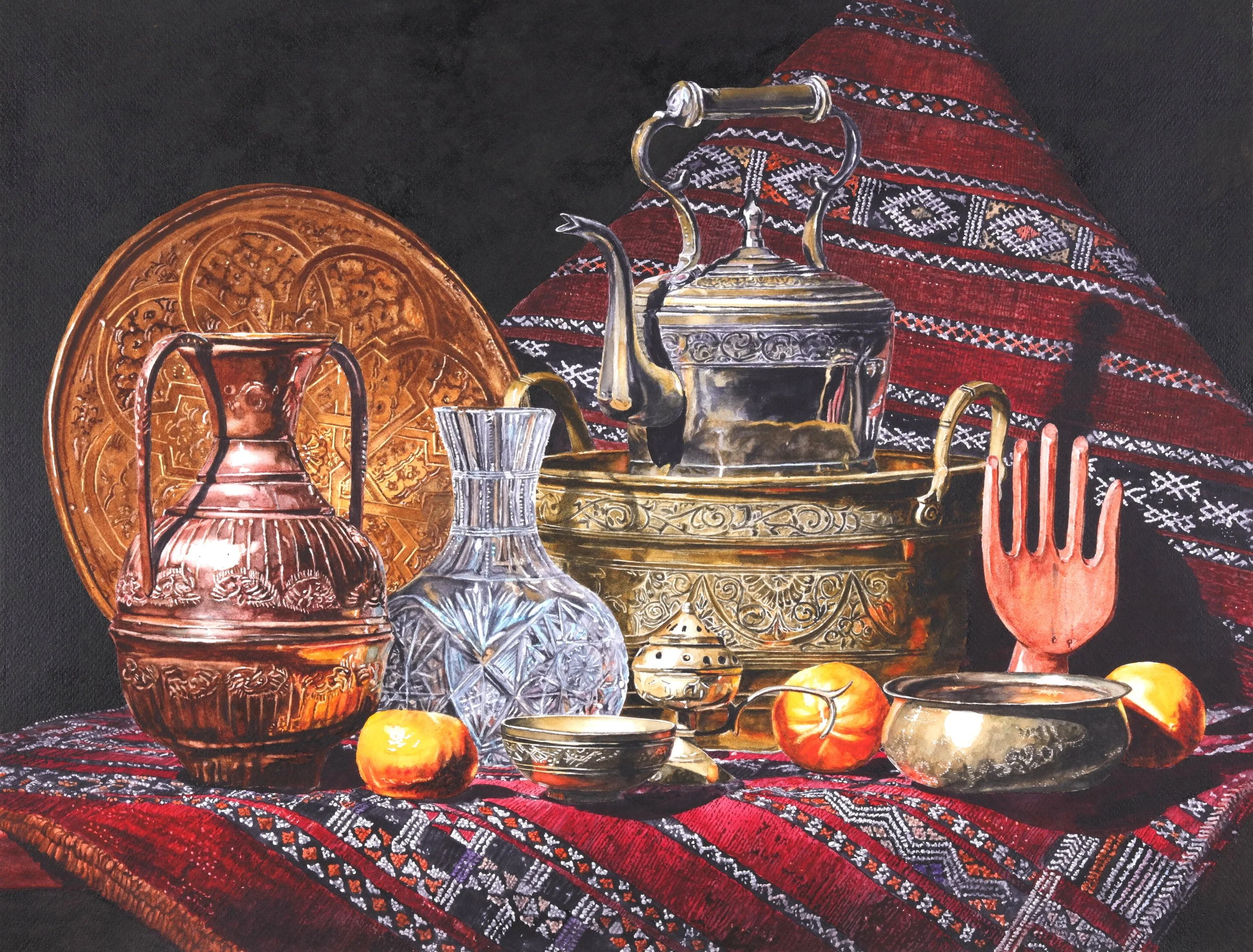
Moroccan Brass

Do you feel pressured to continue to top yourself?

Oh, to some degree, of course. It's part of being a professional, although every now and then I paint something just for the fun of it. I paint what I want to paint. And I think that's really important for every artist. If it's a burden, why are you doing it?

We had a Christmas party for the local watercolor society and had a white elephant gift exchange. I was sitting there with some people I know. This lady came and flopped down next to me, and she was a chatterbox, going on and on. She turned to me, and she asked, “Do you paint?” And I said, “Let me introduce myself. I'm Laurin McCracken.” And she paused and said, “Oh my god.”

Well, you're the Beatles, you know. 

Don't say that.

No, you are!

Well, she jumped up, got her camera, and said, “I’ve got to have a selfie with you to show my husband!” That kind of overreacting? I don't like it, but I don't want to be in their faces about who I am. At the same time, I want them to know that I'm participating in what they're doing. And that's why I try to go to all the demos and all the meetings of my local watercolor society, just to be there to support them.

And well, some days it's just so much fun to be me. 

That should be the headline for this interview. The Watercolor Honor Society will present you with its Lifetime Achievement award at Watercolor USA in late May. You’ve received so many accolades over the years—is this one special?

Oh yes. You know it's a two-sided coin, of course. If you call it a Lifetime Achievement, does that mean this is the end? Because that's the implication. I am so flattered to be recognized, and I'm very appreciative of my peers on the board that I have spent so much time with since I joined them something like twelve years ago.

It's going to be interesting to see what I say when I get to the event, because right now I’m scratching my head. I think I'll just talk about my paintings, but we'll see.

Thank you for all the work you did for the WHS in those years before I joined.

That's why we do these things, you know. I don't do it for myself. I do it for other people. Because over the course of my entire life, I've been very lucky to have mentors who were so gracious to me. I feel this absolute need to pass that on, whether it's art, architecture, sharpening pencils, or whatever it is. I need to share that knowledge.

Sunday 05.10.26
Posted by Kelly Eddington
 

Robert Langdon Interview

This interview originally appeared in the Fall 2023 Watercolor Honor Society newsletter.

Can you tell our readers your backstory, Robert? What kinds of subjects are you drawn to?

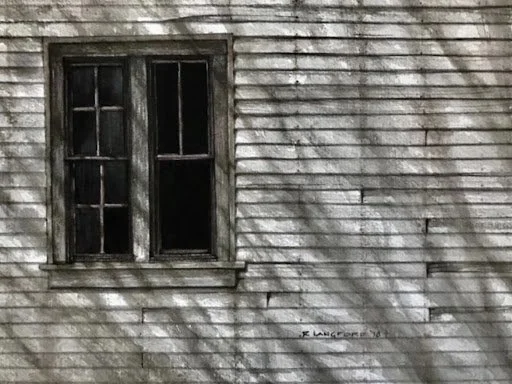
I could go back to my early childhood life and surroundings, but that narrative never gets past the surface before I dismiss the thought. That time was rough and poor, blah blah. That environment was merely the canopy that surrounded my innate motivation to draw and tinker. Drawing and coloring were my 'escape,' although it wasn't really an escape. I was a shy person, and the solitude of 'art' was a comfortable place for me. Maybe the seemingly hostile and chaotic surroundings coupled with my quiet demeanor shaped my interests. As for the weathered textures I'm enamored with and the environments that created them, one could draw a conclusion.

How did teaching art to high school students for 35 years affect your skills as an artist?

I don't know if always hammering at fundamentals for years affected my skills. Oh, I guess it did. The schedule had a bigger impact. The art classroom is a structured environment. Routines make me a better artist and are far better than capitalizing on fleeting moods which offer no consistency. I had to budget my time wisely when not on the job, and I produced some of my best work then.

Are you as disciplined as an artist as you must have been as a teacher?

Those 35 years of structure left me upon retirement...for a time. Retirement required me to create a new routine, and this was not easy, since I'm available anytime, anywhere. So I'm slowly making 'my' art a priority.

During your teaching days, you posted fascinating sketchbook pages. They often featured skillfully drawn and painted subjects that flowed together. These posts were accompanied by captions like, "No time for a painting, so the sketchbook suffices." Can you describe how your sketchbook worked as a creative outlet throughout the school year?

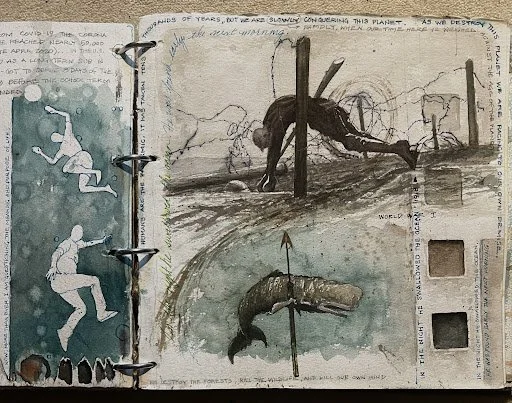
The sketchbook bridges the gap between 'serious' works that require blocks of time. It's very freeing. There's no preconceived image or subject—whatever visual references are on hand typically make it into the sketchbook. Years ago a student showed me how to bind my own sketchbooks. I use 140lb cotton watercolor paper, which is relatively expensive. So the conglomeration of various images on a single page is an economic choice that becomes an exercise in finding a unifying element for that mess of unrelated imagery. So satisfying!

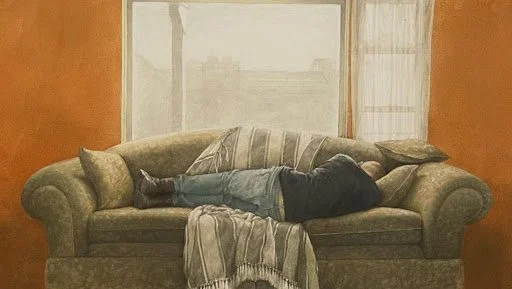
"Escape From Colorado," which was part of this year's Watercolor USA exhibition, made me curious to learn the story behind it. So...what's the story?

Our oldest son was trapped in a toxic 8-year marriage. He shouldered the burden of making it work before finally reaching his limit. At 32, he moved back home, physically and emotionally thrashed. For weeks prior to leaving, he'd been living out of his truck. Seeing him in a deep sleep on the couch told me everything I needed to know. His healing has been slow, but we're happy he's home and doing well.

You produce beautiful work in numerous mediums, and you create sculptures, murals, and even furniture. Do you skip around, or do you work for long periods of time on each one?

So many variables dictate my artistic focus. I took an interest in building tables after I started saving logs from fallen trees. I was commissioned to build one table per month for a client—prior to that I'd built for private individuals. Around then, I painted minimally. Sculpture is a pursuit that happens sporadically because it requires subjects that have to grab me. I'm inconsistent with that medium. My initial response to watercolor in general was that the work was often careless and even sloppy. I was so ignorant! But one day I saw watercolor paintings by a Crow guide at Little Bighorn's tourist center that featured incredible details and mirrored the way I like to work. That artist showed me what was possible and inspired me to take up watercolor painting. Since then I've gained appreciation for looser watercolor techniques.

What does watercolor bring to the table that the others don't?

My detailed oil painting style has drawbacks. If I leave an oil unfinished for an extended period (days or weeks), I find it difficult to blend fresh paint into dried areas, and it can be a real train wreck sometimes. With a watercolor I can pick up where I left off, and depending on my stopping point, it's so much easier!

Do you have any pet peeves about watercolor?

I have no hang-ups about my watercolor process. We all have our methods. Sometimes I struggle with the subject matter of other painters who lean toward cliched and quaint themes. However, my opinions stem from spending so many years working with students and non-art people whose tastes are often 'cliche'. I'm actually very humble and not judgmental, and I'm sure others have similar thoughts about some of my imagery.

When I was a teacher, my supply budget was ridiculously limited, and I had to get creative when sourcing supplies (mat board scraps from a frame shop, clay from the ground when people dug a foundation). Your use of black walnut juice seems like an ingenious way to make basically-free paint.

I remember scrounging for materials in my early days—clay from the local brick plant, newsprint from the Ft. Smith Times. However, as an art teacher for 24 years at Branson High School, my budget was embarrassing by comparison. When I lived with my grandparents in Arkansas, we picked up walnuts for extra income. The stains on our hands lingered for days. Here in Branson, I resumed the practice with my family—gathering walnuts so we could go out for pizza or buy a birthday present. That's when I began experimenting with creating a walnut painting medium. Process: Pack wet, gooey walnuts in a 5-gallon bucket, soak in water up to the top of the walnuts, mash with a hoe, strain the pulp several times, reduce on the stove until rich and almost thick like milk, pour into a brown glass jug or bottle, and add alcohol to prevent bacteria, lest it smell like horse shit! Then it's ready to use.

What's it like to work with? Does it behave like watercolor?

It reacts like watercolor except it tends to hold onto the paper fiber more readily, and this makes it harder to stretch into gradients. Within the umber color is a slight greenish hue. I like to add a bit of drawing ink to achieve a richer burnt umber tone.

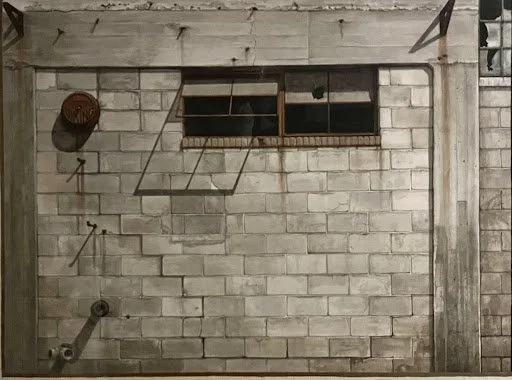
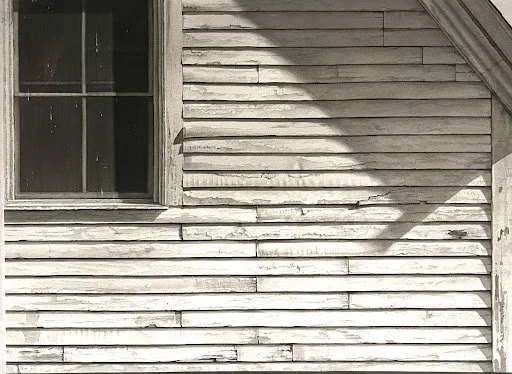
Your painting "Saturday Morning" is almost a portrait of the corner of a white house, and "Ground Floor of Wilson" is a sensitive meditation on concrete blocks and rust. Both feature grays with subtle warm and cool color shifts, and much of your work has an autumnal/wintry mood. Can you explain the appeal of working with a restrained color palette that reflects the colors of decay and age? And are you ever tempted to let loose with bright colors?

Within my dull, boring, omnipresent subjects, I like a more earthy color palette. Burnt umber and yellow ochre actually excite me! Weird, I know. It's linked to whatever it is that draws me to weathered textures and structures. Black and white film photography, which I still develop in my basement, has the same strong appeal. Any painting I've done that features vivid color appears to be a forced effort, so I keep color to a minimum.

On behalf of all of us who were inspired by an exceptional teacher, I'd like to thank you for bringing art to generations of students. Did you have a great teacher?

My high school art teacher, Mr. Gray, was a casual but serious young guy with long hair—a solid mentor. He always had a surrealist painting underway, such as a monkey smoking a banana and so on. He taught fundamentals and covered a lot of ground in what I recall was a short amount of time. As an art teacher, I strictly advocated fundamentals, as I should have. Some kids complained that this stifled creativity. But when you're building a house, you need a solid foundation. Then you can frame and dress it up to your heart's content. Make sure you have a well-stocked toolbox available.

After being away from the classroom for five years, what is your current schedule like?

I'm currently building houses for Eli and myself. My lumber supply is dwindling, and I'm dragging my feet milling the remaining logs...because milling them means building rather than painting. I want painting to become my routine. Once our houses get built, I'll—God willing—retire to my studio, if these old hands can still raise a pencil and brush.

Thursday 05.07.26
Posted by Kelly Eddington
 

L.S. Eldridge Interview

This interview originally appeared in the Fall 2024 Watercolor Honor Society newsletter.

Hashtag Harmony

Could you please tell us a bit about your background? I know you grew up with parents who encouraged your artistic inclinations and that you were a talented math student as well.

My father was a USAF Officer (SAC), and growing up we were stationed in a new place about every two years, so I've lived coast to coast and abroad. It's an interesting lifestyle that left me feeling more like an observer than a participant. Yes, my parents were very supportive of my interest in the arts. They thought it was great that I wanted to dress up as different artists on Halloween. I still have my first painting (age 3) that my father framed and displayed in all of our homes.

I studied art at the University of Central Arkansas, and my favorite studies were watercolor, printmaking (specifically etching), mechanical drawing, and physical geography. I thought I could become a cartographer, but after four years I ran out of time, a.k.a. money. Eventually I became a fiber arts designer and technical writer for a magazine until I decided to paint watercolors full time.

When did you decide that watercolor was your medium of choice?

After my second time through chemo, I considered how I wanted to spend my remaining time. I told my partner I wanted to paint watercolors. He said, "Start tomorrow." I haven't looked back.

Off the Hook

Where do you live currently, and what does an average painting day look like for you?

I live in Rogers, Arkansas. My Choctaw ancestors were forcibly relocated to Oklahoma because of the Indian Removal Act of 1830, and most of my extended family still live in Oklahoma, which is a short drive from here. No matter where we lived, Oklahoma was always considered home. When I had the opportunity to move closer, I jumped at it!

An average painting day for me starts about 9 a.m. at my kitchen table which is situated near a large north-facing window. I tend to hyperfocus, so I usually stop when my partner tells me it is dark outside and I need to quit. Eight to ten hours would be normal for me.

Twenty Thousand Stones

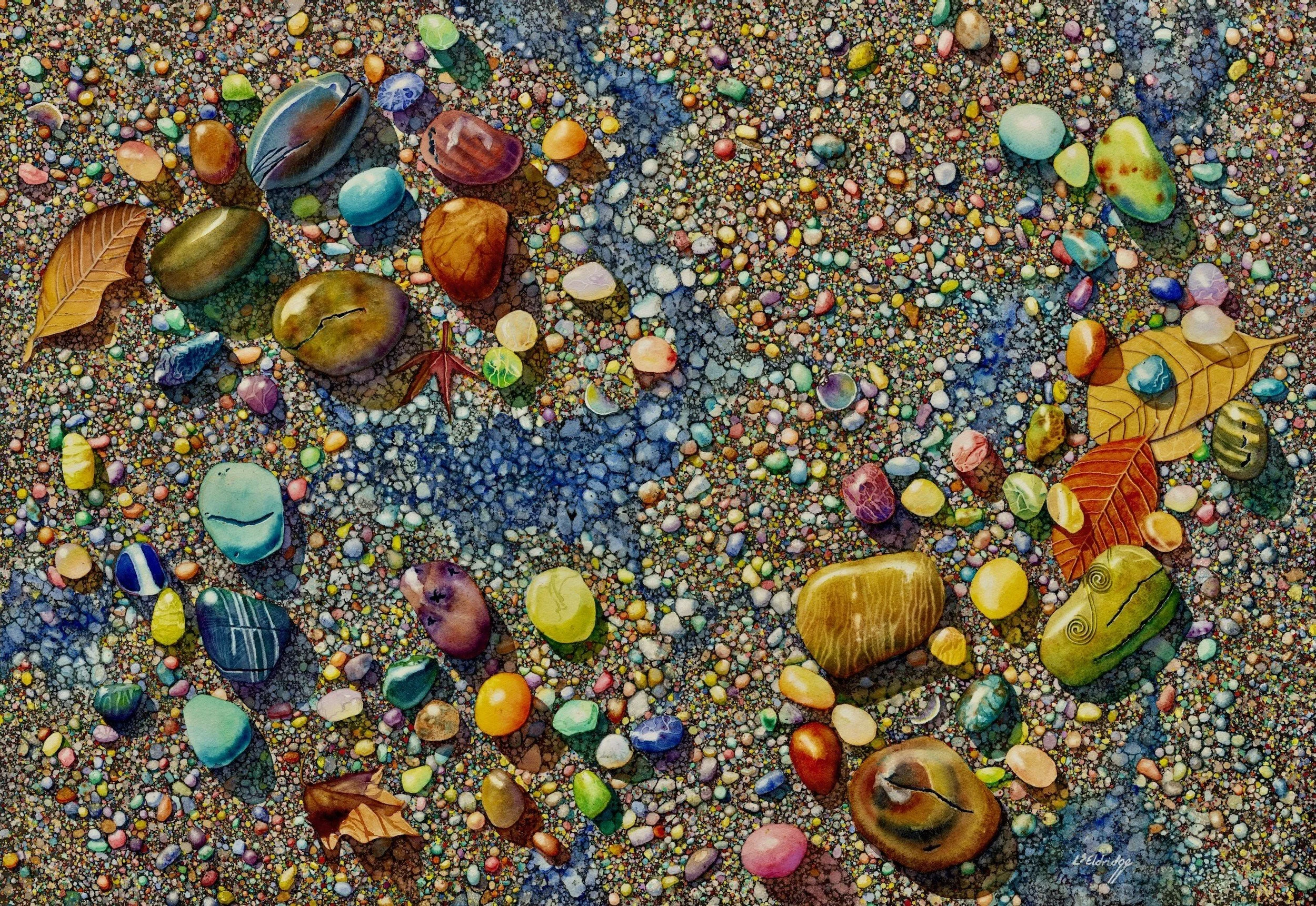
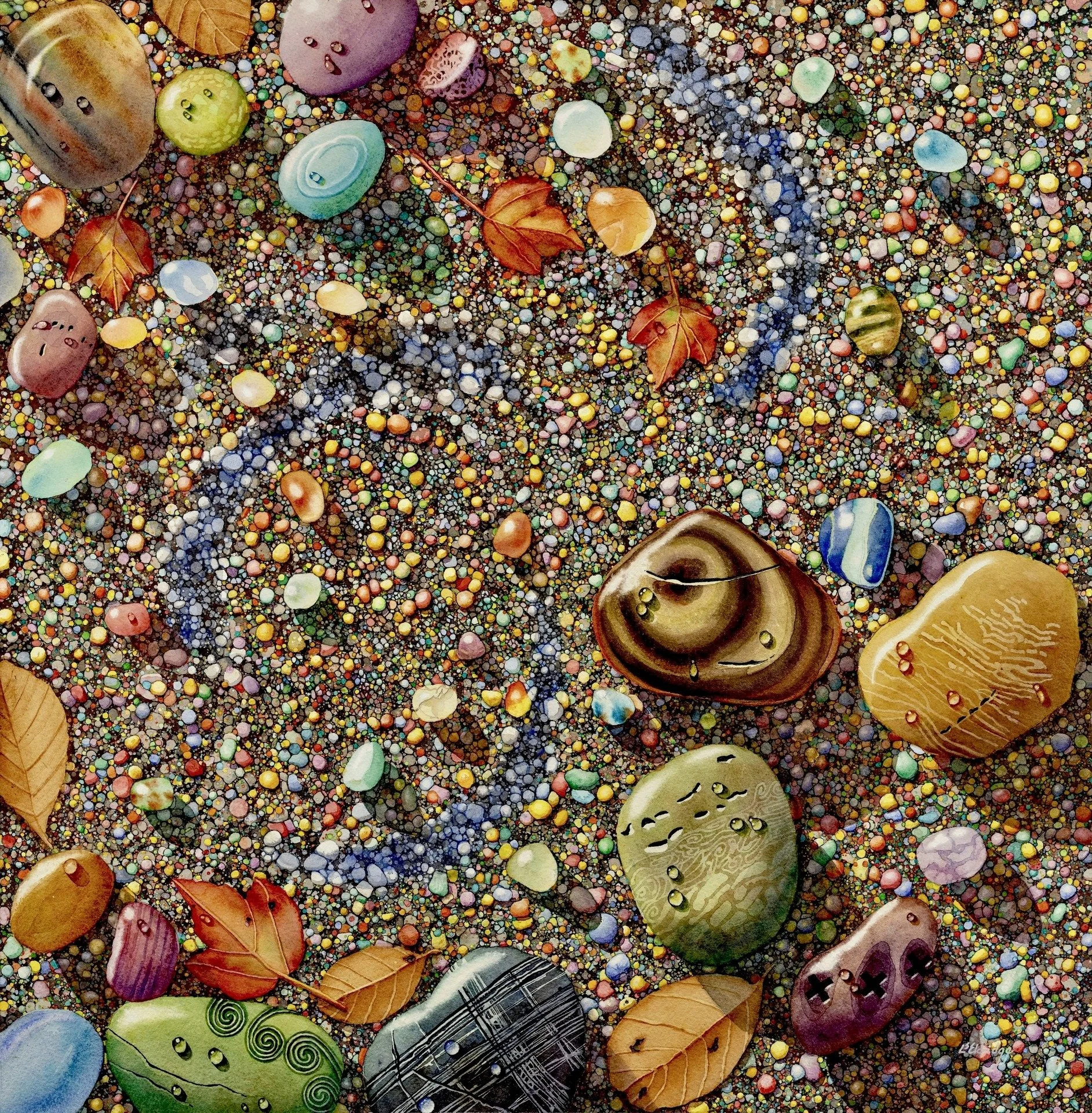
Let's talk about Twenty Thousand Stones, which won the Robert E. Goodier Memorial Award at Watercolor USA this year. At $27" \times 39"$, it really holds down a wall and engulfs the viewer in a world of color and tiny details, all painted transparently and with great care. While I wouldn't want to count them, I absolutely believe that you painted 20,000 rocks and pebbles. What inspired you to create it?

The Arkansas Arts Center (now the Museum of Fine Arts) in Little Rock has an extensive collection of Signac's watercolors. I spent many hours in that dully-lit room contemplating his work. Neo-Impressionism speaks to me because it is so thoughtful. Divisionism/Pointillism is usually employed to address light and hold subjects together. I considered that I could put my own spin on that style of painting. Instead, I would use Divisionism to split the background apart so that each individual color is its own subject. From afar the large stones hold your attention and the impression is that the background is a rather plain riverbank. But get closer and you'll find that the riverbank is unexpectedly detailed and colorful. I used a size 0 or smaller brush for this area. I admit I'm very happy with the result. I think it works.

But why did I paint this painting? As a child I chose books not by subject but by how the pages felt. If asked I would have said 20,000 Words was my favorite. Made for authors, it was a book of only words, no definitions. I'd abscond with this book from my father's desk to run my fingers down the pages and read the words aloud. (I suspect this is where my habit of doing "word sketches" originated.) I was similarly captivated when walking the riverbank with my grandfather. With my eyes focused on the rocks at my feet, I chose to pocket stones based on how they felt when stroked. I thought of those experiences while laboring on this painting. I believe that all things are interconnected. The stones on this riverbank and my favorite book as a child both occupy space on my thread of life and contribute to my sense of identity.

Sometimes when I see a painting, I want to know the story behind it. Occasionally I'm more concerned with the HOW of a painting, and that was the case with Twenty Thousand Stones. On your blog, you said, "Sorry to tell you that I have no hacks or shortcuts to share." But how did you tackle this?

Tackle is a good word. I established the large stones first before starting the background. The large stones are from my personal collection which I use repeatedly in this series. The entire background is just made up—my recollection of the riverside at my grandparents' home. There is no reference photo, just an idea, memory, and creativity. After breaking up the background, I systematically painted sections at a time in a wave, starting with yellow and ending with violet. It took 8–10 hours a day for six months to complete.

You worked on the painting last summer and fall and developed shoulder pain that took your breath away. Months passed, and you picked up your brushes again in April. Are you okay now?

That was a rough seven months away from my brushes. Relative to last fall I have improved mobility. Unfortunately, even now after painting for a day I have trouble lifting my arm.

This is your biggest painting. Framing and shipping costs for oversized watercolors can be daunting, and in the past you have written, "I would rather wipe my eyes with sandpaper than deal with shipping companies." I think every artist reading this can relate to that! Would you consider working on this scale again?

Probably not. There are so many negatives for me: 1. The cost of framing is substantial; 2. Shipping costs are prohibitive as are the shipping containers for this size; 3. Isolation during the long process; and 4. Very few places exhibit this size work. I consider how few people will actually have the opportunity to see it. That said, I wouldn't rule it out if the circumstances were just right.

The Measure of Tools

Your watercolors are often instantly recognizable with their brightly colored tools, such as screwdrivers and metal tape measures. You have said you were inspired by a drawer filled with screwdrivers and other old tools you found in a condemned barn. Along with shiny surfaces, you are capable of creating rusty and other antique-looking textures, so why do you make those old tools look brand new in your paintings?

This is a quite literal "There is no there there." The homes of both sets of my grandparents, though hundreds of miles apart, were set on the same river and have all been torn down due to flood damage. These were tools nobody wanted that were left in a barn that would be torn down. When I held them up to the light, I was flooded with emotions and knew these jewel-hued treasures held the spirit of this place. I took that spirit home with me. So the tools became symbols for what would be no more. Why do I make them look new? Loss is such a sharp emotion. The only way to depict it is with really bright colors. Though the tools I found are scratched, faded, and burned, the memories are vivid. For that reason, I portray the tools as practically new.

Tooling Around

Just curious: how many screwdrivers do you own?

Not as many as you might imagine. As an artist I can change the color or shape at will. A good example of this would be my painting Tribes where I painted 72 tools as either blue or red. (And by the way, that was difficult because, although the concept is spot-on, using only two colors was so boring it depressed me.) I have received many tools as gifts since starting this series, and to honor the spirit of these gifts, I try to use them in paintings. My favorite gift is the green pliers. I recently received an old orange wooden paper cutter that I look forward to adding to the mix.

When described in print, your work seems beyond impossible to paint. For example: Archimedean spirals in various shades of light blue topped with screwdrivers of different sizes that are arranged into a Fibonacci spiral and framed by tape measures and bonus snails. How confident are you when you begin painting subjects this formidable? Do you feel like you're walking on a tightrope from start to finish? Has painting improved your patience?

Experience has taught me not to be overconfident, but a sense of adventure combined with a willingness to fail always awaits when I pick up my brushes. When I painted Off the Hook, the last area I painted was the blue receiver which, in my opinion, felt overworked. I did my ritual goodbye: fire and a beer. I thanked it for the three months of knowledge it imparted and let the embers take it. Then I began again. Some might consider that quite the tight-rope, but I believe hesitation is worse. I'm decidedly averse to creating a doom pile of artwork. The result is the same with either outcome; whether burned or completed, I move forward. I struggle with patience, but I have become a master of acceptance.
Remnants of Enchantment

You've said, "When you're painting, sometimes you just have to swan dive and hope water appears in the pool." What's an example of one of your paintings where you did a swan dive?

I'm pretty sure there is one in every painting to be honest. One that comes to mind is The Measure of Tools. In previous paintings, I made dramatic shadows in combinations of gray. Why not make the shadows colorful instead? I think you lose some drama, but this way conveys a more delicate beauty. Since these tools are symbols for me, a delicate beauty is appropriate.

Some of your work contrasts man-made objects with the natural world. This can be seen in The Nature of Tools, which depicts a daisy whose center is a cluster of silvery hex nuts, and screwdrivers stick out from the center alongside white petals. The daisy is utterly original, beautiful, and disturbing—do you remember how you landed on this idea?

While staying true to the original spirit of the "Measure" series, I began to use the tools to interpret the context and significance of many diverse subjects. After all, everything is a tool in some fashion. The idea blossomed during a conversation with a dear friend who is a master naturalist. We were discussing the decline of pollinators, and I shared the thought that we will need to apply every tool at our disposal to address the issue. The Nature of Tools' focus is mankind's influence on the natural world and the tipping point it has created. Optimistically, I used the common daisy for my backdrop as a symbol of new beginnings.

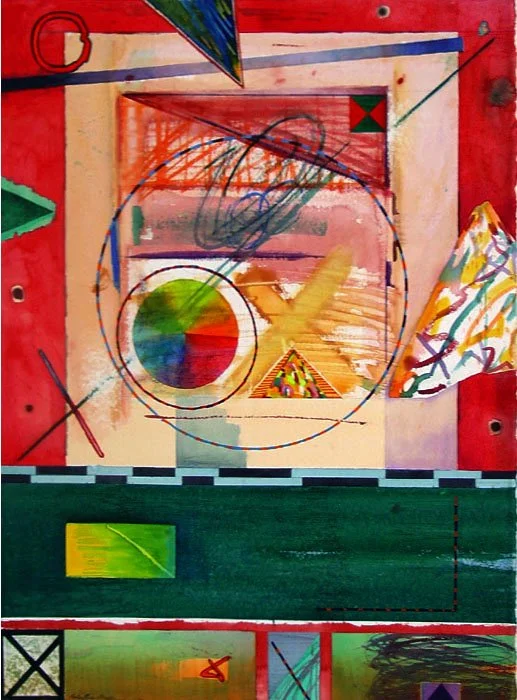
I enjoy your blog and your honesty in describing art's frustrations. Frankly, it humanizes you! I love when you write things like "I am the most agonizingly slow painter," and "It truly takes perseverance on my part to put the thing on the table every day," and "By the time I finish a painting, I'm completely over it." Non-artists tend to assume that what we do is relaxing and fun at all times. Do you have additional pet peeves about watercolor or art in general?

Watercolor is the most capricious yet beautiful medium, and I have no complaints about it. Its versatility constantly inspires me. One of my main triggers is visiting a museum and only finding one or two watercolors. Also, I'm really quite annoyed when people describe non-objective art as though it is a Rorschach test. The same qualities apply to both realist and non-objective work. So please back up and begin by talking about the color, shape, texture, line, and form, not that you "see" a dog's face in the corner. I've stated I struggle with patience, and admittedly these are a couple of my flashpoints.

Your love for painting is clear when you say things in your blog like, "Sticking my paintbrush in a beautiful rich green has lifted my spirits" and "Creating a painting is like a relationship: now it's new and exciting, and later it's like an old friend who shares memories." What other things make being an artist gratifying?

Well, taking the tape off comes to mind. That moment where I am physically reminded of where I began with that blank piece of paper. That is a very satisfying moment. I am grateful for the art community as well. Our empathy combined with our ability to problem-solve creatively is a top rate contribution to this world. I feel extremely lucky to be a part of it.

Thursday 05.07.26
Posted by Kelly Eddington
 

Marilynn Derwenskus Interview

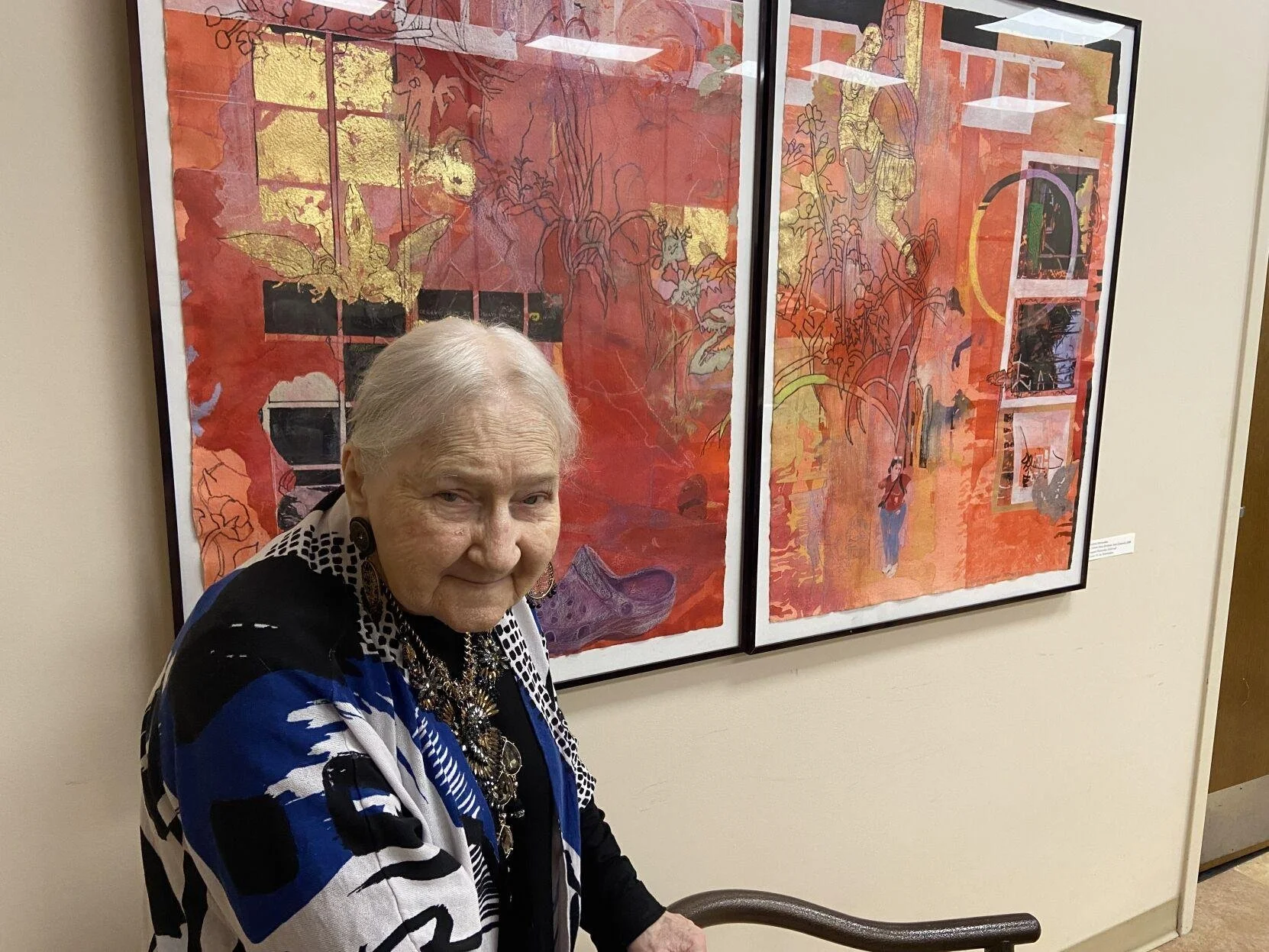
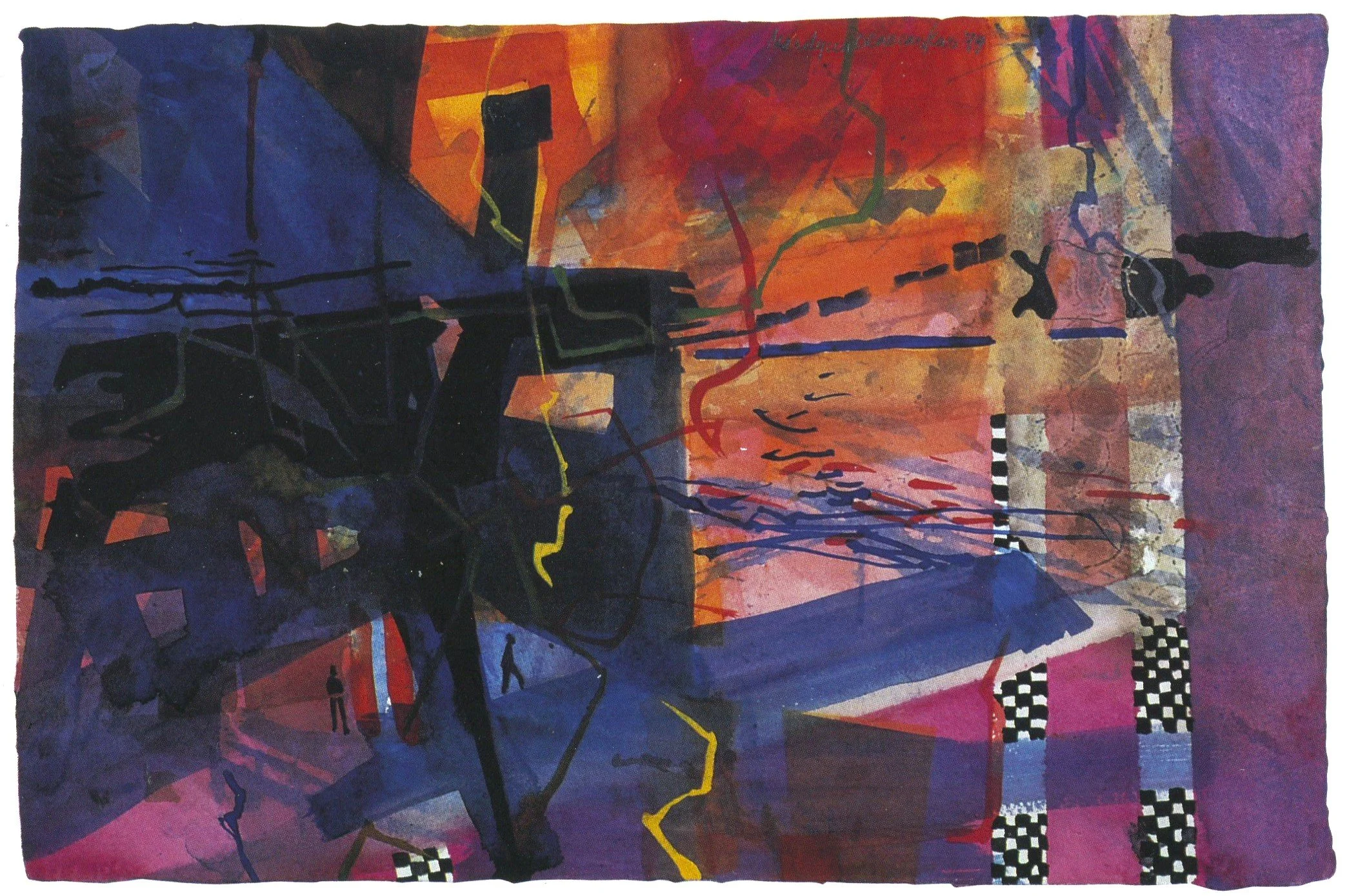
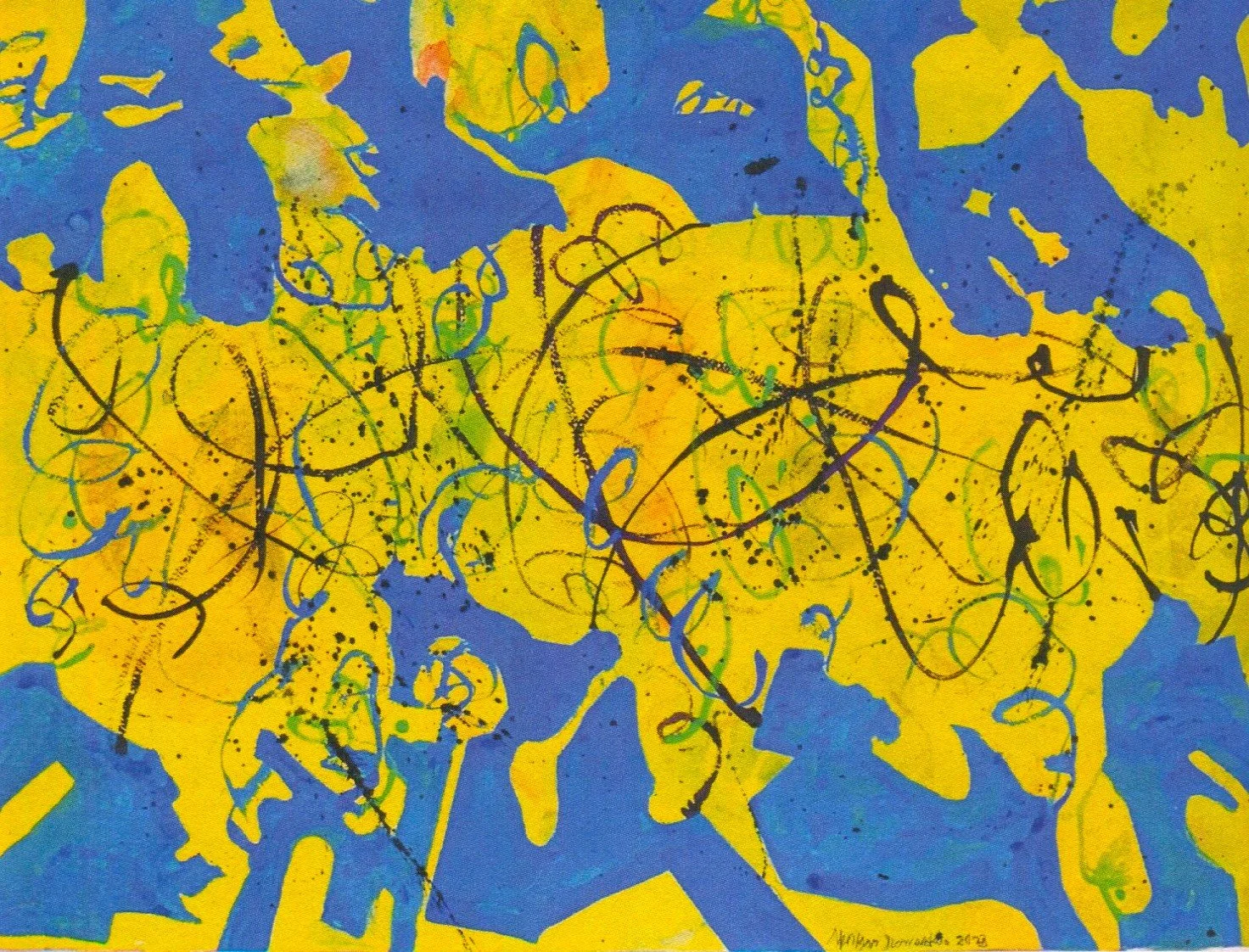
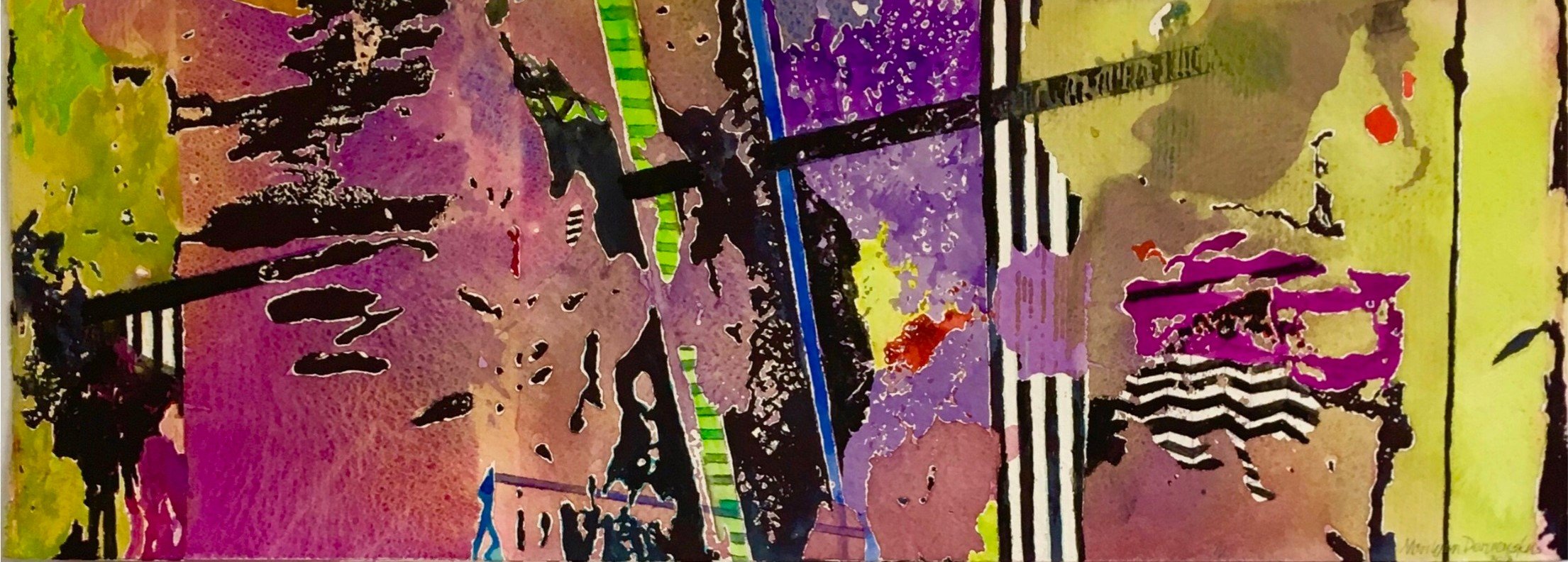
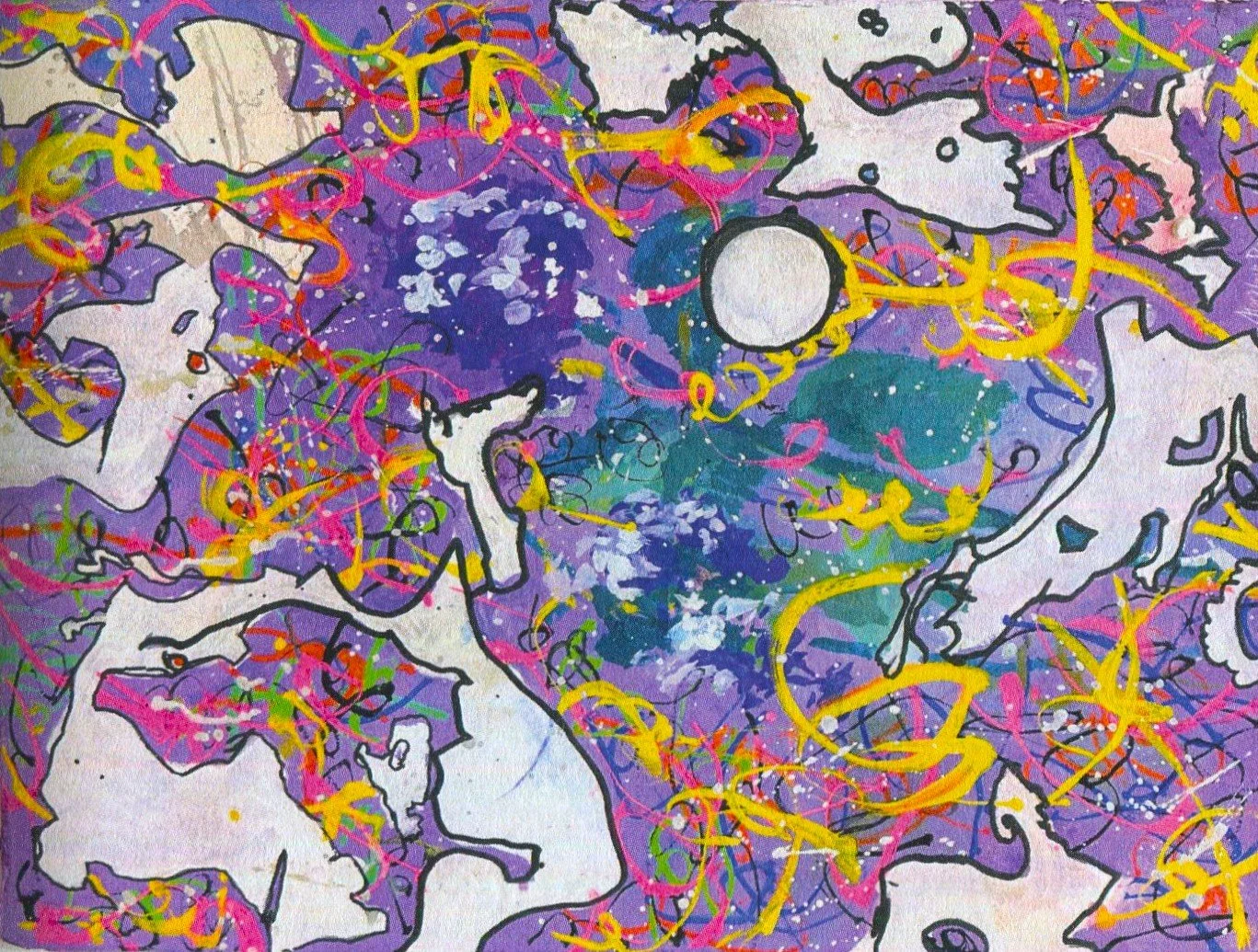
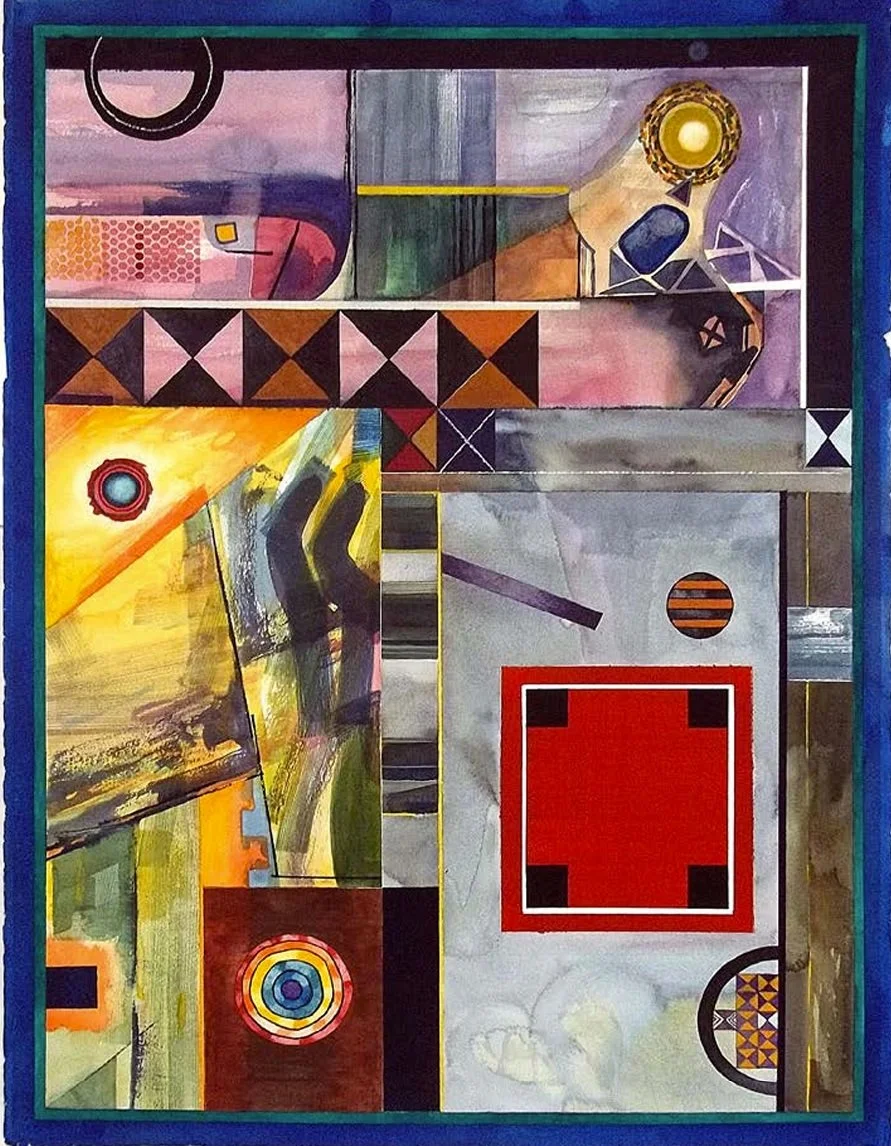
Marilynn Derwenskus’ work is experimental, joyful, and liberated, but with an underlying structure, and those words describe her personality as well. Her most well-known work frequently incorporates unique textures created by multiple pours filtered through porous paper. Then details such as figures, architectural elements, stripes, and checkerboard patterns are added. Born in 1937 in Detroit, Michigan, this artistic pioneer will receive a Lifetime Achievement Award at Watercolor USA for 2024.

This interview originally appeared in the Spring 2024 Watercolor Honor Society newsletter.

You attended Wayne State University in 1955, where you studied with experimental watercolorists Mary Jane Bigler and Louise Nobili. Did your instructors ever give you the impression that watercolor was a lesser medium than, say, oil painting?

Yes. That was the case when I was in school, and I think it still exists. I don't think it's gone. But Mary Jane Bigler definitely tried to change that, and she was one of the founders of the Michigan Watercolor Society. She encouraged us to join, saying it was a professional organization and not a social club. So I joined, and I'm still a member.

You spent your twenties and thirties raising a family and teaching, and then you explored postmodernism during your MFA studies at the University of Chicago in the 1980s. What inspired you to move from pure abstraction to what you call lyrical abstraction, which is abstract expressionism that includes recognizable elements?

The only thing I knew back then was abstraction. Postmodernism was a whole new idea. I was excited to discover it at the University of Chicago, and I had very good faculty members. They encouraged new ways of thinking about art. My main painting advisor was Robert Peters, a multimedia artist who used found objects. One day as he was leaving my studio at the university, he said, "You have to use differences." After the door closed behind him, I opened it and chased after him saying, "Bob, Bob, wait a minute. How different can it be without the loss of unity?" He said, "Don't worry about unity. You're making it. That's the unity." So I thought those were outstanding words, and I told my students that constantly.

You had heart surgery when you were 47. You were not expected to live, but you did. How did this health crisis change your art?

Chicago Buildings and Bridges in Spring

Art is my life. Everything I do is about art, even ugly things. I painted pictures of myself during the surgery. My brother asked me, "How could you do that? You were unconscious." I said, "That's true. But I was still there." I had a gallery show of the work that came out of this, and I was excited about it. One of the paintings was of my doctor, and I included the letter A in it. He thought the A meant "excellent." But he didn't know the A was for "arrogant." He bought the piece.

After earning your MFA from the University of Chicago, you were a painting professor at Ball State University in Muncie, Indiana from 1988 to 2008. What courses did you teach?

I taught watercolor when I arrived, and I think design. Eventually I taught only watercolor and encaustic painting. They built a new facility with ventilation appropriate for encaustic (inhaling the fumes is dangerous). We were the only university in the United States that offered an opportunity to major in encaustic.

Life in the Big City

Can you describe a favorite assignment that helped expand your students' understanding of what was possible with watercolor? Did you have a lesson you always used to teach that was a hit?

Well, first of all, I will tell you I never repeated an assignment.

You didn't? Oh my!

I did not. I was teaching art, and art's creative. So I always changed what I taught because I wanted the students to be creative, and I didn't want them to do the same things over and over again.

Were your art department heads okay with you constantly improvising your curriculum?

Truthfully, at one point they gave me a really hard time. I thought I was going to lose my job because I was focusing on content instead of technique. There are four parts to every work of art: subject, content, composition, and technique. I taught technique, but I didn't focus on it. So when that happened, I was nearly in tears thinking I might lose my job. But I went back to my corner and told myself, "I'm going to make my own work so strong they won't be able to get rid of me. I'll try to win awards." And I did that. So I was there for twenty years.

Not So Long Ago

By all accounts, your students love and revere you and have stayed in touch. Would you like to say anything else about your legacy as a teacher?

I can't tell you how often I walk around my house saying, "I love teaching. Oh, I love to teach." It's my life.

After you retired, you moved to Chicago, and you're currently in Nashville. What does a typical day look like for you?

I have a schedule, and part of it has to do with some health issues that get in the way. I wake up in the morning, and I have to take some medicine that makes me use the bathroom too much. So I can paint in the morning, and the medicine starts to take hold around lunchtime. During the afternoon, I just stay in my bedroom, close to the bathroom, frankly. And then I go back to my studio after supper and paint. Sometimes I'll paint for a total of ten hours each day.

Wow!

Well, I'm sorry. I love what I do! And once I get going, it's hard to stop.

And you don't get worn out physically?

I don't think about myself when I'm painting.

The Unfortunate Ukraine

When I view your work, the painter in me tries to figure out how you create your beautiful imagery. I feel like I'm an archeologist who's sifting through the layers in your paintings. They almost remind me of sedimentary rocks, and I can see the passage of time in your work.

I like finding new ways to add different techniques. So I'll start doing something one way, and somebody might call me up and ask if I knew that so-and-so was copying my work. And I'll say, "Well, it really doesn't matter because I'm already onto something else." I don't stay in the same place.

I think many artists live in fear that some kind of health issue will make it physically impossible to paint. In 2019, you suffered a fall that broke your (dominant) right arm, wrist, and hip. But you said that quitting art was never an option. How did you manage to bounce back? What kinds of adaptations did you come up with? After a fall like that, some people would've said, "Okay, it's time for the rocking chair."

I said, "This is not the time for the rocking chair. I've got to find a new way to paint because I can't do it the old way." I could hardly hold a brush, and I struggled and struggled. How could I make the kind of imagery I wanted with control? Eventually I came up with three steps. Want to know what they are?

Of course!

A long time ago, I used self-made stencils in my work. I created them from thick watercolor paper or cardboard. So I started working with stencils again. To begin a new painting, I place the stencils on my paper and trace around them. Then I paint the background and work around the stencils. This produces imagery with a little bit of control. Then I lift off the stencils, and the shapes they created stay white. Next I add squiggly lines using different kinds of rigger brushes. These have long, short, thick, or thin bristles, and they make a variety of marks. Those marks never go on the white areas. Finally I make droplets using a big brush with a lot of fluid in it. I tap it and let the drops fall on the paper, and I move about and place them where I want them to be.

Is this done mostly with gouache?

Completely gouache. I don't use transparent watercolor.

Spatial Configuration

Are you loyal to any specific art materials such as brushes or brands of paint?

I won a Grumbacher materials award at a show a long time ago. And I thought to myself, "I don't want any supplies I'm just going to use up. I want a trophy!" So I selected a $300 brush. I have it to this day, and I gave all of my students the opportunity to see what a good brush feels like when you paint. That brush is a special thing. I show it to people and say, "See this brush? It was my trophy."

How do viewers react to your work?

I'm going to receive a lifetime achievement award from Watercolor USA, and two years ago, the Michigan Watercolor Society gave me a similar honor. So now I think some people are thinking, "Wait a minute, she might be a good painter." I think they're looking at my work more carefully than they used to. I've noticed that my family is all for whatever I'm doing. They want to see it, and they never used to ask about it. Now that some recognition has been applied to the work, they're trying to figure out why that is.

Have you had to deal with sexism in your career?

I haven't let it exist in my career. I think sexism was present when I was teaching at Ball State and when the women's movement was very strong. At first I joined a women's art group, and then I thought, "You have to do this. You can compete with men." And I did. I'm sort of bullheaded about the idea that women can paint as strongly as men.

Art sales from your most recent exhibition are funding a painting scholarship. How is that going?

It's coming along pretty well. I was told that in order to offer a scholarship, I need to have $10,000. Well, I don't have any money. I live at my daughter's, and she even pays my phone bill. I live like a queen. But I decided I was going to do this. So I had an exhibit last October, and the money from those sales will go to Ball State. So right now I'm not quite there, but I believe I'm going to make it.

What’s Going On in the World

And you intend to write a book, too?

I haven't decided on the title for the book, but I do plan to write it. In fact, the state of Tennessee has become involved. They heard about my work when physical therapists who came to my house saw me in my studio covered with paintings and brushes. I think they realized the seriousness of my dedication. So they sent someone from the state of Tennessee to see me, and they're going to help me get a new computer or some kind of device that can take dictation. The book will be about my life and art. Because art is life, and life is art. 

Thursday 05.07.26
Posted by Kelly Eddington
 

Robert Lee Mejer Interview

It was such an honor to interview Robert Lee Mejer, an Illinois artist who was born and raised in the shadow of Notre Dame University in South Bend, Indiana. A signature member of the National Watercolor Society, a Distinguished Master of the Transparent Watercolor Society of America, and a Master Fellowship Member of the International Society of Experimental Artists, Mejer has been a Distinguished Professor of Art at Quincy University in Quincy, Illinois for a remarkable 57 years. He founded and has been the curator of QU’s Gray Gallery for an equal number of years. His contributions to the Watercolor Honor Society are incalculable: he is a signature charter member, a longtime board member, and he served as WHS President for four years. His innovative work has been shown in over 65 solo exhibitions and accepted for over 500 juried exhibitions. "In my work, I hope to PRESENT (inside to out) rather than REPRESENT (outside to in)," he says. This multidisciplinary artist received the 2025 Lifetime Achievement Award at Watercolor USA.

This interview was previously published in the Spring 2025 WHS newsletter.

Take PC #16

You describe yourself as a Geometric Abstract Intimist. Can you explain what that means? Is that a label that you’ve invented yourself, and are you the only one?

I don’t know if I’m the only one, but I deal with geometry in my work. I think an intimate relationship and an ongoing dialogue exists between my work and myself. I’m a nonobjective painter, but I do relate to reality in a sense. Sometimes I think of my work as looking through a window or walking through a doorway, and I use those proportions in my work. It also has to do with spatial concerns. I agree with Hans Hofmann that his use of forms and colors still contained the suggestion of movement—and movement is the pulse of life.

How long have you been exploring your current style?

Oh, I’ve never given that much thought. I think it’s built up over sixty years. In my earlier years, I was a representational painter and had an empty feeling when I tried to portray things like a camera. I wanted more freedom and challenge and went in the direction of abstraction.

Is watercolor your main focus now, or do you continue to work with other media?

Watercolor is my main focus. At times, I take a break from it and focus on creating water-based monotypes that I began exploring way back in 1979 or so. I think I was one of the early practitioners. I decided to try water-based printing, because it seemed safer and healthier than processes that deal with solvents and oils. I name my work as monotype assemblegraphs. That allows me to print the image only once. Before exploring water-based printing, I employed multiple color block printmaking that involved registration of blocks. One of my oil-based monotypes was selected for the New American Monotype traveling show in 1978-80, and in the catalog I was across from Robert Motherwell. That made me feel good. Lately I’ve been combining watercolor with a product called Createx. I like exploring and combining things that aren’t supposed to be together, so it’s a growth process. You learn as you go, and you try different things. At times my monotypes inform the creation of new watercolors.

When advising artists, you tell them to do the best they can with the gifts they have. What are your gifts?

I think I’m a colorist. I’m influenced by artists’ thinking in the 19th and 20th Centuries, so I focus on collage-space, contrast, and the integrity of the picture plane.

You say painters should try to arrive at a value with the fewest applications of paint.

We work on white paper, so we release light. And the more layering you do, the less light you have. So I’ve tried to retain the sense of light in my work.

What colors are the most enjoyable for you to work with?

Most of the time, I work with the bright, rainbow colors. Yellow, yellow deep, orange, red light, alizarin, purples. I like all of those colors.

Take PC Open Book #4

Do you have a favorite brand of paint?

I use Daniel Smith paints most of the time. I want to try that QoR brand. I used to use Grumbacher, and I grew up using Arches paper.

Do you still use Arches?

Yep. Since high school. My criteria for paper is that it has to be 100% cotton, acid free, mould-made, cold press, and bright white. I also use Saunders Waterford (England), Fabriano, and Kilimanjaro (Italy). I prefer to work on full sheets of 300 lb. paper so I don’t have to worry about stretching them. All I do is push-pin the paper to my Exterior Homosote board. Most of the time, it’s a vertical format. Some of my older work is smaller just because I happened to have frames that I wanted to use. But Leon Golub, an influential artist, once told me, "You’re not gonna be famous unless you work larger".

You’ve been known to piece a few unsuccessful watercolors together into triptychs with horizontal compositions.

Yeah. I’ve made three or four really wide landscape-style triptychs. I cut those paintings up, taped them together, and repainted them. And it seemed to work.

What’s a watercolor technique you love that you don’t see people use very much?

Right now I like imprinting textures. I like to use a sponge or I’ll take a leaf and paint it and transfer it. That’s because I’m also a printmaker. I also rely on positive/negative stencil patterns. My painting is an accumulation of drawing, painting, and printmaking skills. It all comes together as good gestalt.

What’s an average workday look like for you?

Well, I teach a lot. So I have the weekends to paint, and in the summers I can create a body of work. I’m more focused in the summer and work four or five hours a day.

Do you prefer to paint during the day or at night?

Oh, I’m a night owl. But I do both based on my need to develop a new painting.

Is it hard for you to paint in short bursts?

I don’t have a set painting schedule during the school year—just when I can find the time. So I paint in short bursts. Except as I get older, my biggest problem is getting distracted by a framed painting I might have in the studio. And I’ll go, "Oh, shit. Now I’ve got to take it out of the frame and change it". I’ll make the necessary changes, and I’ll be happy with them, but doing that is a lot of work. When I was younger, I believed that once you’ve painted something, you can’t go back. But as I get older, I want to change things. And then I have to watch myself when I try to enter shows, because I might use the old image I’ve saved on my computer. And I’ll think, "Oh, wait a minute. That’s the wrong image. I’ve got to get the new version".

Do you change the paintings dramatically or just little things that are bugging you?

I don’t think any of the changes have been dramatic, but they’ve been essential.

Do you ever feel isolated when you work, or is it more of a refuge for you?

During Covid, people were stressing out right and left because they didn’t know how to deal with being alone. That’s one of the great things about being an artist. You’re always alone in the studio dealing with your work and your ideas, and you feel comfortable. It’s therapeutic. So Covid didn’t bother me.

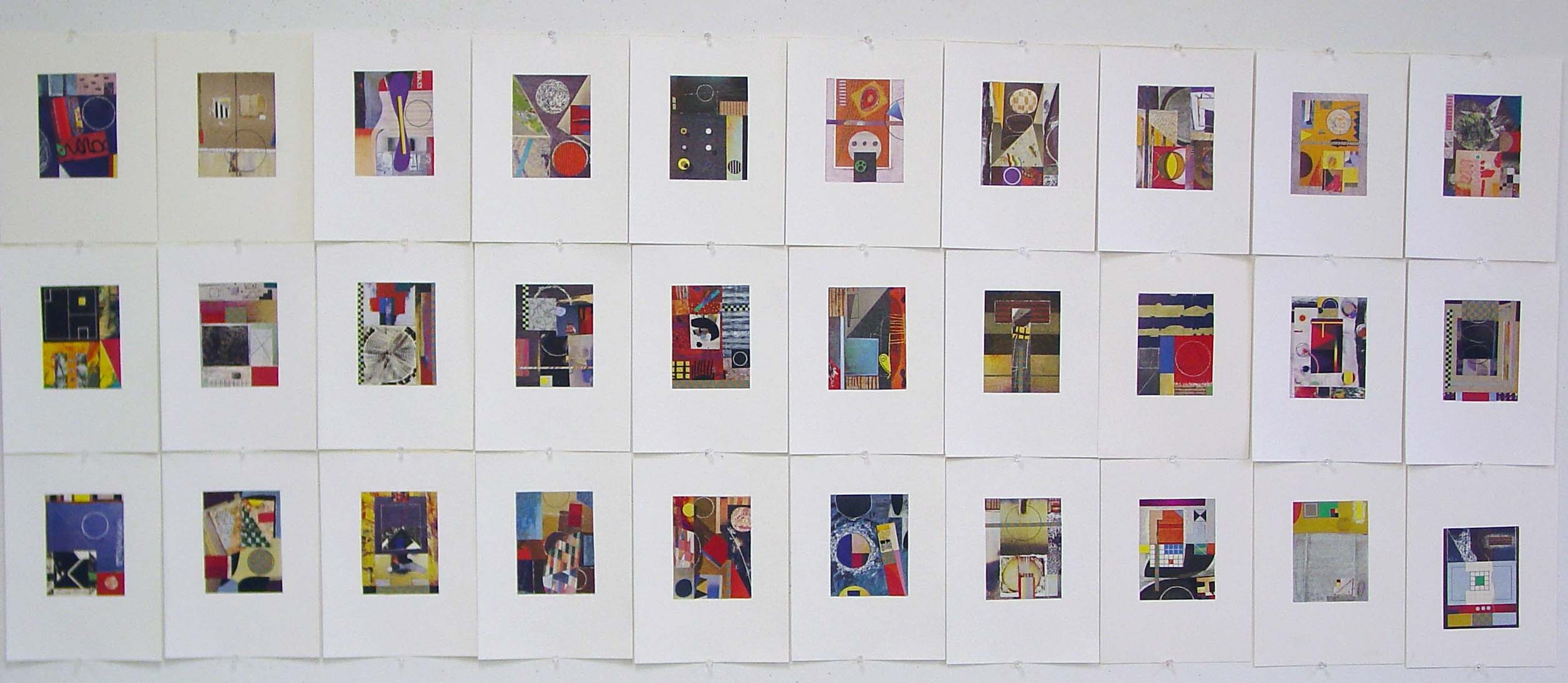
Wall of papier colle studies.

How long do your paintings take to complete?

It’s hard to tell because I might spend four hours on one and think it’s done, and then I’ll come back and then retouch it for another hour. And then two, three, four, or five years later, I’ll come back and think, "Oh, I’ve got to change it again". So I’m not on a set schedule like some people are. My son was asked how he knew when a painting was done; he had a great answer: when it is sold!

Do you work on one at a time, or do you have several going?

I usually work on one at a time. I set out with my thumbnail sketch, and I’ll spend an hour or two drawing. I call that the skeleton. Then I spend time figuring out where the "muscle" is going to be. Sometimes I make a list of different techniques that I could use. Then how will I finish the painting in terms of detail? I always say design first, and detail last.

When do you start thinking about colors?

I try to create a color solution I think will work with that skeleton. I used to do this in a sketchbook; I’d draw skeletons with pen or pencil and write notes alongside them. Maybe I should put green here, or maybe I want a certain texture there. Most of those sketches were very simple. Eventually I switched to creating a series of 6"x4" papier collé pieces to plan future paintings, and they’re all cut out and glued down. Magazine clippings help me visualize the colors. I’ve made a lot of these, and many of them are not paintings yet. But they’re ready to go. I put the ones that have inspired paintings in a folder so I’ll know they’ve been used. Of course, when I create the painting, I’ll make adjustments. I never copy my papier collé pieces exactly.

Several works in progress in Mejer’s studio.

You must have a gigantic collection of magazine clippings.

I have a big box of them. And I also use parts of monotypes and watercolor scraps. I’ll cut those up and eventually make collages with them.

And you call these clippings your vocabulary?

Yeah. They trigger ideas. Occasionally I’ll put two collages side by side and create diptychs from them. I call those my Open Book series of paintings. I have a couple of other ways to plan my paintings. Sometimes when a monotype doesn’t work out, it might become the impetus for something new. Also I teach graphic design, and one day I asked myself, "Why am I avoiding the computer in my own work? I could use it as a sketch tool". I’ll take a picture of an in-progress painting and use Photoshop to work out problems by doing color fills. So I’ll try a pink border, and then a black border, and then a green border. And eventually the border I’ll actually paint is the one I resolved on the computer. This really speeds up the painting process.

Which is more interesting for you? Planning the painting or executing?

Executing. That is the fun part. It’s about discovery and having a dialogue as I work. I’m talking to the painting, and it’s talking back to me, and I’m going, "Wow, this is fun". But then sometimes I’ll say, "Man, this is harder than I thought it was gonna be". Watercolor can be unforgiving if you want to make a major change. But the amount of preparation you do gives you a structure that helps you stay on track. You have to have an idea that’s worth pursuing. And if you don’t have it, you’ll struggle and struggle. That is one reason why it’s important to create thumbnail sketches. You can work out any problems that you might encounter pursuing that idea.

How often do you become frustrated with a painting?

Not as often as I thought I would. But occasionally I’ve got to pay a price, you know? Once in a while, there will be a bummer, and I’ll have to admit it’s not going to work. I’ll put the painting up and come back the next day and walk in the door with fresh eyes. All of a sudden, I’m enlightened. Or I’ll go, "Oh, that’s bad". Right now I’ve got about three or four paintings that I’m not happy with in a portfolio, and I’ve kept them just to challenge myself. Can I pull them off? I really believe that art is about problem-solving, discovery and finding your own voice.

You use universal symbols, such as triangles, rectangles, checkerboard patterns, and circles in your work. I also see lots of plus signs. Or are those crosses?

I leave it up to the viewer to decide which one they want. I had a lot of squares in the beginning, and then lately I’ve moved towards circles and tied them in with the squares. Occasionally, I’ll throw in a triangle. I like the X sign because it could be a cancellation sign, or maybe it’s a crossroads. Same thing with a plus sign; it’s something positive.

Is there a code to your symbols? Could somebody crack your code and interpret what you’re trying to say?

I don’t think so.

Do you want your viewers to interpret your paintings at all?

Yes. The experiences you bring to viewing the painting are what matters. Some people have limited views and some have broader views. But ultimately my paintings are about myself and my discoveries, growth, and insights. Hopefully, my work contains feelings that reach the viewer and they connect with it.

What do you love more, watching watercolors interact with each other or pulling a print for the first time?

Oh. Both are important to me regarding how the medium behaves with each process. I love pulling the print because I don’t know if it’s going to work. I don’t know if I’ve got enough pressure. I don’t know how the paints will interact. I don’t know if that painted paper shape I put in there is going to glue itself to it or if it’ll fall off.

Variant Zig-Zag

Your paintings in recent years have become increasingly colorful and uplifting. Do you think they reflect your life at this point?

Yeah. I would say so. I mean, I’m content where I’m going. I think of color as life and life as color. A world without color would be so boring.

And you’ve been teaching at Quincy University for something like 57 years?

Since 1968. Everybody’s asked me when I’ll retire. And I’ve told them that it’s not in my vocabulary. Why would I want to retire if I like what I’m doing? Also, I like sharing and interacting with the youth; it keeps me feeling young.

Has being an artist helped you deal with tragedies?

I guess I keep them separate. It’s a place to go to if I want to be alone and if I want to reflect and if I want to explore. We all have tragedies. When my son died [artist Jason Dillard Mejer, 1969-2014], I had my family come in and just said, "Pick one of his works and take it with you". Because I still have most of his artwork. Whenever I encounter it, I feel his presence. I took a one-week workshop with Miles Batt, and his son is following his footsteps. I told Miles I liked his work, and he said, "Well, I like your work, too," so we made a trade. And the thing I remember most from his workshop was when he said, in response to the idea of repetition, "Your work has to have difference". Yeah. "It has to have difference". So that’s the beauty of meeting other artists. You see how productive and how involved they are, and you discover that you have similar ideas. I take advantage of meeting artists that I so admire, and many times we end up trading each other’s artwork.

Do you think four years of college is enough time to master the rules and then start to break the rules?

I believe taking many types of art courses in college helps you gain a wealth of visual vocabulary, various processes, and insights that will feed your imagination and creativity as you seek your own voice and medium with passion. I’m still trying to learn how to master the rules; it never ends. Make a discovery; try to master it. And then you don’t want to be so successful with it that you start repeating yourself, because then it’s not fun anymore. You are no longer challenged to grow.

Take PC #29

Would you like to talk about your legacy as a teacher?

Oh, I don’t know if I have a legacy. I just keep plugging away. What makes me happy, though, is seeing former students out there, still growing, and hopefully having taken something away from me. For nineteen summers I taught watercolor and monotypes at Skidmore College in Saratoga Springs, New York. One summer I taught a class of high school art teachers. Last week I received a postcard from one informing me of her show in New York where she showcased thirty monotypes. She wrote on the postcard, "Thank You," and "My Mentor" and drew a heart next to it. She informed me that two of her monotypes were titled Ode to Robert Lee Mejer I & II. Earlier this year, a guy from New Jersey named Don Fletcher-Apprentice came to visit me regarding a book and two major shows on my famous friend, the potter Toshiko Takaezu. Toshiko was on the faculty at Princeton University (1967-1992). We were both visiting artists at Skidmore College during the 90s, and she approached me one evening to teach her how to create monotypes as a relief from doing pottery all day. We worked together for several summers in the print lab, and she produced many. While curating her show, Don was not aware of the process or how the prints came to be. They were shown in Columbus, Ohio, and credit was given to me. She always left me a wonderful pot after each session. I received the most comprehensive book on her life as a "Living Treasure of Hawai’i".

How does it feel to receive a lifetime achievement award from the Watercolor Honor Society?

Shocking and humbling. But it’s nice because I turned 80 on the day I learned about it. It’s a great eightieth birthday present. I am most grateful! Many times I say that I had good people at the right time and in the right place who supported me, encouraged me, and taught me. I’m so happy to be here. It is important for me to pay it forward! That is the beauty of being human. Like a conductor I orchestrate my paintings in order to create an inspiring visual sound and enlightenment via color. I love this quote by Kandinsky: "Color is the keyboard. The eyes are the harmonies. The soul is a piano with many strings. The artist is a hand that plays, touching one key or another to cause vibrations in the soul". How about that?

Here is a video of Bob talking about his life’s work, along with a demo of his printmaking process.

Friday 04.17.26
Posted by Kelly Eddington
 

Finding An Original Subject

This article originally appeared in the Watercolor Honor Society’s Spring 2023 newsletter.

Menomorphosis: X-Woman

Some established artists own certain subjects I wouldn’t dare touch (light bulbs or fruit on quilts, anyone?). Years ago I painted marbles, which I thought were basic enough to be fair game, and another artist who had painted them once or twice messaged me with an incredulous “Marbles? Really?” At the same time, I’ve seen people paint subjects that are eerily similar to my own, and I have had the same reaction.

I felt pressured to stake my claim on a still life idea before anyone else landed on it, and when I saw groundbreaking ideas by my contemporaries, I kicked myself for not thinking of them first. Painting started to seem like a race, and my work became unnecessarily complicated, sterile, and academic.

I’m ultimately more drawn to paintings that tell a story beyond “pretty things are pretty.” And in most cases they involve people, which I find more satisfying to paint than still life. When the isolation of the pandemic hit, I began looking inward, and ultimately this led to what I consider to be the best watercolor idea I’ve ever had.

The nice thing about self portraits is the absolute guarantee that no one else is painting what you are. When I turned fifty, perimenopause and its troubling symptoms began knocking on my door, and I wanted to capture myself during this transitional period. But I was becoming bored with my pale face and dark hair.

Larry Mullen Jr Drumming

As I mentioned earlier, I run a U2 website where I write about and create illustrations of the band. I enjoy painting them in concert situations because their lighting can be extremely colorful, and in recent years I’ve given those four aging white guys red, blue, yellow, magenta, and even green skin. I wanted to try to paint myself in such a way, but I didn’t know how I’d do that beyond investing in some party bulbs.

Then one night I was watching a documentary about the Velvet Underground (another band I love), specifically the part where Andy Warhol projected images onto them as they performed. And that’s when the idea hit me: I could project colors and images onto myself.

But what images would convey menopause? I began to collect photos of things like dry, cracked earth, but they were kind of one-note when I did a trial run with the projector. 

I searched for more dynamic imagery such as explosions.The most beautiful explosions I’ve ever seen in photos are nebulas. Some nebulas are dying stars—which is how many people view women my age. Nebulas come in colors more varied and complex than anything U2 could ever devise. I like to paint things that are daunting, and nebulas projected onto my face and body certainly clicked that box. 

Working on this series was so fulfilling, and I quickly realized that I’d have trouble returning to regular skin tones. So I’ve continued to use projections in my paintings, and recent ones have incorporated cracked mirrors and, with this one, stained glass. Competition jurors seem to either love or hate this work, and while it’s not as accessible or commercial as, say, a classical still life with a dark background, I know for certain that this one is mine.

Thursday 04.16.26
Posted by Kelly Eddington
 

Mary Jansen Interview

This interview originally appeared in the Watercolor Honor Society’s Fall 2025 newsletter.

It was my pleasure to interview the great Mary Jansen. She is a new member of the Watercolor Honor Society, and her painting Emerald City received a WHS Board of Directors award at Watercolor USA 2025.

Emerald City

You grew up in northern California, and after working as a graphic artist, you're currently a full-time watercolorist in Portland, Oregon. Could you tell us a little more about your artistic background?
My first serious introduction to watercolor was at the California College of Arts and Crafts in Oakland, CA. I majored in Graphic Design, but felt it important to incorporate fine arts into my curriculum. Practicality led me to graduate with a BFA in Graphic Design, but I always knew in my heart that I would eventually drift back to watercolor full time.

What can watercolor do for you that other mediums can't?
There is something about this medium—where the tangible meets the spiritual—that beckons me. Watercolors can be complex or whimsical or disciplined. The medium allows for a vast diversity of approaches, and I am continually amazed by my watercolor peers and their unique applications and hope to grow and expand through their influence. For this reason, I feel I have little creative reserve to venture into any other mediums...but that may change too someday.

During the 00s, you created quite a few miniature paintings. Can you talk about the appeal of working on this scale?
I was very involved in miniature painting for quite some time. My mini-paintings ranged in size from 4" x 7" to 1" x 1". Working so small is a contemplative process, and I felt it relaxed my mind, much as a good meditation might. All of my pieces were done in watercolor of course, and the brushes I used were very small. Some declared they were the width of a gnat's eyelash, and their observations were not far off! I competed and won multiple awards and signatures before I felt compelled to move forward in my exploration of this medium.

Please describe an average painting day (or week, month, whatever you like).
I have four muses that dominate my life. They are: Studio Muse, Garden Muse, Kitchen Muse and Writing Muse. They all bicker amongst themselves for my time, but the Studio and Garden muses are the strongest and dominate my thoughts. They have a mutual understanding: the summer months belong to the Garden Muse, and the winter months are owned by the Studio Muse. During the winter, I gather and process images and ideas collected throughout the year and set them to compositions.

How many major paintings do you produce during an average year?
I may have five different paintings going at the same time but am lucky to bring three of them to finality by the time spring planting begins. I also spend time organizing teaching notes and thinking of ways to inspire my students and enhance their skills.

Heiwa

Birds are popular subjects for painters, but your birds are not decorative co-stars or shown in straightforward scenes from nature. They infiltrate the human sphere and interact with manufactured objects such as containers and lace under dramatic, almost Baroque lighting. Your admiration of these creatures is evident in every picture you paint, and you portray them as beautiful and sentient focal points. As I studied your portfolio, I wrote things like, "I want wild birds to be part of my life like this. I want to see a pelican on my windowsill," and "I think she is the David Lynch of bird painters." All of this is to say: why birds?
I believe birds are intrinsically beautiful and fascinating creatures. But I also believe they can serve as conduits to a spiritual realm. This may all be a part of my imagination, of course, but after spending years observing birds' unique personalities and antics, I have come to love and respect them for their inherent and seemingly otherworldly attributes. I will never incorporate a bird into a composition to merely serve as a place holder. Nor will I attempt to "Disney-fy" a bird for fear of crossing over to an anthropocentric ideology. My hope is that when a viewer observes the birds in my paintings, they will celebrate the birds' unique personas and attributes. And maybe the viewer will also come away with a sense of mystery and transcendence.

Are you a birder, and if so, do you have any good birding stories?
Why yes, I am! I've had countless interactions with birds, and I have thousands of reference photos that I use exclusively for my work. There was one incident, however, that moved me to tears. My father passed away in 2019, and in his eulogy I compared his free soul to that of a Brown Creeper—a feisty bird with an insatiable appetite for exploration. This active bird perpetually pokes and prods for invertebrates between the bark furrows on one tree and then alights on another and begins the process all over again. How like my dad and his zest for learning and exploring! Having completed my eulogy, I went outside for a breather, when suddenly I felt a light thump on the back of my head. When I turned around to investigate, the only creature present was a Brown Creeper making its way up the side of a tree. I was a blubbering mess the rest of the day. But I was also happy and grateful for that sweet interaction. My dad had a wicked sense of humor!

Phoenix Rising

You've enjoyed spectacular success with your paintings, which have been honored with TWSA's Skyledge Award in 2024 and this year's Women In Watercolor's Best of Show, among many others. Are you confident when you begin a painting?
No. I can plan and draw in every detail and still feel apprehensive and insecure when laying down initial washes. Watercolors are like little children: unpredictable and likely to disrupt into a heated tantrum at any time. Granted, some pigments are better-behaved than others, but I don't necessarily choose those colors. I love the way certain pigments, such as Daniel Smith's Cascade Green, take on a life of their own. Others, such as the DS Quinacridones, contribute to gorgeous transparent glows. There are moments when, while painting, one needs to let go and allow for a change in flow. To strong-arm these paints into submission is only asking for trouble.

Do you feel pressured to top yourself with each new project?
I don't try to out perform previous paintings, but I do venture to find means of making bigger impacts with future works. I think about this all the time. What could I do better? How might I deliver the message in a more poignant way? Deeper contrast? Subtler value variations? Do I have enough coffee to get me through the next long painting session? All important considerations. Sometimes a piece does not meet my expectations at all. I will pursue an idea or thought that deviates from the original plan, and it will ultimately end up a mess. I will take these works and put them away in a dark closet for months to "marinate." When I bring them out again, I am able to see them with fresh eyes and can often salvage them.

It's easy to imagine you living a Snow White-like existence, with birds constantly flying around you, perching on your fingers, and helping you with chores. But I assume that your imagery is not the result of you and your camera waiting around for a Common Yellowthroat to land on a dramatically-lit jar of lemons. After an idea for a new watercolor lands in your mind, does it evolve much before you start to paint? Do you build a picture around the bird or the still life?
Ideas and epiphanies land in the most ridiculous of times. I'll be pulling weeds or processing tomatoes when an idea strikes, and I'll have to abandon my task to write it down. I will then take that idea and build a still life around it. Having thousands of my own bird photos from which to choose, I don't have too many limitations when it comes to setting up my painting. I select subject matter that is consistent with the angle of light in the painting set up. The bird also needs to sit well within its environment and evoke a certain emotion or atmosphere. This is where the composition of a painting becomes tricky. For it's not only placement but lighting and movement and mood that are central considerations before even getting the brush wet. In fact, it's not the application that takes so much time but the concepts that are all time consuming. That being said, I also make certain that the birds in my paintings are anatomically correct and that they sit comfortably within their surroundings. For this reason, I make sure that I have several reference photos of my birds so I can accurately render the subject matter. Too many times, I have seen distorted birds flung into a painting without much consideration for their believability. Unless a viewer can truly feel the weight, gesture, and proper stance of the bird, the composition fails to deliver.

How difficult is it to integrate your bird references with your still life setups? You do this so convincingly.
Having taken too many set up reference photos, I will proceed to narrow down and incorporate elements using Photoshop. I use PS merely to assess my composition and values and that's about it. The real magic happens when the painting begins. I will have my reference and greyscale photos to work from, but variations and adjustments inevitably will follow as I paint.

Challenging Brood

Can you explain your painting process? Do you complete one section at a time, skip around randomly and work on several areas at once, or build up colors over your entire sheet of paper glaze by glaze?
I generally begin painting with broad washes. This allows me to set the larger spaces and get a feel for blocked-in elements. I love the effect of multiple glazes, as the technique allows for beautiful illuminating light to fall on the subjects. Detail work is then incorporated and glazed and either brought forth or recessed. At this point my process is stop and go. I paint, stop and assess, paint some more, and assess again. Repetitive standing back for evaluation helps me to stay loyal to my targeted mission.

When you're painting, do you save certain fun parts as rewards for getting through difficult sections?
Yeah...sometimes I do. When I finally get to painting the eye of the bird, it feels as though life has been blown into my work, and the painting ignites with living energy.

I often think that all animals are perfect—they're certainly better than us—and your birds possess a special kind of gravitas that underlines this idea in my mind. Your birds also manage to convey serenity and even a sense of humor. How do viewers react to your paintings?
I get all kinds of feedback on my work—and I welcome it all, of course! The best comments are those that come from collectors and viewers who express how the painting made them feel. They get it. They understand the work involved in putting together a piece full of ambience and emotion. And then there are those who, though well meaning, say, "It looks so REAL!" And I simultaneously laugh and cry on the inside. Not everyone has the means to perceive art at a deeper level. Paintings are meant to be experienced. A good piece has agency and power to move and change another. The mission of the artist is to keep trying and to educate and to draw more people into a richer way of perceiving.

Presence

I'm curious about your painting Presence. It haunts me! Is there a story behind it?
Presence was an emotional piece to create. It is about finding that still, sacred sliver of ultimate peace between the past and the future. In this state, you cannot be bothered by the atrocities of the world and how they will affect you, nor can you experience guilt for decisions made in the past. It is a place that holds no judgement or fear or anticipation—only being. I chose a Brown Pelican for my subject matter because I have always felt these birds possess a certain deep wisdom. You can see it in their eyes. The lighting in Presence is intentionally ethereal and translucent, and it gives the bird a sense of mystery. Why is it placed before a window? Why is it resting on a convoluted fabric? Why not? In this state, the idiosyncrasies of life become the norm.

Easter eggs

Do your paintings contain any Easter eggs?
Funny you should ask! When I need some down time, I'll often pull out my Pysanky dyes and work on a Ukrainian Easter egg. The process is meditative and remarkably relaxing! I will often say a prayer while working on one and then give it away to whomever needs a little boost in their life. I have placed some of my pieces in abandoned robins' nests and had thought of incorporating them in a painting. But that composition hasn't yet come to fruition. Perhaps some day.

Rapid-fire Materials Questions!

What paper do you prefer to work on?
I use Arches 140lb cold press. If I need more saturation, I may jump to 300lb. But for the most part, 140lb suits my needs. I like the stubbly texture of Arches better than other brands.

What size are the majority of your paintings?
Most of my paintings are sheets...about 22" x 25" or so depending on the layout.

Are you loyal to certain brands of paint?
I tend to lean toward DS paints. But Holbein blues, especially Compose and Peacock, are fabulous! Winsor & Newton are familiar standbys, and I use them, too. They have the best Burnt Sienna in my opinion. I have tried some honey-based brands, but they tend to be opaque and dry up in the tube easily. It's nice to have a variety of brands from which to choose. Artists are fussy that way.

How about brushes?
I'll use brushes that my cat doesn't pilfer and hide away. My serious brushes are kept locked in a box. I've had good luck with some less expensive brands, too. I love the wet and super-soft application of the Dream Catcher series. And da Vinci Cosmotops are lovely and juicy as well.

What kind of palette do you use?
I love to segregate my colors into three to four small palette trays. This way I can maneuver the palette more easily in my workspace. I use a lot of colors, and some of them just don't get along. So it's important to place those colors in their separate corners and not have to worry about them picking a fight on my painting and churning it all to mud.

Do you work at an easel or on a table?
I work flat on the table.

What kind of lighting setup do you have?
I have an overhead LED cool sunlight lamp that puts out a LOT of light...maybe too much. And I have a swivel drafting lamp that I use most of the time. If I need to check my colors for accuracy or take a photo, I pull out my fancy Neewer panel lights and adjust the amperage and temperature color.

Do you always work transparently, or does opaque white come into play?
I always work with transparent pigments. I feel as though opaque paints limit the playful interaction of paints on the surface of the paper. That's not to say the opaques don't have their place. If there is a need for some saturated drama, I will use them too...just sparingly.

Do you use masking fluid, and if so, what brand do you like?
There are many areas in my work that require distinct edges, so I will use masking to help me delineate those places. I like WN's masking fluid and Fineliner masking pen. Some other brands tend to leave a blue stain on the paper.

Do you have favorite colors that play nicely together in your paintings?
My favorite colors...oh there are so many! But I tend to use the DS Quins in my work as well as WN Burnt Sienna. Holbein Royal Blue is a big winner. It mixes beautifully with Burnt Sienna for a rich, warm gray. I tend to stay away from granular pigments unless I'm working on a landscape. But my still lifes consist of mostly transparent colors, both staining and liftable.

You can learn more about Mary and her work at her website, Mary Jansen Watercolors.

Thursday 04.16.26
Posted by Kelly Eddington
 

Powered by Squarespace.