
It was such an honor to interview Robert Lee Mejer, an Illinois artist who was born and raised in the shadow of Notre Dame University in South Bend, Indiana. A signature member of the National Watercolor Society, a Distinguished Master of the Transparent Watercolor Society of America, and a Master Fellowship Member of the International Society of Experimental Artists, Mejer has been a Distinguished Professor of Art at Quincy University in Quincy, Illinois for a remarkable 57 years. He founded and has been the curator of QU’s Gray Gallery for an equal number of years. His contributions to the Watercolor Honor Society are incalculable: he is a signature charter member, a longtime board member, and he served as WHS President for four years. His innovative work has been shown in over 65 solo exhibitions and accepted for over 500 juried exhibitions. "In my work, I hope to PRESENT (inside to out) rather than REPRESENT (outside to in)," he says. This multidisciplinary artist received the 2025 Lifetime Achievement Award at Watercolor USA.
This interview was previously published in the Spring 2025 WHS newsletter.
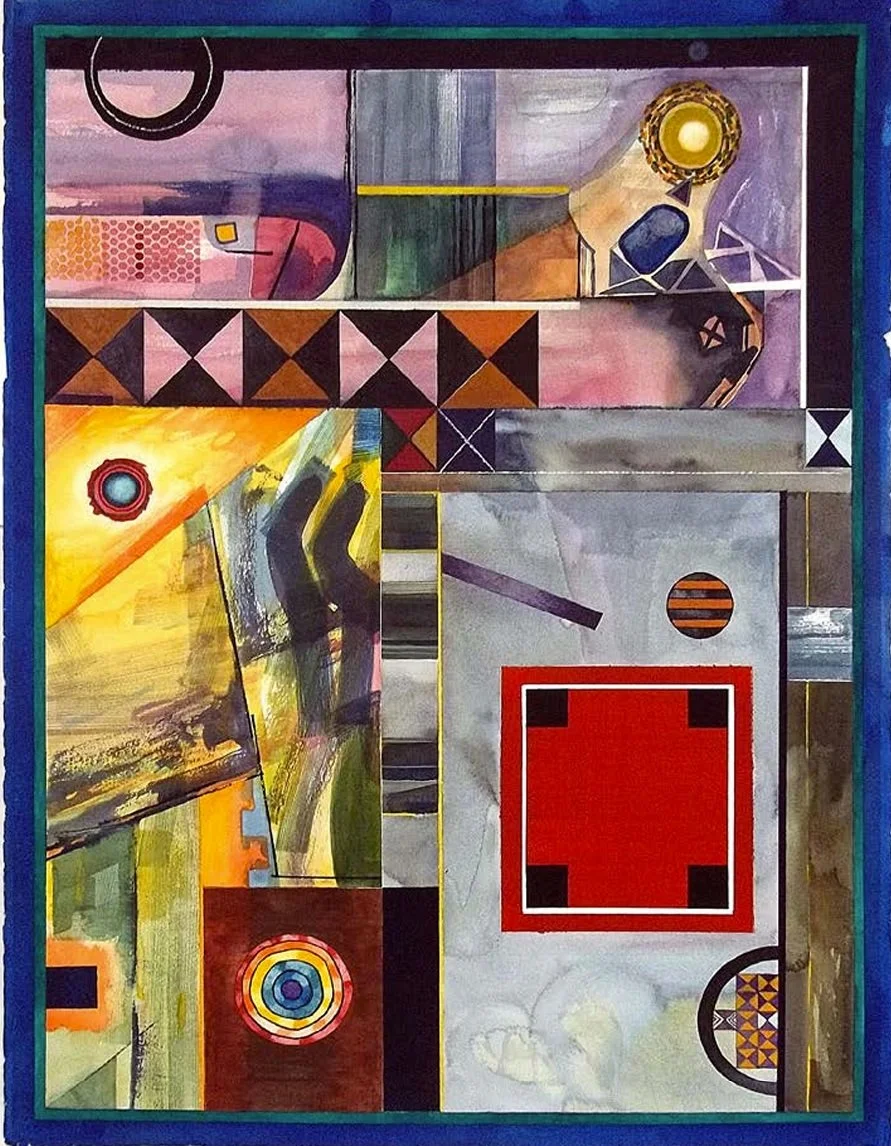
Take PC #16
You describe yourself as a Geometric Abstract Intimist. Can you explain what that means? Is that a label that you’ve invented yourself, and are you the only one?
I don’t know if I’m the only one, but I deal with geometry in my work. I think an intimate relationship and an ongoing dialogue exists between my work and myself. I’m a nonobjective painter, but I do relate to reality in a sense. Sometimes I think of my work as looking through a window or walking through a doorway, and I use those proportions in my work. It also has to do with spatial concerns. I agree with Hans Hofmann that his use of forms and colors still contained the suggestion of movement—and movement is the pulse of life.
How long have you been exploring your current style?
Oh, I’ve never given that much thought. I think it’s built up over sixty years. In my earlier years, I was a representational painter and had an empty feeling when I tried to portray things like a camera. I wanted more freedom and challenge and went in the direction of abstraction.
Is watercolor your main focus now, or do you continue to work with other media?
Watercolor is my main focus. At times, I take a break from it and focus on creating water-based monotypes that I began exploring way back in 1979 or so. I think I was one of the early practitioners. I decided to try water-based printing, because it seemed safer and healthier than processes that deal with solvents and oils. I name my work as monotype assemblegraphs. That allows me to print the image only once. Before exploring water-based printing, I employed multiple color block printmaking that involved registration of blocks. One of my oil-based monotypes was selected for the New American Monotype traveling show in 1978-80, and in the catalog I was across from Robert Motherwell. That made me feel good. Lately I’ve been combining watercolor with a product called Createx. I like exploring and combining things that aren’t supposed to be together, so it’s a growth process. You learn as you go, and you try different things. At times my monotypes inform the creation of new watercolors.
When advising artists, you tell them to do the best they can with the gifts they have. What are your gifts?
I think I’m a colorist. I’m influenced by artists’ thinking in the 19th and 20th Centuries, so I focus on collage-space, contrast, and the integrity of the picture plane.
You say painters should try to arrive at a value with the fewest applications of paint.
We work on white paper, so we release light. And the more layering you do, the less light you have. So I’ve tried to retain the sense of light in my work.
What colors are the most enjoyable for you to work with?
Most of the time, I work with the bright, rainbow colors. Yellow, yellow deep, orange, red light, alizarin, purples. I like all of those colors.
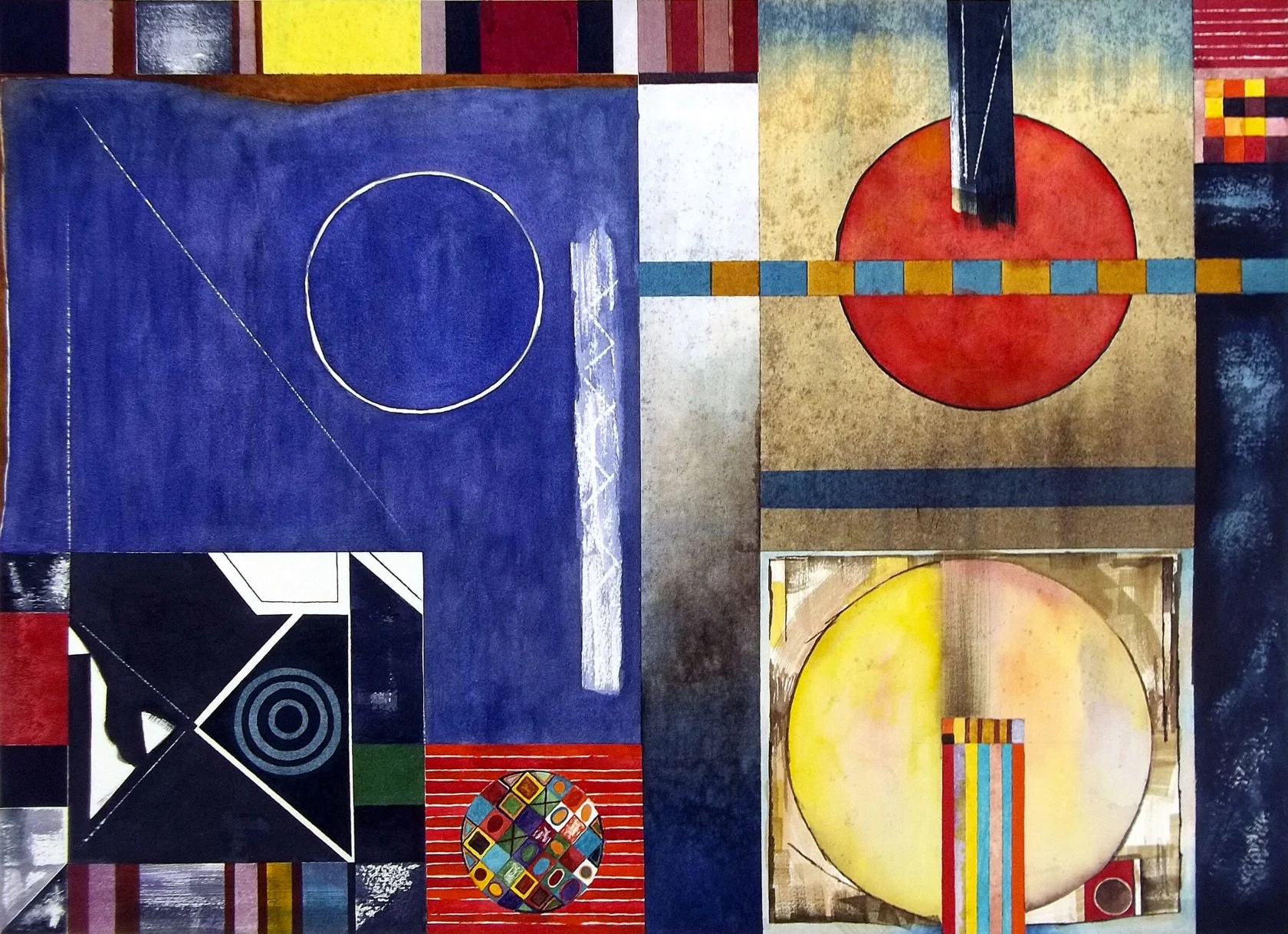
Take PC Open Book #4
Do you have a favorite brand of paint?
I use Daniel Smith paints most of the time. I want to try that QoR brand. I used to use Grumbacher, and I grew up using Arches paper.
Do you still use Arches?
Yep. Since high school. My criteria for paper is that it has to be 100% cotton, acid free, mould-made, cold press, and bright white. I also use Saunders Waterford (England), Fabriano, and Kilimanjaro (Italy). I prefer to work on full sheets of 300 lb. paper so I don’t have to worry about stretching them. All I do is push-pin the paper to my Exterior Homosote board. Most of the time, it’s a vertical format. Some of my older work is smaller just because I happened to have frames that I wanted to use. But Leon Golub, an influential artist, once told me, "You’re not gonna be famous unless you work larger".
You’ve been known to piece a few unsuccessful watercolors together into triptychs with horizontal compositions.
Yeah. I’ve made three or four really wide landscape-style triptychs. I cut those paintings up, taped them together, and repainted them. And it seemed to work.
What’s a watercolor technique you love that you don’t see people use very much?
Right now I like imprinting textures. I like to use a sponge or I’ll take a leaf and paint it and transfer it. That’s because I’m also a printmaker. I also rely on positive/negative stencil patterns. My painting is an accumulation of drawing, painting, and printmaking skills. It all comes together as good gestalt.
What’s an average workday look like for you?
Well, I teach a lot. So I have the weekends to paint, and in the summers I can create a body of work. I’m more focused in the summer and work four or five hours a day.
Do you prefer to paint during the day or at night?
Oh, I’m a night owl. But I do both based on my need to develop a new painting.
Is it hard for you to paint in short bursts?
I don’t have a set painting schedule during the school year—just when I can find the time. So I paint in short bursts. Except as I get older, my biggest problem is getting distracted by a framed painting I might have in the studio. And I’ll go, "Oh, shit. Now I’ve got to take it out of the frame and change it". I’ll make the necessary changes, and I’ll be happy with them, but doing that is a lot of work. When I was younger, I believed that once you’ve painted something, you can’t go back. But as I get older, I want to change things. And then I have to watch myself when I try to enter shows, because I might use the old image I’ve saved on my computer. And I’ll think, "Oh, wait a minute. That’s the wrong image. I’ve got to get the new version".
Do you change the paintings dramatically or just little things that are bugging you?
I don’t think any of the changes have been dramatic, but they’ve been essential.
Do you ever feel isolated when you work, or is it more of a refuge for you?
During Covid, people were stressing out right and left because they didn’t know how to deal with being alone. That’s one of the great things about being an artist. You’re always alone in the studio dealing with your work and your ideas, and you feel comfortable. It’s therapeutic. So Covid didn’t bother me.
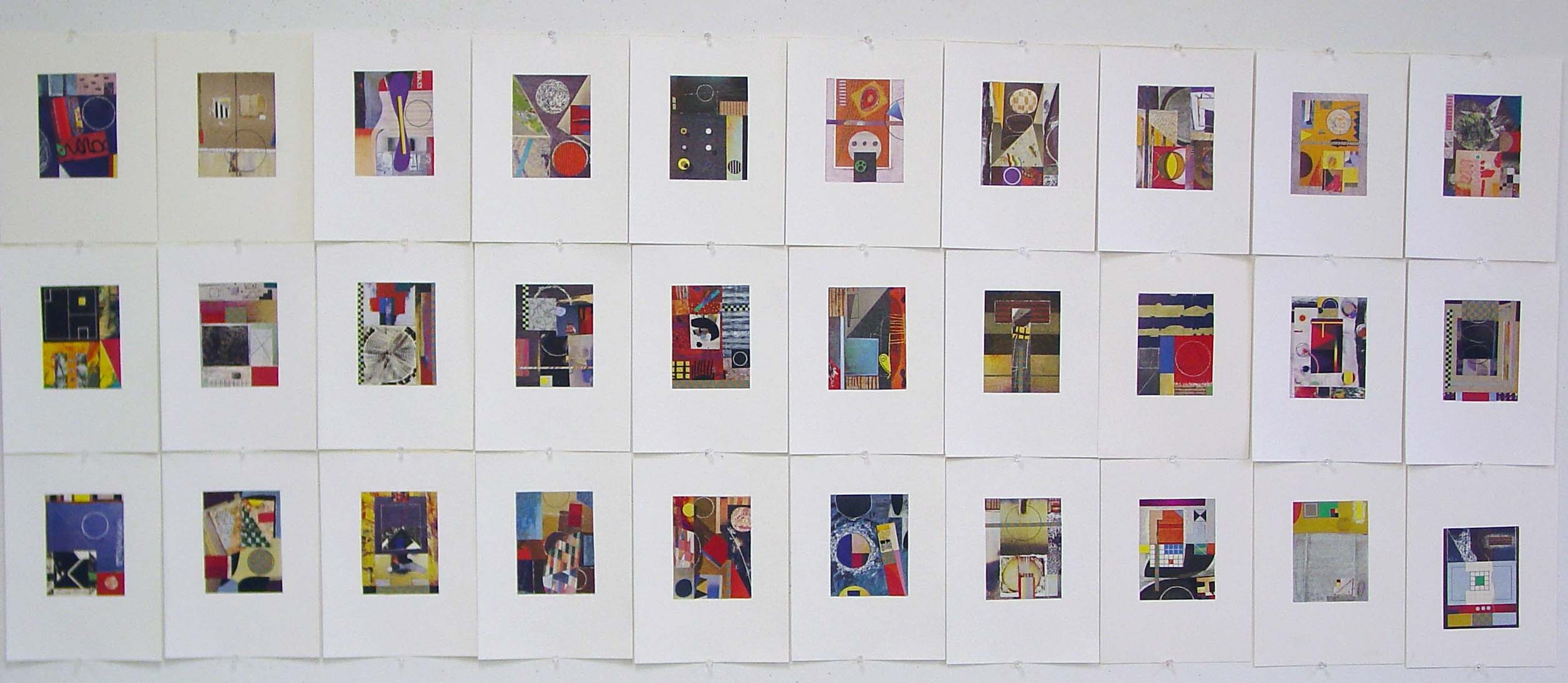
Wall of papier colle studies.
How long do your paintings take to complete?
It’s hard to tell because I might spend four hours on one and think it’s done, and then I’ll come back and then retouch it for another hour. And then two, three, four, or five years later, I’ll come back and think, "Oh, I’ve got to change it again". So I’m not on a set schedule like some people are. My son was asked how he knew when a painting was done; he had a great answer: when it is sold!
Do you work on one at a time, or do you have several going?
I usually work on one at a time. I set out with my thumbnail sketch, and I’ll spend an hour or two drawing. I call that the skeleton. Then I spend time figuring out where the "muscle" is going to be. Sometimes I make a list of different techniques that I could use. Then how will I finish the painting in terms of detail? I always say design first, and detail last.
When do you start thinking about colors?
I try to create a color solution I think will work with that skeleton. I used to do this in a sketchbook; I’d draw skeletons with pen or pencil and write notes alongside them. Maybe I should put green here, or maybe I want a certain texture there. Most of those sketches were very simple. Eventually I switched to creating a series of 6"x4" papier collé pieces to plan future paintings, and they’re all cut out and glued down. Magazine clippings help me visualize the colors. I’ve made a lot of these, and many of them are not paintings yet. But they’re ready to go. I put the ones that have inspired paintings in a folder so I’ll know they’ve been used. Of course, when I create the painting, I’ll make adjustments. I never copy my papier collé pieces exactly.
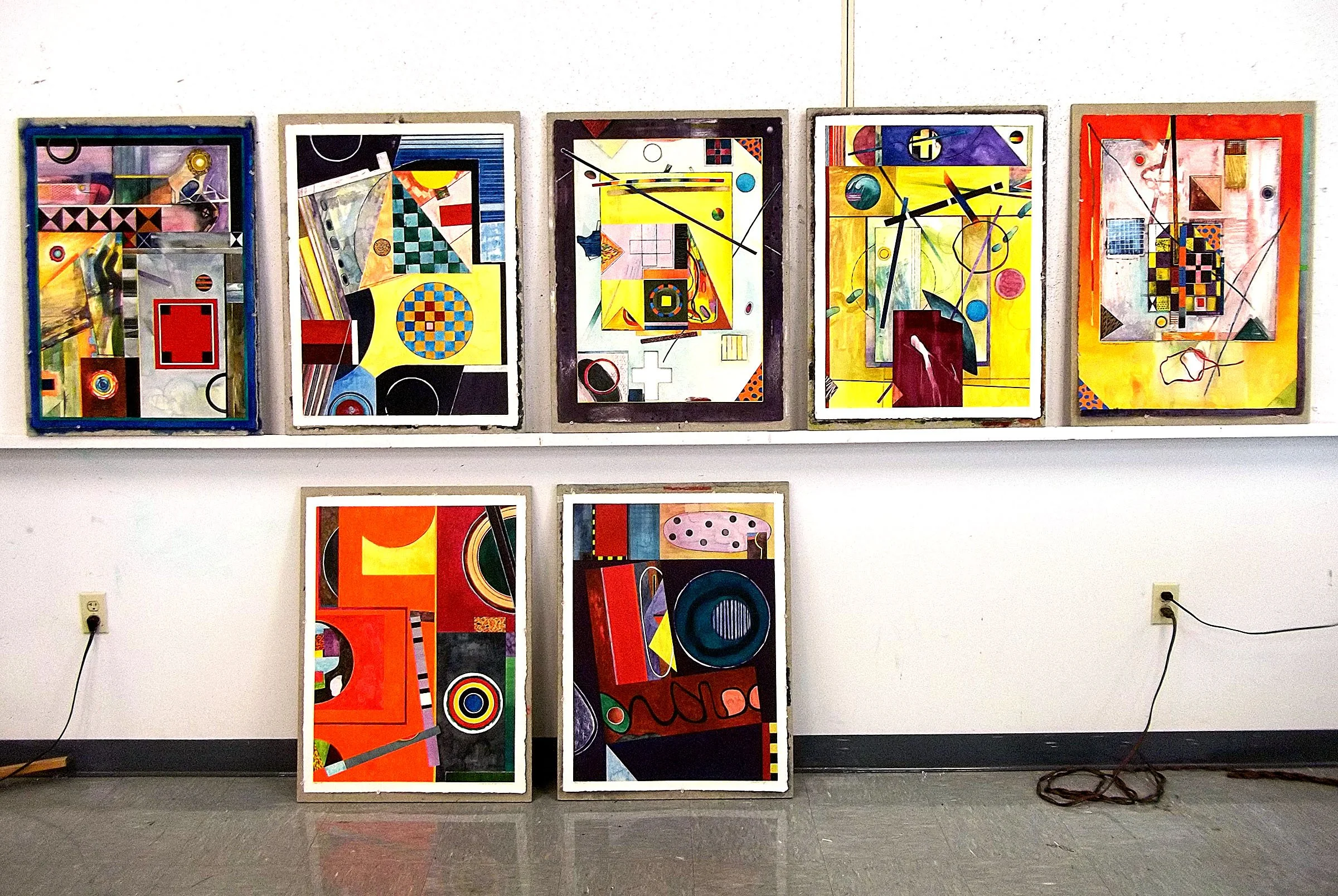
Several works in progress in Mejer’s studio.
You must have a gigantic collection of magazine clippings.
I have a big box of them. And I also use parts of monotypes and watercolor scraps. I’ll cut those up and eventually make collages with them.
And you call these clippings your vocabulary?
Yeah. They trigger ideas. Occasionally I’ll put two collages side by side and create diptychs from them. I call those my Open Book series of paintings. I have a couple of other ways to plan my paintings. Sometimes when a monotype doesn’t work out, it might become the impetus for something new. Also I teach graphic design, and one day I asked myself, "Why am I avoiding the computer in my own work? I could use it as a sketch tool". I’ll take a picture of an in-progress painting and use Photoshop to work out problems by doing color fills. So I’ll try a pink border, and then a black border, and then a green border. And eventually the border I’ll actually paint is the one I resolved on the computer. This really speeds up the painting process.
Which is more interesting for you? Planning the painting or executing?
Executing. That is the fun part. It’s about discovery and having a dialogue as I work. I’m talking to the painting, and it’s talking back to me, and I’m going, "Wow, this is fun". But then sometimes I’ll say, "Man, this is harder than I thought it was gonna be". Watercolor can be unforgiving if you want to make a major change. But the amount of preparation you do gives you a structure that helps you stay on track. You have to have an idea that’s worth pursuing. And if you don’t have it, you’ll struggle and struggle. That is one reason why it’s important to create thumbnail sketches. You can work out any problems that you might encounter pursuing that idea.
How often do you become frustrated with a painting?
Not as often as I thought I would. But occasionally I’ve got to pay a price, you know? Once in a while, there will be a bummer, and I’ll have to admit it’s not going to work. I’ll put the painting up and come back the next day and walk in the door with fresh eyes. All of a sudden, I’m enlightened. Or I’ll go, "Oh, that’s bad". Right now I’ve got about three or four paintings that I’m not happy with in a portfolio, and I’ve kept them just to challenge myself. Can I pull them off? I really believe that art is about problem-solving, discovery and finding your own voice.
You use universal symbols, such as triangles, rectangles, checkerboard patterns, and circles in your work. I also see lots of plus signs. Or are those crosses?
I leave it up to the viewer to decide which one they want. I had a lot of squares in the beginning, and then lately I’ve moved towards circles and tied them in with the squares. Occasionally, I’ll throw in a triangle. I like the X sign because it could be a cancellation sign, or maybe it’s a crossroads. Same thing with a plus sign; it’s something positive.
Is there a code to your symbols? Could somebody crack your code and interpret what you’re trying to say?
I don’t think so.
Do you want your viewers to interpret your paintings at all?
Yes. The experiences you bring to viewing the painting are what matters. Some people have limited views and some have broader views. But ultimately my paintings are about myself and my discoveries, growth, and insights. Hopefully, my work contains feelings that reach the viewer and they connect with it.
What do you love more, watching watercolors interact with each other or pulling a print for the first time?
Oh. Both are important to me regarding how the medium behaves with each process. I love pulling the print because I don’t know if it’s going to work. I don’t know if I’ve got enough pressure. I don’t know how the paints will interact. I don’t know if that painted paper shape I put in there is going to glue itself to it or if it’ll fall off.
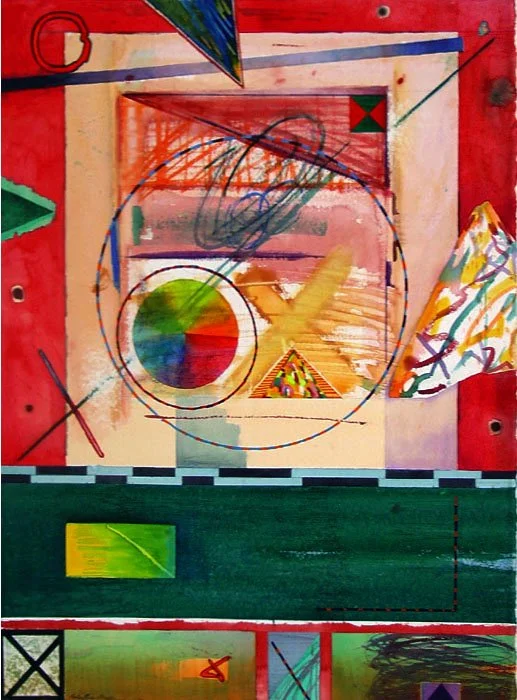
Variant Zig-Zag
Your paintings in recent years have become increasingly colorful and uplifting. Do you think they reflect your life at this point?
Yeah. I would say so. I mean, I’m content where I’m going. I think of color as life and life as color. A world without color would be so boring.
And you’ve been teaching at Quincy University for something like 57 years?
Since 1968. Everybody’s asked me when I’ll retire. And I’ve told them that it’s not in my vocabulary. Why would I want to retire if I like what I’m doing? Also, I like sharing and interacting with the youth; it keeps me feeling young.
Has being an artist helped you deal with tragedies?
I guess I keep them separate. It’s a place to go to if I want to be alone and if I want to reflect and if I want to explore. We all have tragedies. When my son died [artist Jason Dillard Mejer, 1969-2014], I had my family come in and just said, "Pick one of his works and take it with you". Because I still have most of his artwork. Whenever I encounter it, I feel his presence. I took a one-week workshop with Miles Batt, and his son is following his footsteps. I told Miles I liked his work, and he said, "Well, I like your work, too," so we made a trade. And the thing I remember most from his workshop was when he said, in response to the idea of repetition, "Your work has to have difference". Yeah. "It has to have difference". So that’s the beauty of meeting other artists. You see how productive and how involved they are, and you discover that you have similar ideas. I take advantage of meeting artists that I so admire, and many times we end up trading each other’s artwork.
Do you think four years of college is enough time to master the rules and then start to break the rules?
I believe taking many types of art courses in college helps you gain a wealth of visual vocabulary, various processes, and insights that will feed your imagination and creativity as you seek your own voice and medium with passion. I’m still trying to learn how to master the rules; it never ends. Make a discovery; try to master it. And then you don’t want to be so successful with it that you start repeating yourself, because then it’s not fun anymore. You are no longer challenged to grow.
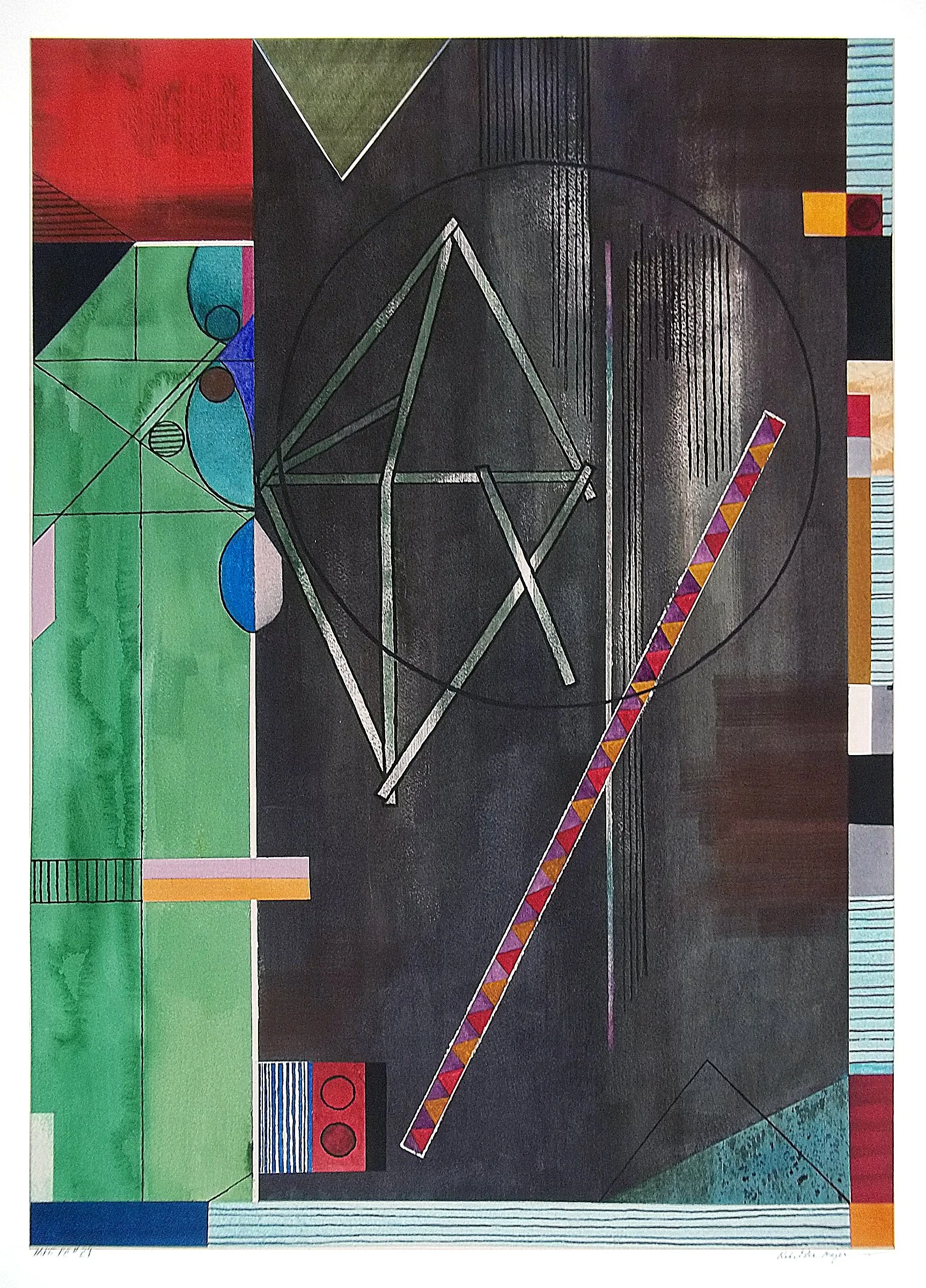
Take PC #29
Would you like to talk about your legacy as a teacher?
Oh, I don’t know if I have a legacy. I just keep plugging away. What makes me happy, though, is seeing former students out there, still growing, and hopefully having taken something away from me. For nineteen summers I taught watercolor and monotypes at Skidmore College in Saratoga Springs, New York. One summer I taught a class of high school art teachers. Last week I received a postcard from one informing me of her show in New York where she showcased thirty monotypes. She wrote on the postcard, "Thank You," and "My Mentor" and drew a heart next to it. She informed me that two of her monotypes were titled Ode to Robert Lee Mejer I & II. Earlier this year, a guy from New Jersey named Don Fletcher-Apprentice came to visit me regarding a book and two major shows on my famous friend, the potter Toshiko Takaezu. Toshiko was on the faculty at Princeton University (1967-1992). We were both visiting artists at Skidmore College during the 90s, and she approached me one evening to teach her how to create monotypes as a relief from doing pottery all day. We worked together for several summers in the print lab, and she produced many. While curating her show, Don was not aware of the process or how the prints came to be. They were shown in Columbus, Ohio, and credit was given to me. She always left me a wonderful pot after each session. I received the most comprehensive book on her life as a "Living Treasure of Hawai’i".
How does it feel to receive a lifetime achievement award from the Watercolor Honor Society?
Shocking and humbling. But it’s nice because I turned 80 on the day I learned about it. It’s a great eightieth birthday present. I am most grateful! Many times I say that I had good people at the right time and in the right place who supported me, encouraged me, and taught me. I’m so happy to be here. It is important for me to pay it forward! That is the beauty of being human. Like a conductor I orchestrate my paintings in order to create an inspiring visual sound and enlightenment via color. I love this quote by Kandinsky: "Color is the keyboard. The eyes are the harmonies. The soul is a piano with many strings. The artist is a hand that plays, touching one key or another to cause vibrations in the soul". How about that?
Here is a video of Bob talking about his life’s work, along with a demo of his printmaking process.