
Marilynn Derwenskus’ work is experimental, joyful, and liberated, but with an underlying structure, and those words describe her personality as well. Her most well-known work frequently incorporates unique textures created by multiple pours filtered through porous paper. Then details such as figures, architectural elements, stripes, and checkerboard patterns are added. Born in 1937 in Detroit, Michigan, this artistic pioneer will receive a Lifetime Achievement Award at Watercolor USA for 2024.
This interview originally appeared in the Spring 2024 Watercolor Honor Society newsletter.
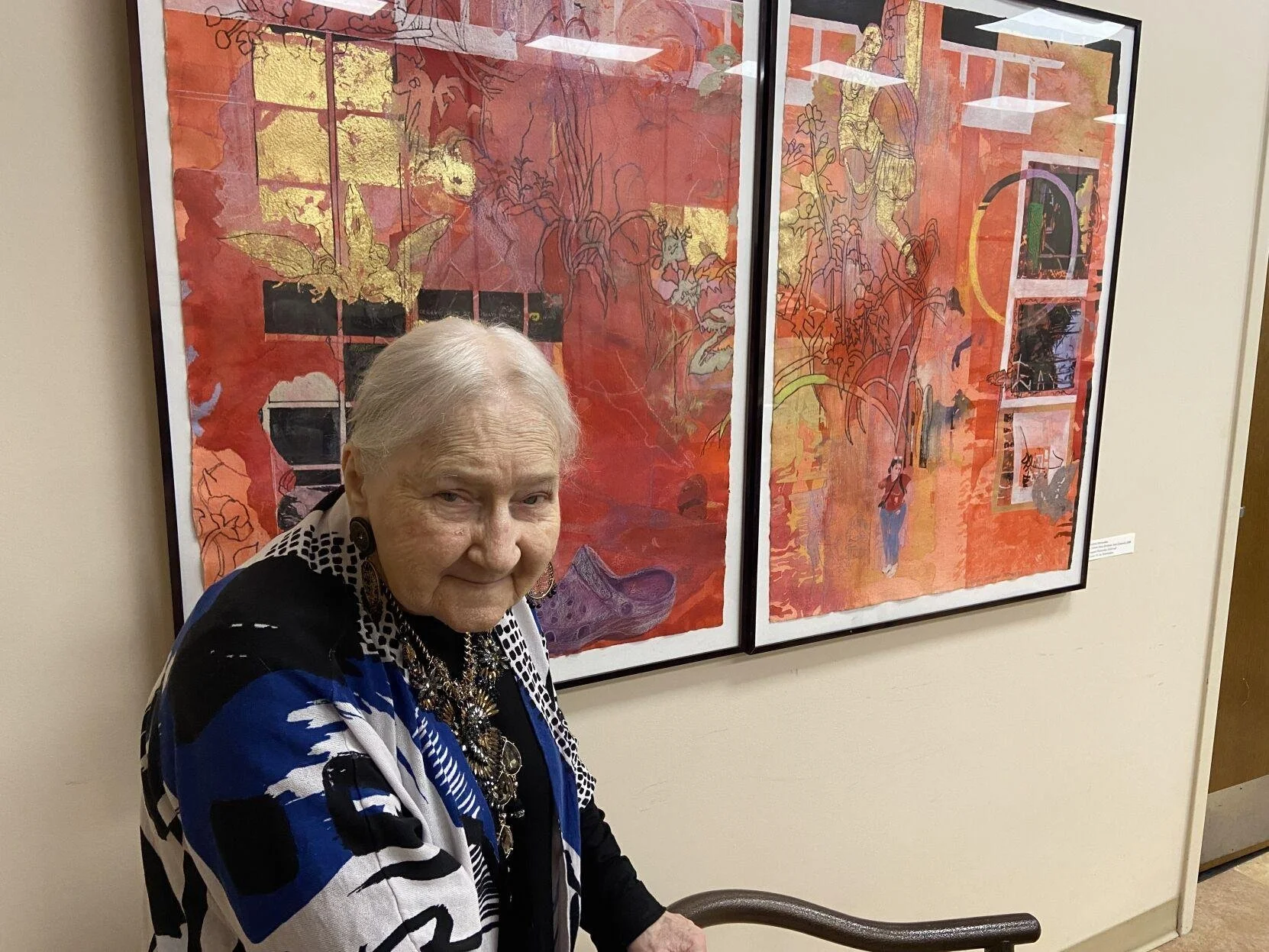
You attended Wayne State University in 1955, where you studied with experimental watercolorists Mary Jane Bigler and Louise Nobili. Did your instructors ever give you the impression that watercolor was a lesser medium than, say, oil painting?
Yes. That was the case when I was in school, and I think it still exists. I don't think it's gone. But Mary Jane Bigler definitely tried to change that, and she was one of the founders of the Michigan Watercolor Society. She encouraged us to join, saying it was a professional organization and not a social club. So I joined, and I'm still a member.
You spent your twenties and thirties raising a family and teaching, and then you explored postmodernism during your MFA studies at the University of Chicago in the 1980s. What inspired you to move from pure abstraction to what you call lyrical abstraction, which is abstract expressionism that includes recognizable elements?
The only thing I knew back then was abstraction. Postmodernism was a whole new idea. I was excited to discover it at the University of Chicago, and I had very good faculty members. They encouraged new ways of thinking about art. My main painting advisor was Robert Peters, a multimedia artist who used found objects. One day as he was leaving my studio at the university, he said, "You have to use differences." After the door closed behind him, I opened it and chased after him saying, "Bob, Bob, wait a minute. How different can it be without the loss of unity?" He said, "Don't worry about unity. You're making it. That's the unity." So I thought those were outstanding words, and I told my students that constantly.
You had heart surgery when you were 47. You were not expected to live, but you did. How did this health crisis change your art?
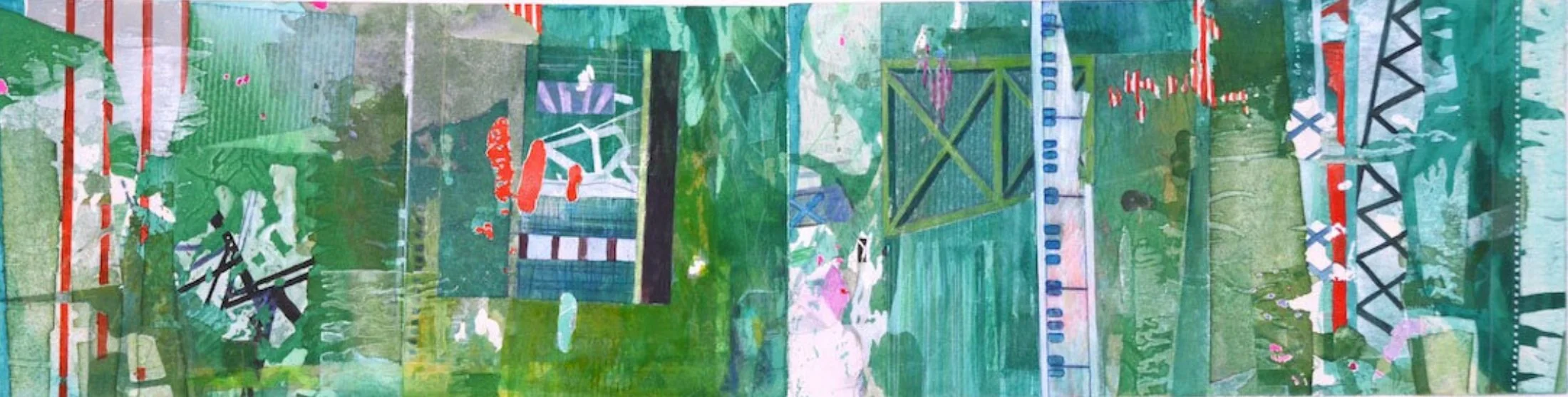
Chicago Buildings and Bridges in Spring
Art is my life. Everything I do is about art, even ugly things. I painted pictures of myself during the surgery. My brother asked me, "How could you do that? You were unconscious." I said, "That's true. But I was still there." I had a gallery show of the work that came out of this, and I was excited about it. One of the paintings was of my doctor, and I included the letter A in it. He thought the A meant "excellent." But he didn't know the A was for "arrogant." He bought the piece.
After earning your MFA from the University of Chicago, you were a painting professor at Ball State University in Muncie, Indiana from 1988 to 2008. What courses did you teach?
I taught watercolor when I arrived, and I think design. Eventually I taught only watercolor and encaustic painting. They built a new facility with ventilation appropriate for encaustic (inhaling the fumes is dangerous). We were the only university in the United States that offered an opportunity to major in encaustic.

Life in the Big City
Can you describe a favorite assignment that helped expand your students' understanding of what was possible with watercolor? Did you have a lesson you always used to teach that was a hit?
Well, first of all, I will tell you I never repeated an assignment.
You didn't? Oh my!
I did not. I was teaching art, and art's creative. So I always changed what I taught because I wanted the students to be creative, and I didn't want them to do the same things over and over again.
Were your art department heads okay with you constantly improvising your curriculum?
Truthfully, at one point they gave me a really hard time. I thought I was going to lose my job because I was focusing on content instead of technique. There are four parts to every work of art: subject, content, composition, and technique. I taught technique, but I didn't focus on it. So when that happened, I was nearly in tears thinking I might lose my job. But I went back to my corner and told myself, "I'm going to make my own work so strong they won't be able to get rid of me. I'll try to win awards." And I did that. So I was there for twenty years.
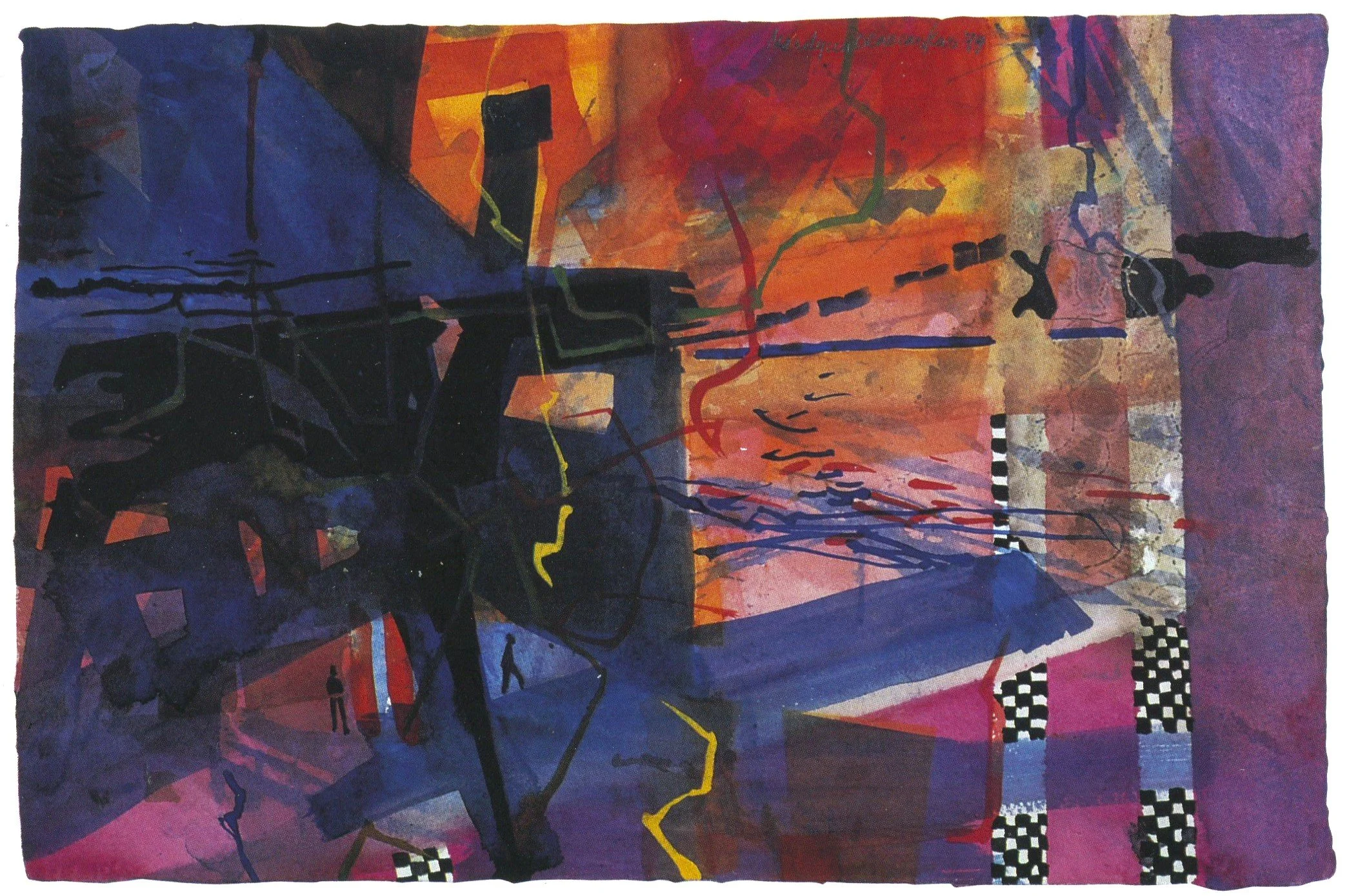
Not So Long Ago
By all accounts, your students love and revere you and have stayed in touch. Would you like to say anything else about your legacy as a teacher?
I can't tell you how often I walk around my house saying, "I love teaching. Oh, I love to teach." It's my life.
After you retired, you moved to Chicago, and you're currently in Nashville. What does a typical day look like for you?
I have a schedule, and part of it has to do with some health issues that get in the way. I wake up in the morning, and I have to take some medicine that makes me use the bathroom too much. So I can paint in the morning, and the medicine starts to take hold around lunchtime. During the afternoon, I just stay in my bedroom, close to the bathroom, frankly. And then I go back to my studio after supper and paint. Sometimes I'll paint for a total of ten hours each day.
Wow!
Well, I'm sorry. I love what I do! And once I get going, it's hard to stop.
And you don't get worn out physically?
I don't think about myself when I'm painting.
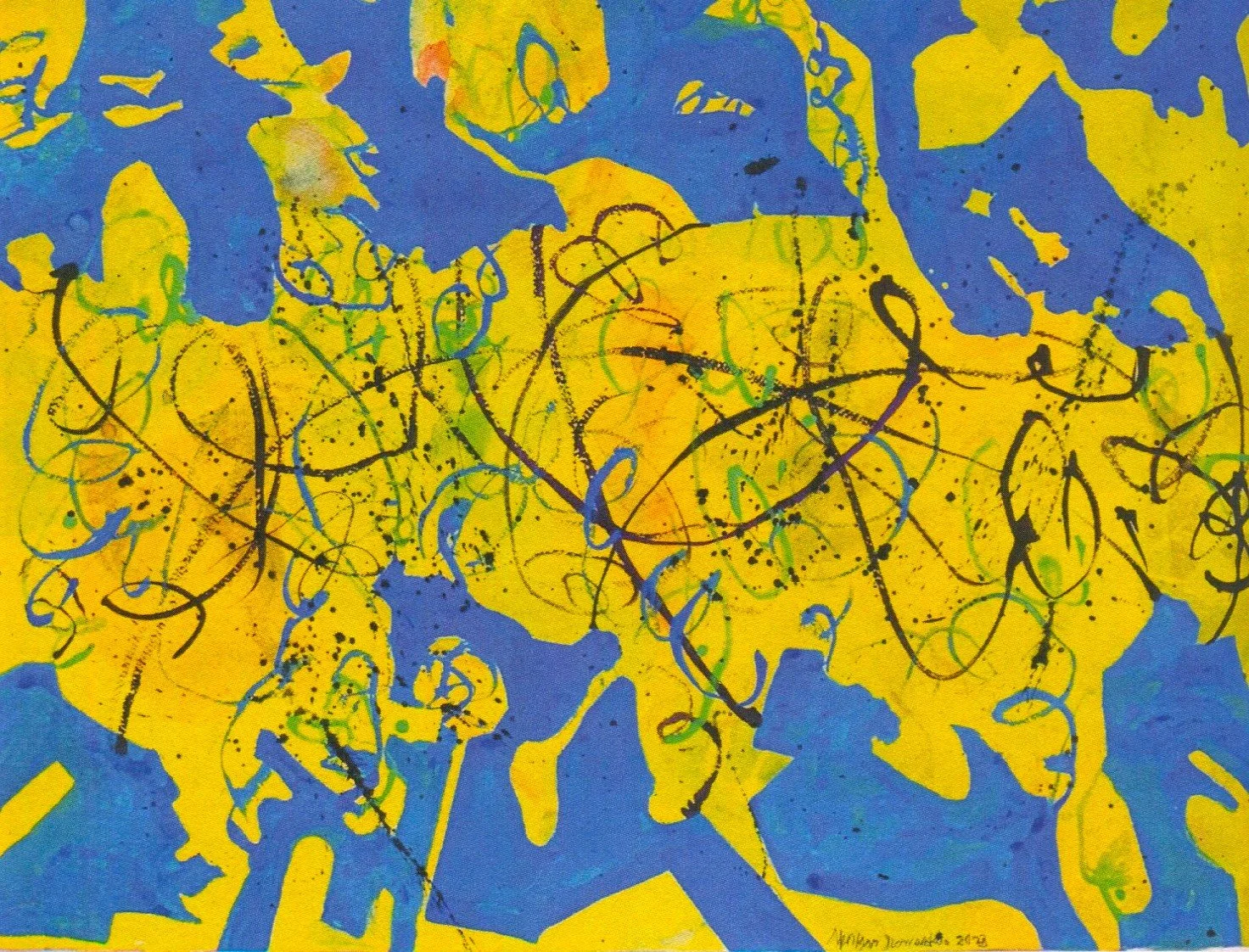
The Unfortunate Ukraine
When I view your work, the painter in me tries to figure out how you create your beautiful imagery. I feel like I'm an archeologist who's sifting through the layers in your paintings. They almost remind me of sedimentary rocks, and I can see the passage of time in your work.
I like finding new ways to add different techniques. So I'll start doing something one way, and somebody might call me up and ask if I knew that so-and-so was copying my work. And I'll say, "Well, it really doesn't matter because I'm already onto something else." I don't stay in the same place.
I think many artists live in fear that some kind of health issue will make it physically impossible to paint. In 2019, you suffered a fall that broke your (dominant) right arm, wrist, and hip. But you said that quitting art was never an option. How did you manage to bounce back? What kinds of adaptations did you come up with? After a fall like that, some people would've said, "Okay, it's time for the rocking chair."
I said, "This is not the time for the rocking chair. I've got to find a new way to paint because I can't do it the old way." I could hardly hold a brush, and I struggled and struggled. How could I make the kind of imagery I wanted with control? Eventually I came up with three steps. Want to know what they are?
Of course!
A long time ago, I used self-made stencils in my work. I created them from thick watercolor paper or cardboard. So I started working with stencils again. To begin a new painting, I place the stencils on my paper and trace around them. Then I paint the background and work around the stencils. This produces imagery with a little bit of control. Then I lift off the stencils, and the shapes they created stay white. Next I add squiggly lines using different kinds of rigger brushes. These have long, short, thick, or thin bristles, and they make a variety of marks. Those marks never go on the white areas. Finally I make droplets using a big brush with a lot of fluid in it. I tap it and let the drops fall on the paper, and I move about and place them where I want them to be.
Is this done mostly with gouache?
Completely gouache. I don't use transparent watercolor.
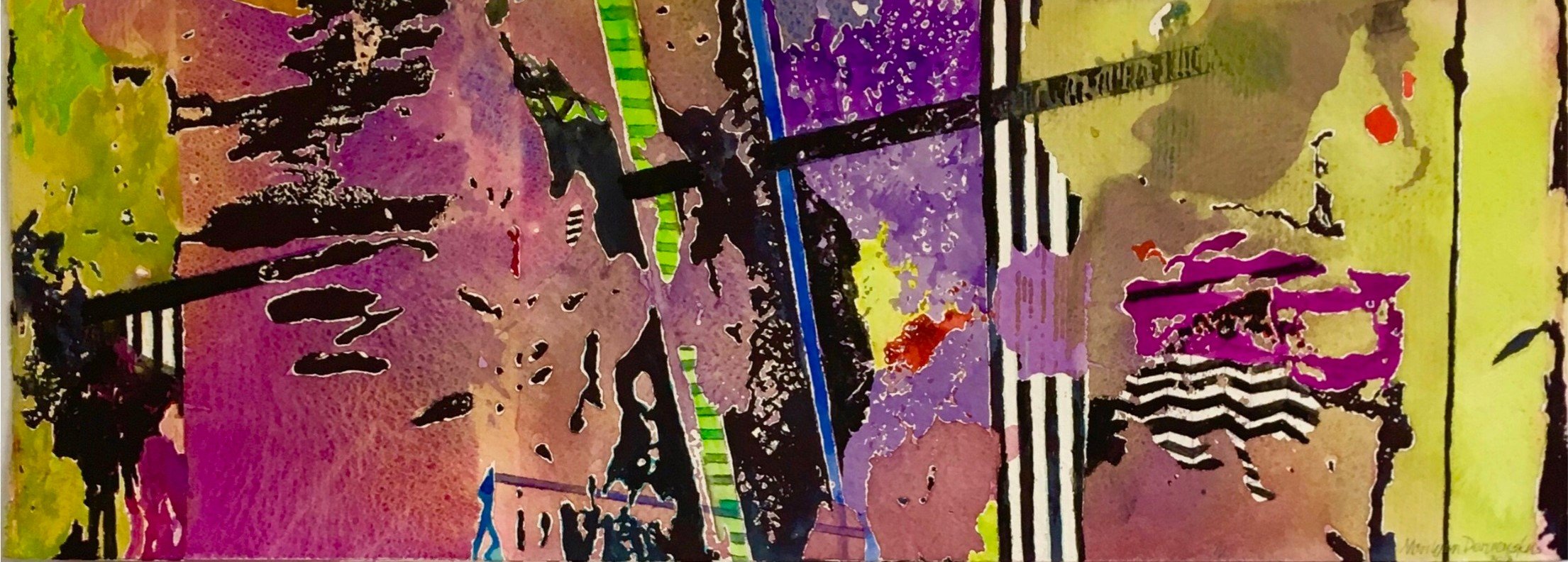
Spatial Configuration
Are you loyal to any specific art materials such as brushes or brands of paint?
I won a Grumbacher materials award at a show a long time ago. And I thought to myself, "I don't want any supplies I'm just going to use up. I want a trophy!" So I selected a $300 brush. I have it to this day, and I gave all of my students the opportunity to see what a good brush feels like when you paint. That brush is a special thing. I show it to people and say, "See this brush? It was my trophy."
How do viewers react to your work?
I'm going to receive a lifetime achievement award from Watercolor USA, and two years ago, the Michigan Watercolor Society gave me a similar honor. So now I think some people are thinking, "Wait a minute, she might be a good painter." I think they're looking at my work more carefully than they used to. I've noticed that my family is all for whatever I'm doing. They want to see it, and they never used to ask about it. Now that some recognition has been applied to the work, they're trying to figure out why that is.
Have you had to deal with sexism in your career?
I haven't let it exist in my career. I think sexism was present when I was teaching at Ball State and when the women's movement was very strong. At first I joined a women's art group, and then I thought, "You have to do this. You can compete with men." And I did. I'm sort of bullheaded about the idea that women can paint as strongly as men.
Art sales from your most recent exhibition are funding a painting scholarship. How is that going?
It's coming along pretty well. I was told that in order to offer a scholarship, I need to have $10,000. Well, I don't have any money. I live at my daughter's, and she even pays my phone bill. I live like a queen. But I decided I was going to do this. So I had an exhibit last October, and the money from those sales will go to Ball State. So right now I'm not quite there, but I believe I'm going to make it.
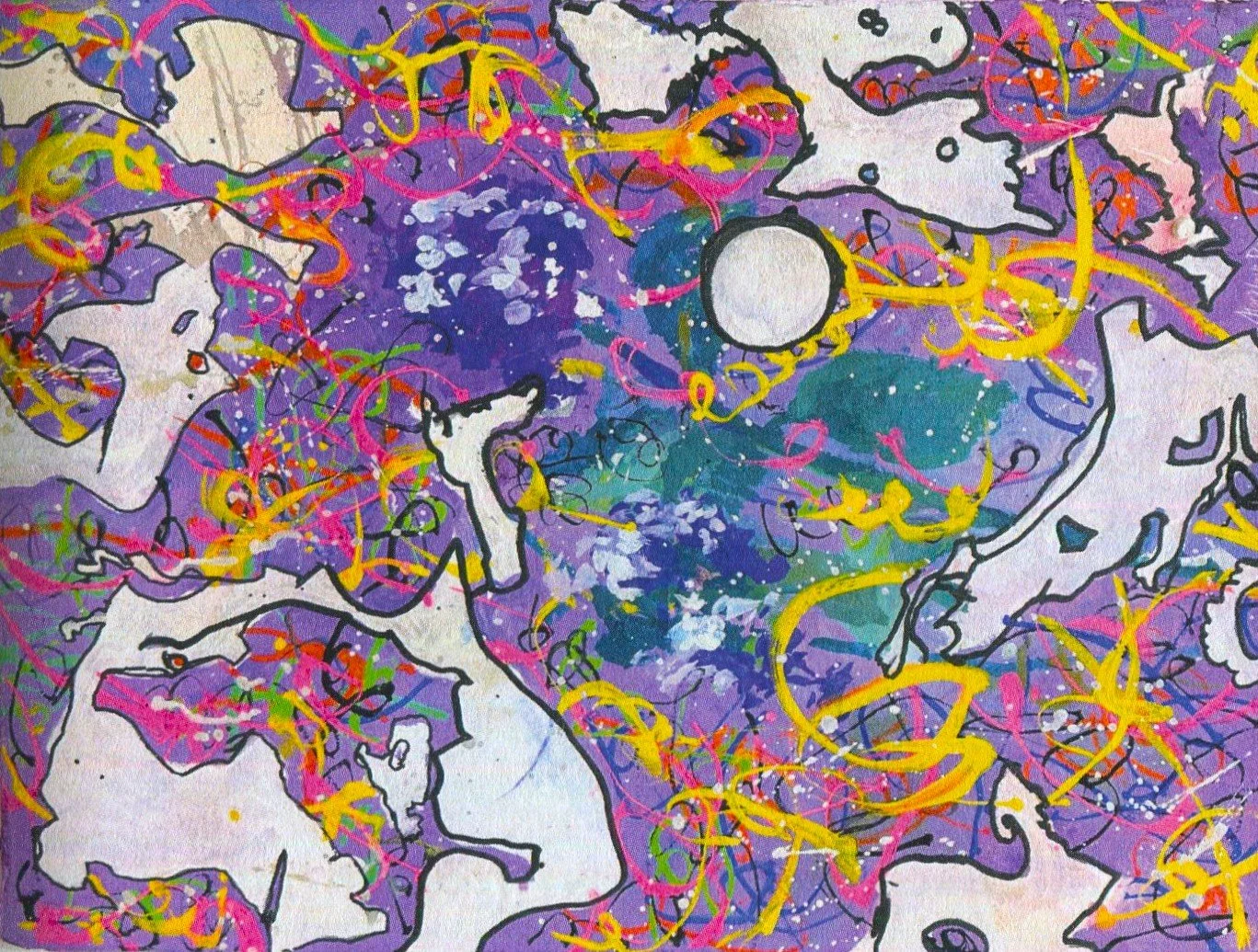
What’s Going On in the World
And you intend to write a book, too?
I haven't decided on the title for the book, but I do plan to write it. In fact, the state of Tennessee has become involved. They heard about my work when physical therapists who came to my house saw me in my studio covered with paintings and brushes. I think they realized the seriousness of my dedication. So they sent someone from the state of Tennessee to see me, and they're going to help me get a new computer or some kind of device that can take dictation. The book will be about my life and art. Because art is life, and life is art.