
“Talk about an opportunity.”
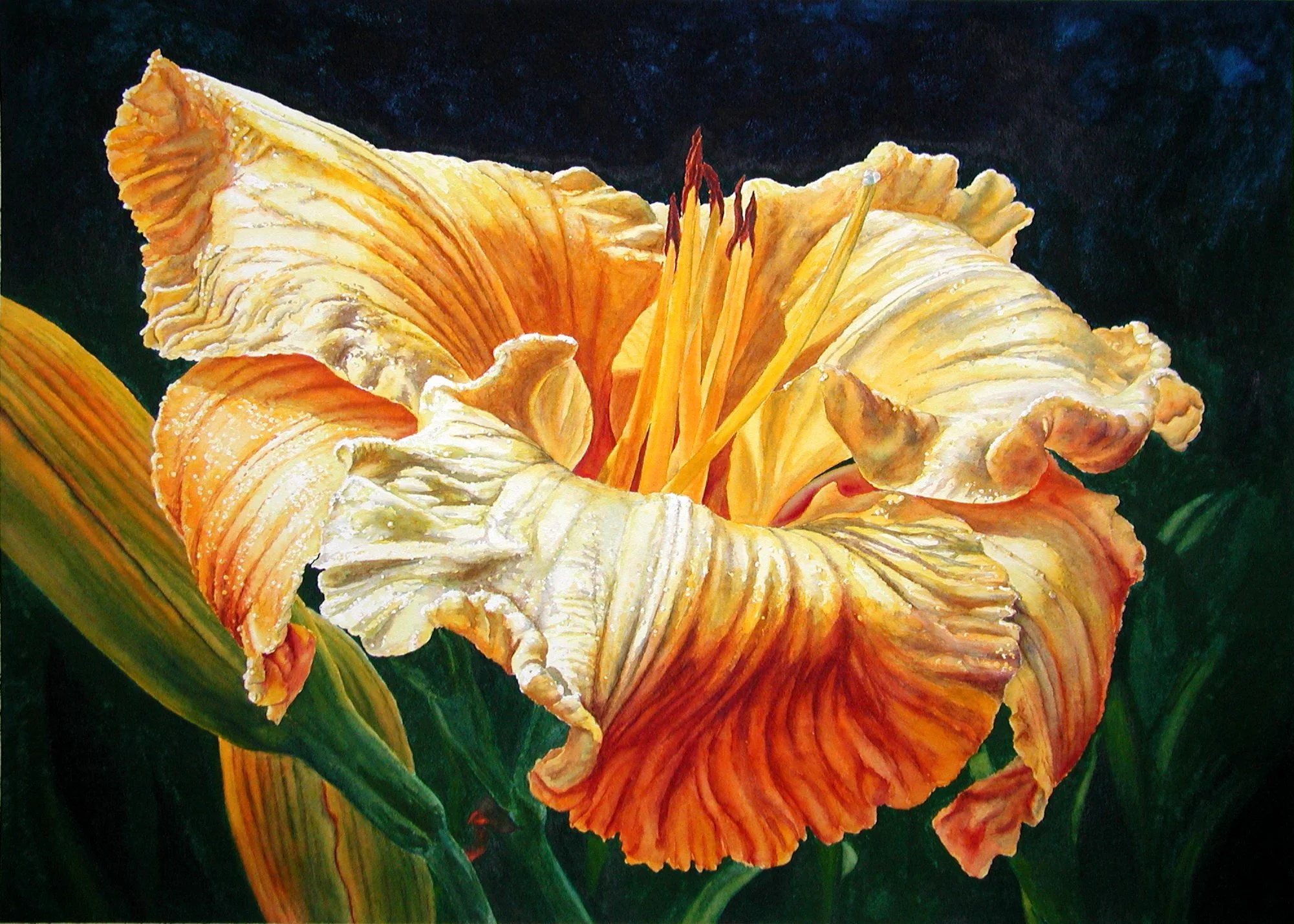
Yellow Day Lily
You’ve said the elements that go into making good architecture also apply to good paintings. Did you have to un-learn anything from your architectural training in order to work with watercolors?
No, because none of that involved brushes and water. It was all drawing, so everything from my architectural training was directly applicable to watercolor. The architectural drawings I did were very precise, so the only way I can paint is very precise. I’ve tried to paint loose, and my head just doesn't work that way. My doctors tell me that at some point my hand might start to tremor as I age, so maybe one day I'll become a cubist.
Your earliest still life watercolors featured flowers. Later you wanted to incorporate silver and crystal into your paintings but couldn’t find any instruction on how to paint these with watercolor. How long did it take to teach yourself?
Well, I know this sounds really weird, but it didn't take any time. I could just envision it. In Gwen Bragg’s class, when she’d show us that day’s subject, I drew it in a third of the time of anybody else. And then she would say, “Well, Laurin, here's how to wet your brush, and here's how to fade that edge.” And I could just do it, no questions asked. I also realized that the major myth in watercolor is that if you make a mistake, you can't correct it. There's nothing further from the truth. Once I found out that I could correct anything I did, I was free. I don't have to correct many things, but if I do something that is not right, I know how to fix it, so I'm just free and easy out there.
Given your background, were you tempted to paint city scenes or interiors a la Vermeer during those early days?
No. I decided that I would pick a subject that would teach me to paint difficult things I was not familiar with. I'm very familiar with straight lines. I can create the most elaborate perspectives and the most complex pen and ink drawings. I decided that curves were my challenge, so that's why I picked florals. I figured that if I could master painting shadows on petals and leaves and things like that, I could master anything.
You amassed a body of work before you began entering watercolor competitions, right?
I eventually discovered that not only were there watercolor societies, but those watercolor societies had competitions, and if you were going to show people how good you were, that was the route you had to take. I had no idea there were over 263 watercolor societies.
I visit New Orleans every year or so, just to eat for a few days, and I became familiar with the work of Dean Mitchell. He showed his paintings at the Blaine Gallery there. I bought one of his books, and his bio said that he was a signature member of sixteen watercolor societies. Well, that must be the standard, I thought, and I started entering competitions. The Tennessee Watercolor Society seemed like a good place to start. I entered two florals, and they both got in the show, even though only one was supposed to, and they jointly won first prize. Over the next four years, I didn't do anything but enter competitions, so that's how I ended up with sixteen signature memberships.

Silver Service with Magnolia
Noticing that there was no shortage of floral watercolorists, you felt the need to find a unique subject to paint. You landed on subject matter inspired by the Dutch artists you admired during your time in Germany. And you asked yourself, “Is that level of realism possible with watercolor?”
I was living in Mississippi at the time, and there was a lady friend. Everything involves the other sex, right? We hit it off. I moved down to live with her, and she had a rental house on her property. I used that as a studio. Her great grandparents and other relatives had come from Poland and places like that, and they had brought silver services, Chinese porcelains, and other beautiful objects. I started setting them up. I did one silver pot just to see if I could paint silver, and yeah, I could. And so the set ups became more and more complex. Then I started adding crystal because, you know, what can be more difficult than painting colors bouncing around in a cut crystal vase? And really, none of it was challenging. There's no two ways about it. I mean, I had to work hard at it, but it wasn't what I would call difficult.
You also began submitting your work to American Artist and Watercolor Artist magazines and landed on their covers. Did you enter paintings in the magazines’ various competitions, or did you pitch articles?
One of the things I did for all of those architectural firms was to represent them to the press. And twice a year I went to New York and met with the senior editors of Architectural Record and other publications and showed them the projects we had coming down the pike. I knew how to talk to editors.
So I put together a portfolio of my florals and mailed them to Steve Doherty at American Artist. Of course, I didn't hear anything back. But three months later, I was in New York visiting those architectural magazine editors. It was coming up on lunchtime when I noticed that I was in the same building that housed American Artist magazine’s headquarters. So I walked over to the secretary there, and I said, “Would you ask Mr. Doherty if he has a minute to see me?” And she got flustered, dialed his number, and handed me the phone. Talk about an opportunity. So I said, “Mr. Doherty, this is Laurin McCracken. I just had meetings with—” And I name-dropped two of the top editors of those architectural magazines, right? I'm not stupid.
And he said, “Laurin, you're not going to believe this. I've got your portfolio in the middle of my desk, and I've been studying it. But right now I have a meeting. In fact, I'm late.” A moment later, he said, “I'm coming down.” Two seconds later, he walked out of the elevator and said, “I really am late, late, late for a meeting. But I want to follow up, yes. I want to talk to you about an article.” We shook hands and eventually ended up having a great telephone conversation. About two months later, I was back in New York. Steve and I went to lunch, and he reached into his coat pocket, pulled out a roll of paper, and handed it to me. I took the rubber band off. It was an eight page article on me, and it was the cover story of the magazine.
That’s amazing.
And this is what I keep telling people: you’ve just got to show up. You can't do it by letter. If you really want to get in somebody's mind, you’ve got to get in their face. Otherwise you're going to be just another person in the deck of cards that they're working with.
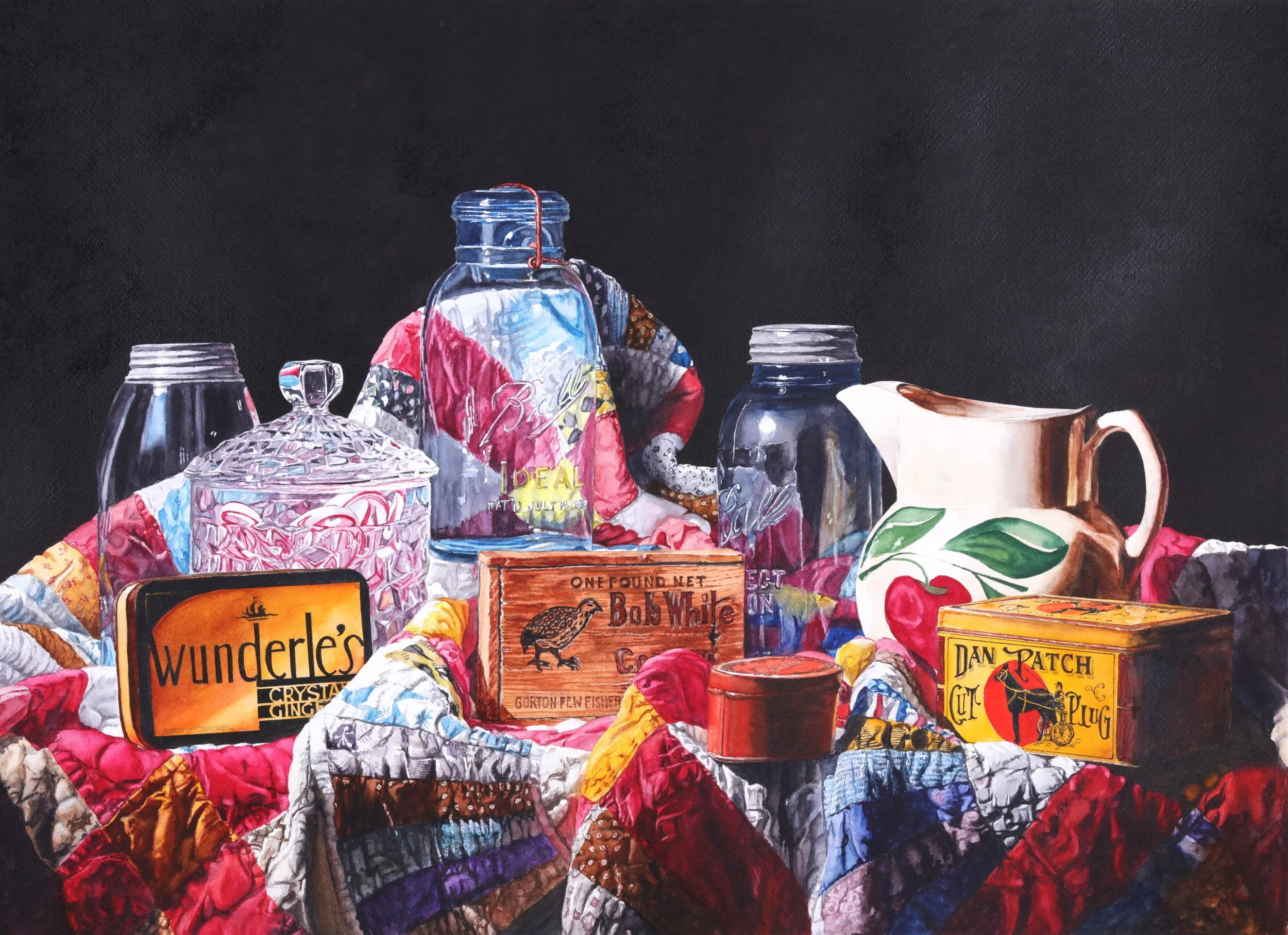
Objects on a Quilt
I don’t think anyone can argue with your three basic things a painter needs: the ability to see in a fresh way, the realization that drawing is fundamental in all art, and the work involved to become a master of their craft. The last two things can be achieved with a certain amount of discipline, but the ability to see in a fresh way seems like something you either have or you don’t. Do you agree with this?
I believe that I was born with all of those things in my head because they've come to me so easily. I certainly believe that everything but inspiration can be learned. The problem is that most people are not willing to work hard and spend enough time to master their craft. They want to do it once or twice and say they've learned it. Then it becomes The Wreck of the Hesperus, and they can't figure out why they can't get from A to Z. That's because they went from A to B to F to Z.
One of my favorite quotes from you is this: "Watercolor is a dance that involves the artist, the paint, the brush, and the paper. The artist must lead in this dance and hope that the very active elements of this medium will participate and enhance the effort. I enjoy the dance." When I look at your work, I see an artist who is in total control of this dance. Do you ever experience “happy accidents” when you paint? Do you ever allow your dance partner to lead for a while?
Oh yeah, all the time. And they're little things. But I can spend all day on a drawing, put it on my painting table, and just immediately see three things that are wrong.
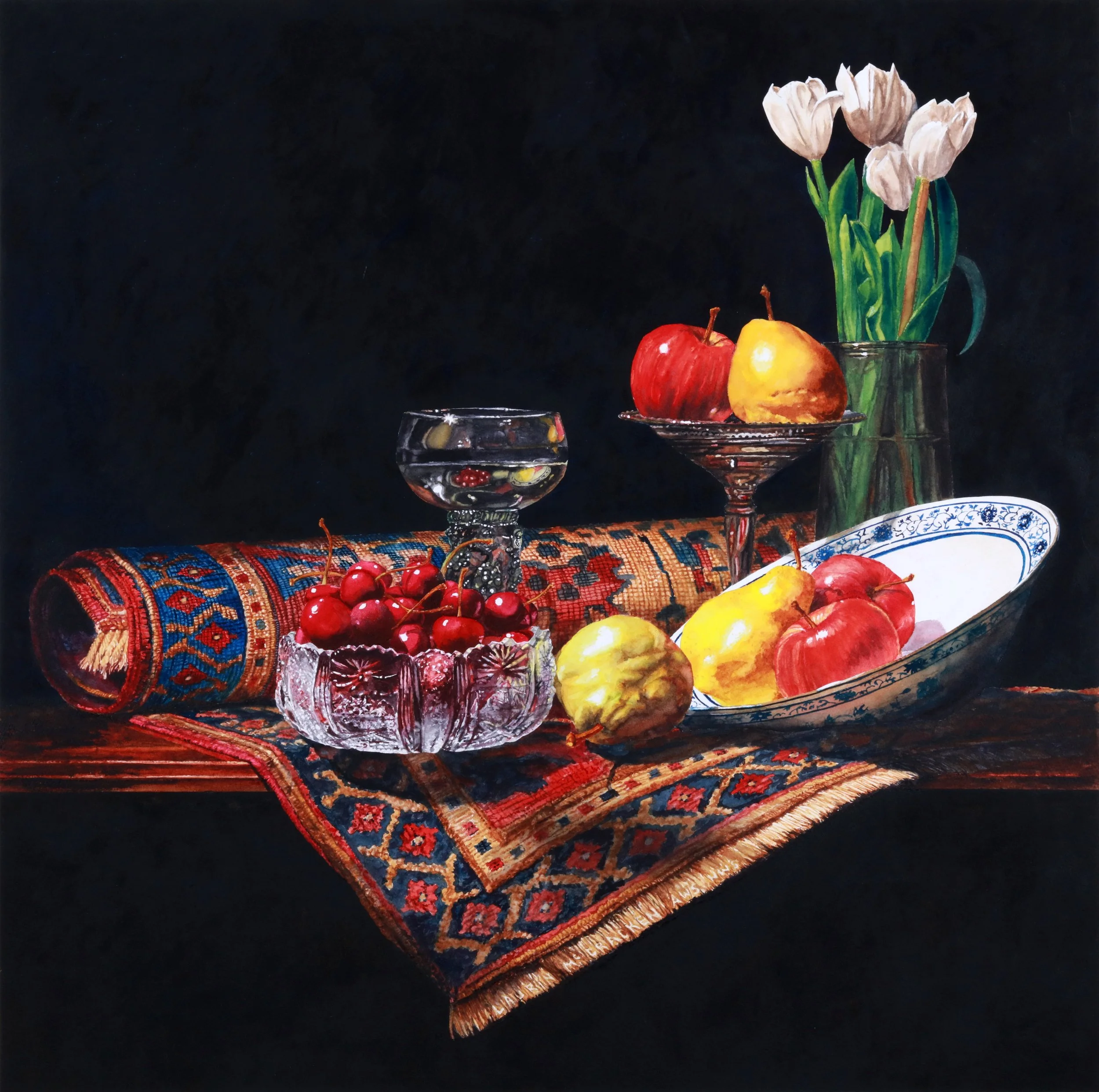
Still Life on Hand Tied Rug
You possess an enviable and some would say superhuman amount of energy. You show your paintings worldwide, and you’re a sought-after juror and workshop instructor. I’m still astonished that you managed to bring Fabriano in Acquarello to Fort Worth in 2024, and I’m sure you did the lion’s share of the work. Have you always been like this, or has your second career in art galvanized you in a special way?
I have always been the guy who brings people together. I had a little rock band in high school, and later on I formed a Glenn Miller-style dance band. When I was in marketing, I invited the fifteen best marketers in the United States to come to a Holiday Inn in Florida and talk about how we market architectural engineering services.
And now, about every other month, I invite a group of artist friends to come to my house, and we talk about issues unique to watercolor and critique each other’s work. I also have a Zoom group of a couple dozen artists who talk about what is happening in the art world today that's impacting either the business side of things or whatever is going on with us as a group.