
“It’s about doing it in a better way.”
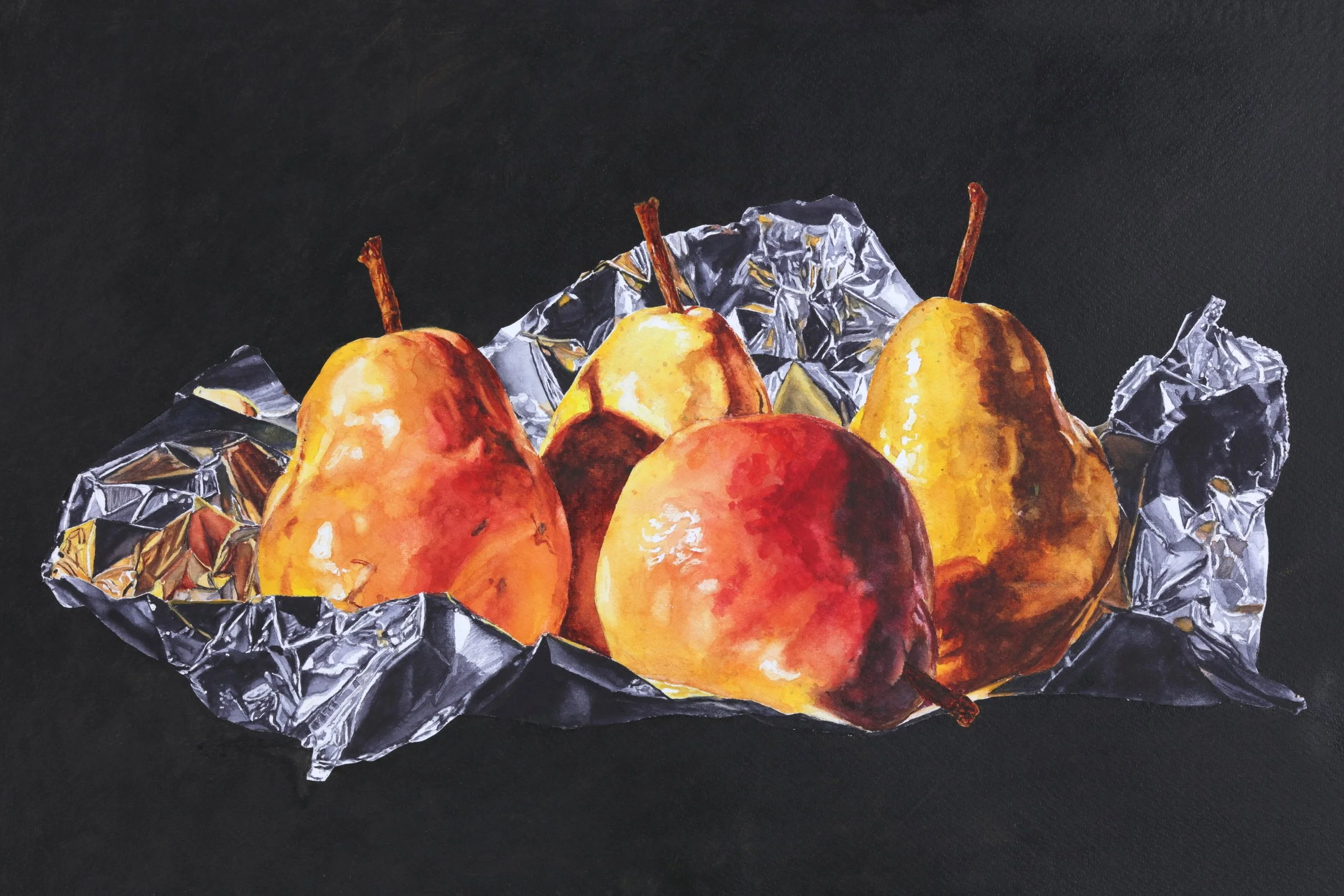
Four Pears on Foil
You work on the tiniest and most complex details in your paintings, moving slowly and methodically while living inside these tiny worlds. Your paintings can take more than a hundred hours to complete. Can I ask you some questions as we walk through your process?
Ask me anything.
First you set up your still life arrangements and take photos. How long does this process last?
Probably a couple of hours, I would say. This yields about 70 to 100 images, if I know what I'm looking for. If I go to somebody's house and they've got three or four things they want me to consider, I may come back with 300 or 400 images, but a lot of those are repeats or small adjustments.
In recent years, you’ve started incorporating modern items.
Oh yeah. That's what led me to work with aluminum foil. What could I paint that had today's product in it but also had a visual link to art history?
Your pieces of fruit wrapped in plastic bags are at once humble and breathtaking.
Exactly the same idea.
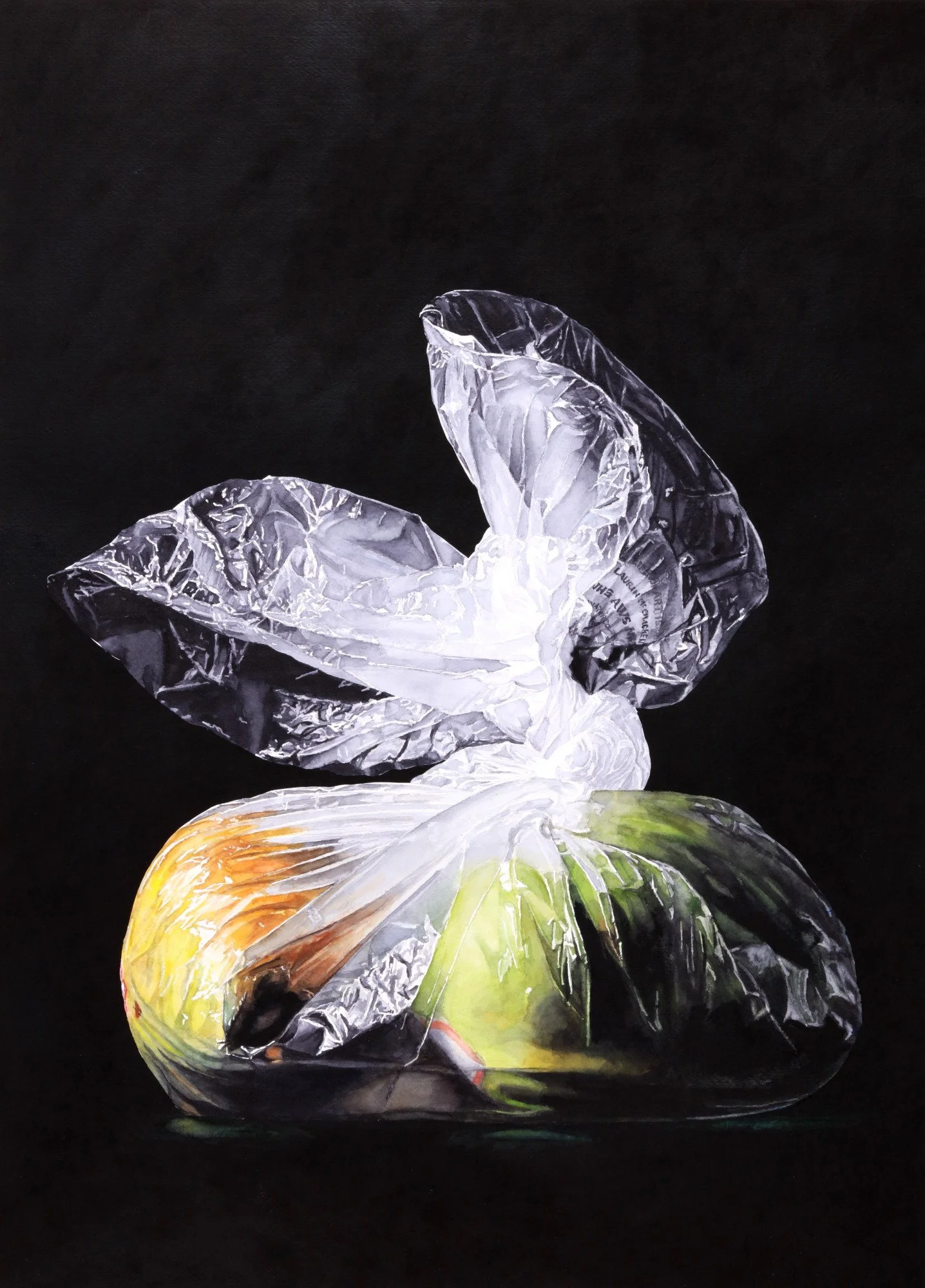
Pears in a Plastic Bag
After one lucky reference photo is selected, you use an LCD projector to trace the image onto your paper with a 2H mechanical pencil. When I first read that you work with a projector, I applauded. I feel like this is the equivalent of a movie star admitting to getting plastic surgery. Most of them do it, but they won’t own up to it. And I’m guessing lots of artists use projectors, but I’ve only heard of a few of us who openly acknowledge this. Would you like to speak on that?
Yes, and I have a good story. I did a step-by-step article for a watercolor magazine of one of my still lifes. In that article, I mentioned that I used a projector to create my paintings’ preliminary drawings. After it was published, the editor called me and said, “Laurin, your use of projectors has produced more letters to the editor than anything I've ever seen at the magazine.” And I asked, “Well, what are they saying?” She said, “The responses are about 50-50. Half of them are damning you, and half are saying, finally, somebody is willing to admit to this.” So the reason she was calling was not only to report that, but she also said that she had been talking with other artists in other mediums who use projectors. So she selected six of us to do an article for The Artist’s Magazine, and all of us told our projection stories. So for years, I walked around waving that article at people.
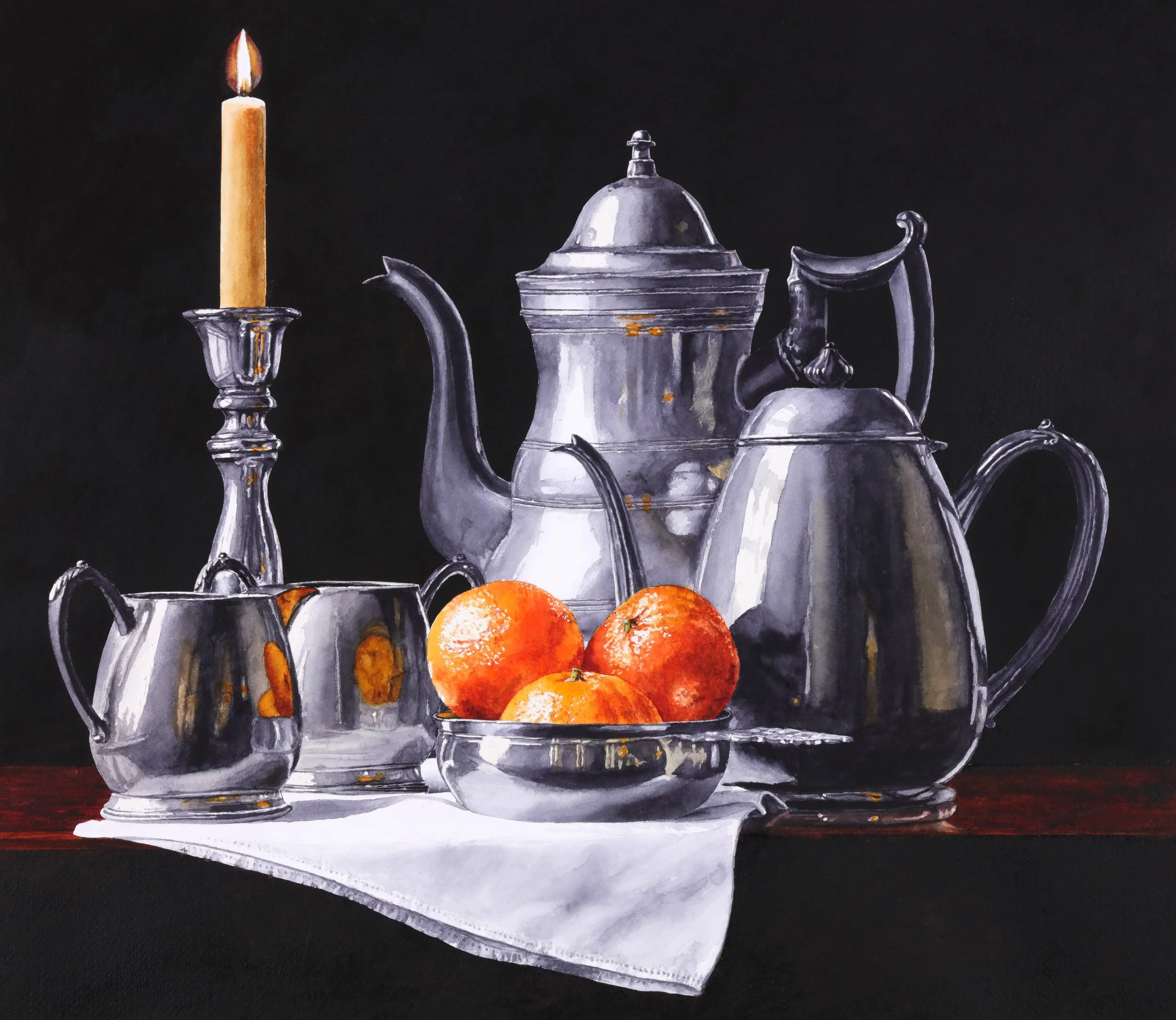
Clementines with Pewter
You begin painting the things that define the picture, such as clementines that will be seen reflected onto pewter objects in other parts of the painting. After that, do you have a system that tells you what objects to paint next?
I work left to right. Overriding that, I paint the most difficult thing first. And if there's something in there that I've never painted before, I’ll paint that first. Now, since I've done plenty of these foil things, I typically paint the objects that have multiple layers of color and work with wet-into-wet first. Then once they're absolutely dry, I can mask out that grouping and start on one edge of the foil and go around to the other. And I do the black background last.
You cover your entire painting surface with lightweight tracing paper to protect it from splatter. Then you cut out openings where you will be painting that day “much as a surgeon drapes a patient for an operation.” This is ingenious. When did you begin doing that?
In architecture, when you're working on a huge drawing, you mask it with tracing paper so you don't smear the areas you’ve spent two weeks on. The tracing paper is sort of translucent, so you can always relate what’s underneath it to what you're doing as a whole. I'm all about using any tool that will get me there, but it’s not about speed. It's about doing it in a better way that makes the job easier and makes the painting process more enjoyable.
What is your favorite part of the painting process?
Oh, I love the whole thing. There's no one part. It's such a progression from the time I'm considering an object to the point where the painting is finished.
Have you ever trashed a painting that just didn't work?
No. Since I've been painting seriously, I've never started a painting that I didn't finish and wasn't pleased with.
Do you work on multiple paintings at the same time?
I almost always have three or four in progress. I typically have two drawn, so when I'm painting one, I'm not thinking about the other. But you know, if I'm driving or something, I might start thinking about the second painting. So by the time I start that second painting, mentally I'm already into it.
You’ve said you like to work with warm water…?
This is another thing I’ve learned. One day I was painting in the dead of winter. The tap water was cold as could be, and my paint was just not behaving itself. And so I said, let me try something. I went back to the sink and let the water run until it was warm, filled my two containers, and took them back. Bingo. It was dead on. It's the second law of thermodynamics: things tend to go into solution faster the higher the temperature.
Escoda created a set of three watercolor brushes selected by you (Versatil synthetic Kolinsky round brushes in sizes #4, #6, and #10). Do you use those brushes most of the time?
Brushes are the biggest issue out there. There are good paints, and we have lots of papers to choose from, but finding the right brushes is a real problem, and they're very personal.
I happen to like Escoda brushes because they are the only people who still make them by hand. My view is that an Escoda brush has a soul.
While I use the Versatil brushes, most of the time I paint with their Chronos range. I typically use #4, #6, #8, and #10 round brushes, and for big areas, I use larger flats. Like every other artist, I probably have 400 brushes, and people like to send me stuff. I'll put those on the shelf, because nothing's going to compete with what I already use, and I'm not going to relearn what I know on a free brush just for their benefit.
In my workshops, if I see somebody who has potential, but they're struggling because they’re using the wrong brush, I have the ability to give them an Escoda Versatil or two and say, “Why don't you try these?” What a difference that makes.
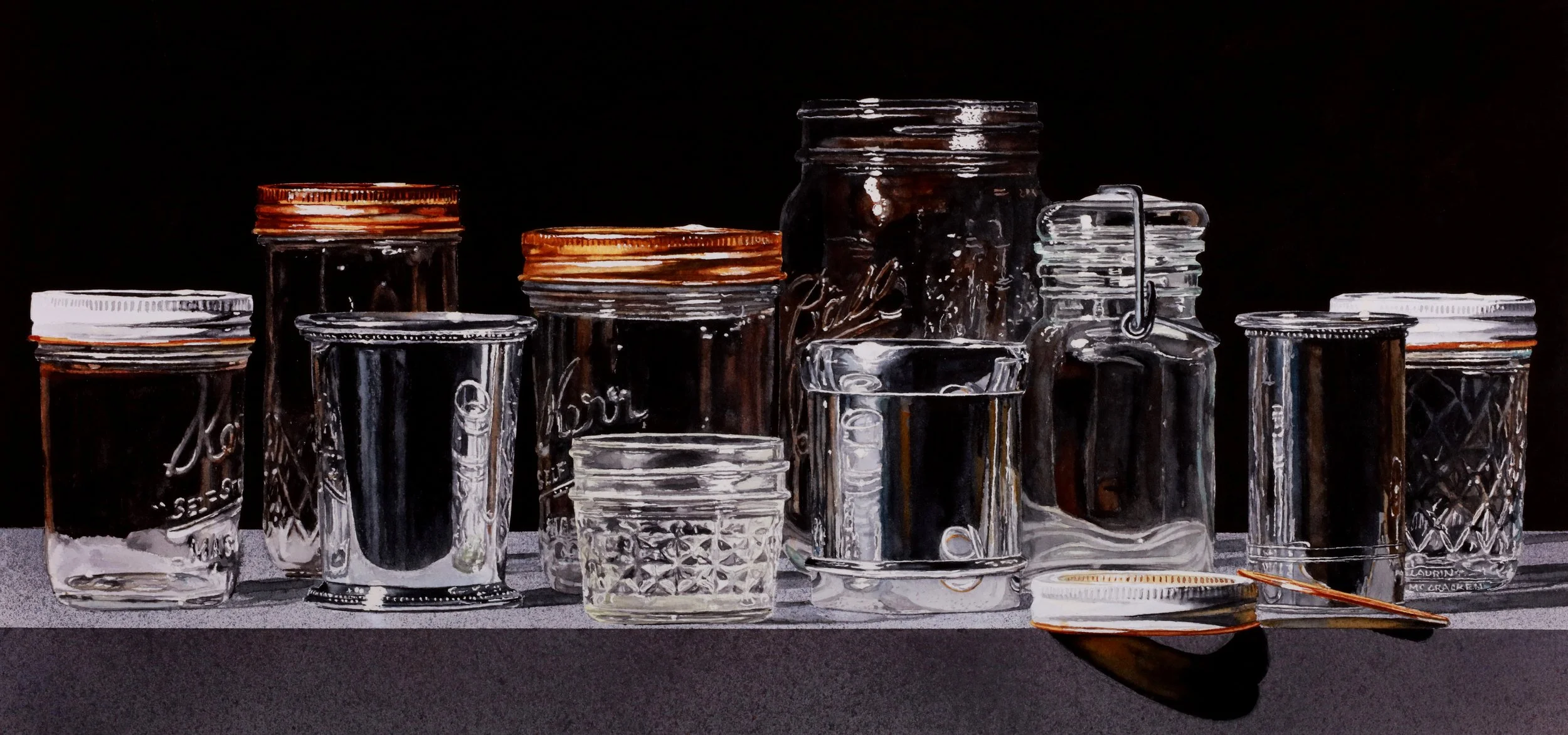
Glassware and Silver on Granite
What is an average painting day like for you?
Every now and then I’ll have an ideal day. By nine o'clock, I've had my coffee, I've looked at the emergency emails, and I'm in my studio. The water in my paint containers is warm and ready to paint with. I paint pretty continuously all morning without any interruptions except for changing my water, and I do that a lot.
I’ll have a quick lunch for fifteen minutes. I mean, I eat for sustenance, and some days I don't eat lunch at all. I’ll just drink a glass of water and try to lie down for about fifteen or twenty minutes. And then I'll work for two or three hours in the afternoon. If I'm really into something that's very detailed, like a lace tablecloth, I may continue to work on that. But if it’s time to move on to a new section, I'll use the afternoon to get the painting ready for the next day. I don't ever start anything that's new and fresh in the afternoon, such as the next pear, for instance, or a new bit of foil. If I'm lost in an area of foil I’ve started, I can still continue, because my mind is already in that place.
And then at 4:30 or so, I’ll stop and carefully clean the brushes I've used so they’re ready for the next day. I’ll make sure my materials are back where they're supposed to be. I’ll put the the #6 back where I keep the #6, so the next day I won't have to wonder where it is. The place I paint is very small, and it's like the cockpit of an airplane. I know where that X-Acto blade is. I don't have to look around. All I have to do is lean back and pick it up. Some people might think I'm crazy in this regard, but for me it's about being efficient and being able to move forward at a pace that is comfortable.
At 5:00, I’ll fix myself a scotch, get a small bowl of really fine mixed nuts, and sit and read for an hour and a half. And then I’ll fix my little dinner.