
This interview originally appeared in the Fall 2024 Watercolor Honor Society newsletter.

Hashtag Harmony
Could you please tell us a bit about your background? I know you grew up with parents who encouraged your artistic inclinations and that you were a talented math student as well.
My father was a USAF Officer (SAC), and growing up we were stationed in a new place about every two years, so I've lived coast to coast and abroad. It's an interesting lifestyle that left me feeling more like an observer than a participant. Yes, my parents were very supportive of my interest in the arts. They thought it was great that I wanted to dress up as different artists on Halloween. I still have my first painting (age 3) that my father framed and displayed in all of our homes.
I studied art at the University of Central Arkansas, and my favorite studies were watercolor, printmaking (specifically etching), mechanical drawing, and physical geography. I thought I could become a cartographer, but after four years I ran out of time, a.k.a. money. Eventually I became a fiber arts designer and technical writer for a magazine until I decided to paint watercolors full time.
When did you decide that watercolor was your medium of choice?
After my second time through chemo, I considered how I wanted to spend my remaining time. I told my partner I wanted to paint watercolors. He said, "Start tomorrow." I haven't looked back.

Off the Hook
Where do you live currently, and what does an average painting day look like for you?
I live in Rogers, Arkansas. My Choctaw ancestors were forcibly relocated to Oklahoma because of the Indian Removal Act of 1830, and most of my extended family still live in Oklahoma, which is a short drive from here. No matter where we lived, Oklahoma was always considered home. When I had the opportunity to move closer, I jumped at it!
An average painting day for me starts about 9 a.m. at my kitchen table which is situated near a large north-facing window. I tend to hyperfocus, so I usually stop when my partner tells me it is dark outside and I need to quit. Eight to ten hours would be normal for me.
Twenty Thousand Stones
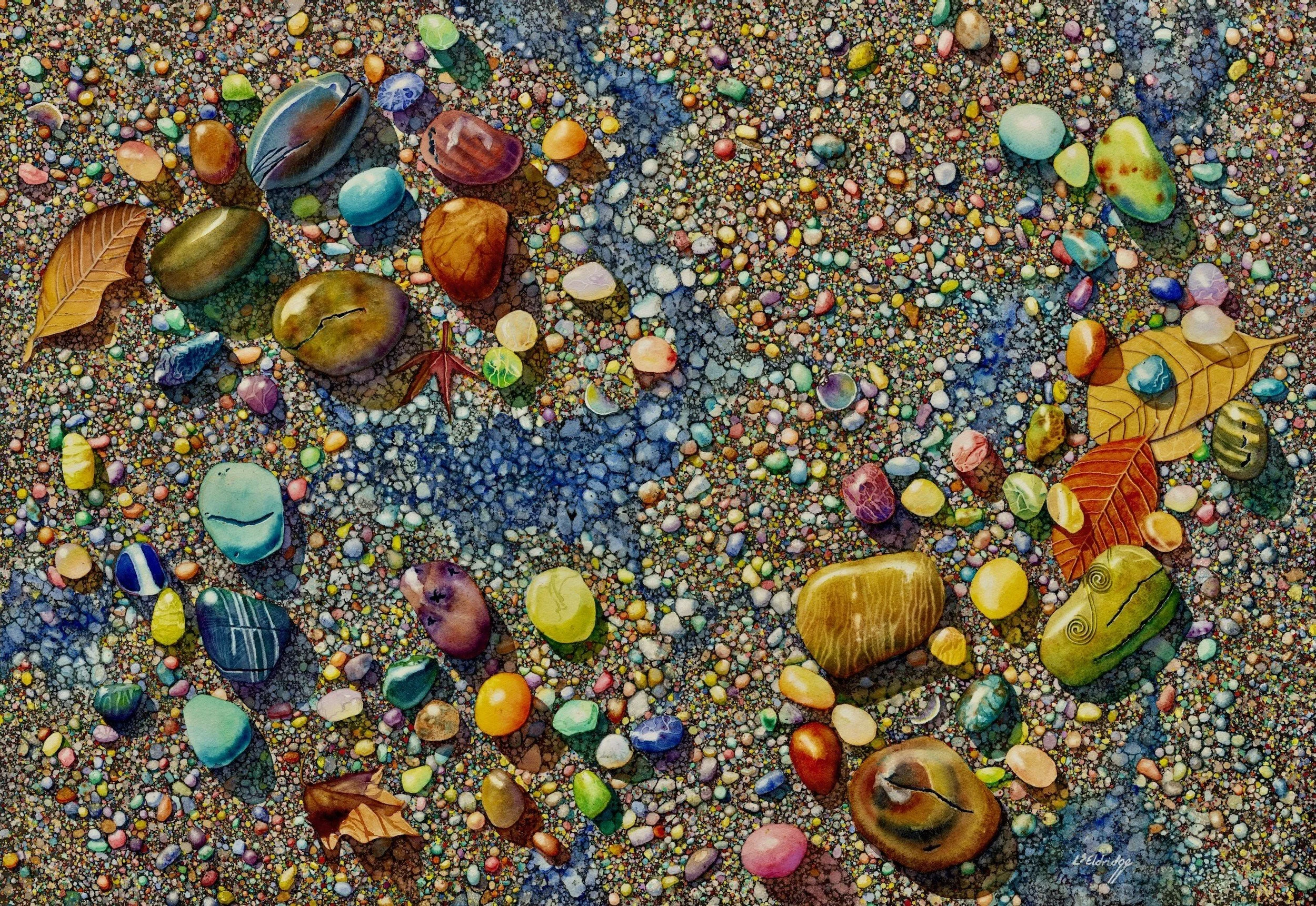
Let's talk about Twenty Thousand Stones, which won the Robert E. Goodier Memorial Award at Watercolor USA this year. At $27" \times 39"$, it really holds down a wall and engulfs the viewer in a world of color and tiny details, all painted transparently and with great care. While I wouldn't want to count them, I absolutely believe that you painted 20,000 rocks and pebbles. What inspired you to create it?
The Arkansas Arts Center (now the Museum of Fine Arts) in Little Rock has an extensive collection of Signac's watercolors. I spent many hours in that dully-lit room contemplating his work. Neo-Impressionism speaks to me because it is so thoughtful. Divisionism/Pointillism is usually employed to address light and hold subjects together. I considered that I could put my own spin on that style of painting. Instead, I would use Divisionism to split the background apart so that each individual color is its own subject. From afar the large stones hold your attention and the impression is that the background is a rather plain riverbank. But get closer and you'll find that the riverbank is unexpectedly detailed and colorful. I used a size 0 or smaller brush for this area. I admit I'm very happy with the result. I think it works.
But why did I paint this painting? As a child I chose books not by subject but by how the pages felt. If asked I would have said 20,000 Words was my favorite. Made for authors, it was a book of only words, no definitions. I'd abscond with this book from my father's desk to run my fingers down the pages and read the words aloud. (I suspect this is where my habit of doing "word sketches" originated.) I was similarly captivated when walking the riverbank with my grandfather. With my eyes focused on the rocks at my feet, I chose to pocket stones based on how they felt when stroked. I thought of those experiences while laboring on this painting. I believe that all things are interconnected. The stones on this riverbank and my favorite book as a child both occupy space on my thread of life and contribute to my sense of identity.
Sometimes when I see a painting, I want to know the story behind it. Occasionally I'm more concerned with the HOW of a painting, and that was the case with Twenty Thousand Stones. On your blog, you said, "Sorry to tell you that I have no hacks or shortcuts to share." But how did you tackle this?
Tackle is a good word. I established the large stones first before starting the background. The large stones are from my personal collection which I use repeatedly in this series. The entire background is just made up—my recollection of the riverside at my grandparents' home. There is no reference photo, just an idea, memory, and creativity. After breaking up the background, I systematically painted sections at a time in a wave, starting with yellow and ending with violet. It took 8–10 hours a day for six months to complete.
You worked on the painting last summer and fall and developed shoulder pain that took your breath away. Months passed, and you picked up your brushes again in April. Are you okay now?
That was a rough seven months away from my brushes. Relative to last fall I have improved mobility. Unfortunately, even now after painting for a day I have trouble lifting my arm.
This is your biggest painting. Framing and shipping costs for oversized watercolors can be daunting, and in the past you have written, "I would rather wipe my eyes with sandpaper than deal with shipping companies." I think every artist reading this can relate to that! Would you consider working on this scale again?
Probably not. There are so many negatives for me: 1. The cost of framing is substantial; 2. Shipping costs are prohibitive as are the shipping containers for this size; 3. Isolation during the long process; and 4. Very few places exhibit this size work. I consider how few people will actually have the opportunity to see it. That said, I wouldn't rule it out if the circumstances were just right.

The Measure of Tools
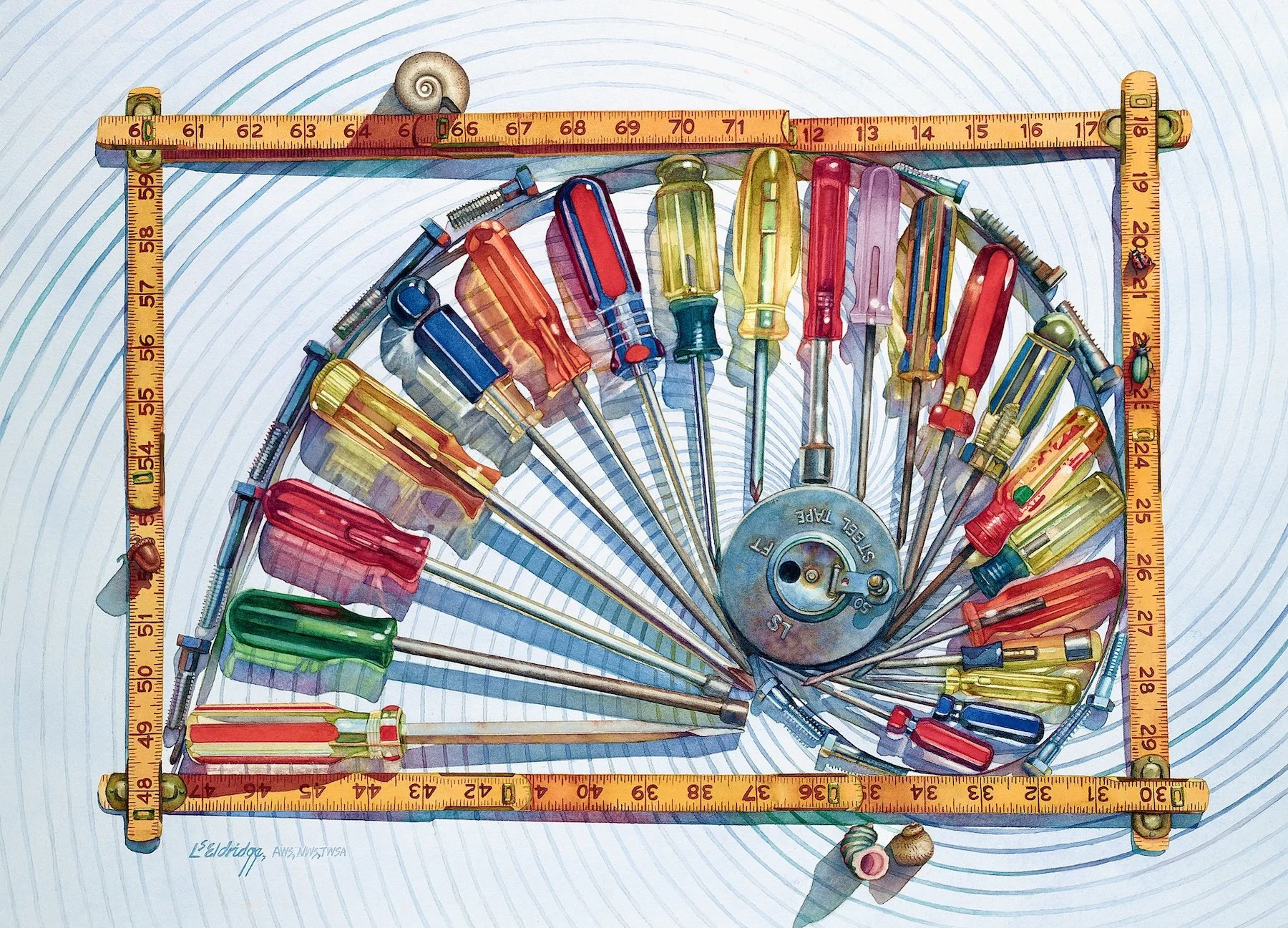
Your watercolors are often instantly recognizable with their brightly colored tools, such as screwdrivers and metal tape measures. You have said you were inspired by a drawer filled with screwdrivers and other old tools you found in a condemned barn. Along with shiny surfaces, you are capable of creating rusty and other antique-looking textures, so why do you make those old tools look brand new in your paintings?
This is a quite literal "There is no there there." The homes of both sets of my grandparents, though hundreds of miles apart, were set on the same river and have all been torn down due to flood damage. These were tools nobody wanted that were left in a barn that would be torn down. When I held them up to the light, I was flooded with emotions and knew these jewel-hued treasures held the spirit of this place. I took that spirit home with me. So the tools became symbols for what would be no more. Why do I make them look new? Loss is such a sharp emotion. The only way to depict it is with really bright colors. Though the tools I found are scratched, faded, and burned, the memories are vivid. For that reason, I portray the tools as practically new.
Tooling Around
Just curious: how many screwdrivers do you own?
Not as many as you might imagine. As an artist I can change the color or shape at will. A good example of this would be my painting Tribes where I painted 72 tools as either blue or red. (And by the way, that was difficult because, although the concept is spot-on, using only two colors was so boring it depressed me.) I have received many tools as gifts since starting this series, and to honor the spirit of these gifts, I try to use them in paintings. My favorite gift is the green pliers. I recently received an old orange wooden paper cutter that I look forward to adding to the mix.
When described in print, your work seems beyond impossible to paint. For example: Archimedean spirals in various shades of light blue topped with screwdrivers of different sizes that are arranged into a Fibonacci spiral and framed by tape measures and bonus snails. How confident are you when you begin painting subjects this formidable? Do you feel like you're walking on a tightrope from start to finish? Has painting improved your patience?
Experience has taught me not to be overconfident, but a sense of adventure combined with a willingness to fail always awaits when I pick up my brushes. When I painted Off the Hook, the last area I painted was the blue receiver which, in my opinion, felt overworked. I did my ritual goodbye: fire and a beer. I thanked it for the three months of knowledge it imparted and let the embers take it. Then I began again. Some might consider that quite the tight-rope, but I believe hesitation is worse. I'm decidedly averse to creating a doom pile of artwork. The result is the same with either outcome; whether burned or completed, I move forward. I struggle with patience, but I have become a master of acceptance.
Remnants of Enchantment
You've said, "When you're painting, sometimes you just have to swan dive and hope water appears in the pool." What's an example of one of your paintings where you did a swan dive?
I'm pretty sure there is one in every painting to be honest. One that comes to mind is The Measure of Tools. In previous paintings, I made dramatic shadows in combinations of gray. Why not make the shadows colorful instead? I think you lose some drama, but this way conveys a more delicate beauty. Since these tools are symbols for me, a delicate beauty is appropriate.
Some of your work contrasts man-made objects with the natural world. This can be seen in The Nature of Tools, which depicts a daisy whose center is a cluster of silvery hex nuts, and screwdrivers stick out from the center alongside white petals. The daisy is utterly original, beautiful, and disturbing—do you remember how you landed on this idea?
While staying true to the original spirit of the "Measure" series, I began to use the tools to interpret the context and significance of many diverse subjects. After all, everything is a tool in some fashion. The idea blossomed during a conversation with a dear friend who is a master naturalist. We were discussing the decline of pollinators, and I shared the thought that we will need to apply every tool at our disposal to address the issue. The Nature of Tools' focus is mankind's influence on the natural world and the tipping point it has created. Optimistically, I used the common daisy for my backdrop as a symbol of new beginnings.
I enjoy your blog and your honesty in describing art's frustrations. Frankly, it humanizes you! I love when you write things like "I am the most agonizingly slow painter," and "It truly takes perseverance on my part to put the thing on the table every day," and "By the time I finish a painting, I'm completely over it." Non-artists tend to assume that what we do is relaxing and fun at all times. Do you have additional pet peeves about watercolor or art in general?
Watercolor is the most capricious yet beautiful medium, and I have no complaints about it. Its versatility constantly inspires me. One of my main triggers is visiting a museum and only finding one or two watercolors. Also, I'm really quite annoyed when people describe non-objective art as though it is a Rorschach test. The same qualities apply to both realist and non-objective work. So please back up and begin by talking about the color, shape, texture, line, and form, not that you "see" a dog's face in the corner. I've stated I struggle with patience, and admittedly these are a couple of my flashpoints.
Your love for painting is clear when you say things in your blog like, "Sticking my paintbrush in a beautiful rich green has lifted my spirits" and "Creating a painting is like a relationship: now it's new and exciting, and later it's like an old friend who shares memories." What other things make being an artist gratifying?
Well, taking the tape off comes to mind. That moment where I am physically reminded of where I began with that blank piece of paper. That is a very satisfying moment. I am grateful for the art community as well. Our empathy combined with our ability to problem-solve creatively is a top rate contribution to this world. I feel extremely lucky to be a part of it.