
This interview originally appeared in the Fall 2023 Watercolor Honor Society newsletter.
Can you tell our readers your backstory, Robert? What kinds of subjects are you drawn to?
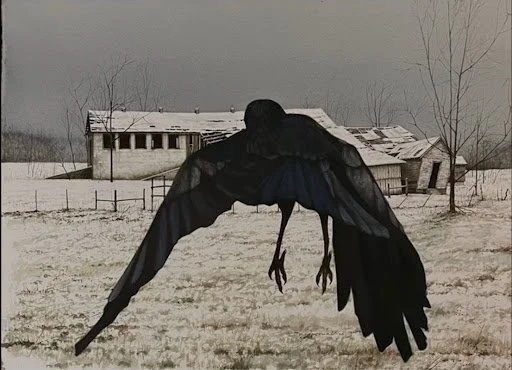
I could go back to my early childhood life and surroundings, but that narrative never gets past the surface before I dismiss the thought. That time was rough and poor, blah blah. That environment was merely the canopy that surrounded my innate motivation to draw and tinker. Drawing and coloring were my 'escape,' although it wasn't really an escape. I was a shy person, and the solitude of 'art' was a comfortable place for me. Maybe the seemingly hostile and chaotic surroundings coupled with my quiet demeanor shaped my interests. As for the weathered textures I'm enamored with and the environments that created them, one could draw a conclusion.
How did teaching art to high school students for 35 years affect your skills as an artist?
I don't know if always hammering at fundamentals for years affected my skills. Oh, I guess it did. The schedule had a bigger impact. The art classroom is a structured environment. Routines make me a better artist and are far better than capitalizing on fleeting moods which offer no consistency. I had to budget my time wisely when not on the job, and I produced some of my best work then.
Are you as disciplined as an artist as you must have been as a teacher?
Those 35 years of structure left me upon retirement...for a time. Retirement required me to create a new routine, and this was not easy, since I'm available anytime, anywhere. So I'm slowly making 'my' art a priority.
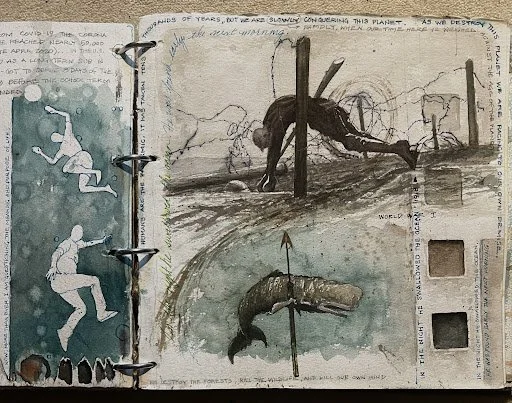
During your teaching days, you posted fascinating sketchbook pages. They often featured skillfully drawn and painted subjects that flowed together. These posts were accompanied by captions like, "No time for a painting, so the sketchbook suffices." Can you describe how your sketchbook worked as a creative outlet throughout the school year?
The sketchbook bridges the gap between 'serious' works that require blocks of time. It's very freeing. There's no preconceived image or subject—whatever visual references are on hand typically make it into the sketchbook. Years ago a student showed me how to bind my own sketchbooks. I use 140lb cotton watercolor paper, which is relatively expensive. So the conglomeration of various images on a single page is an economic choice that becomes an exercise in finding a unifying element for that mess of unrelated imagery. So satisfying!
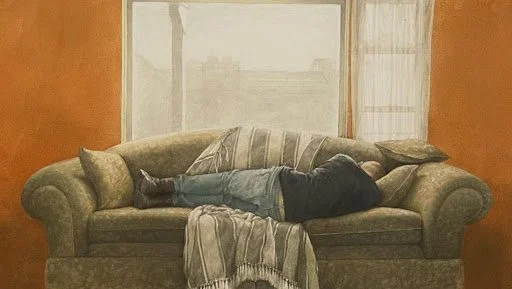
"Escape From Colorado," which was part of this year's Watercolor USA exhibition, made me curious to learn the story behind it. So...what's the story?
Our oldest son was trapped in a toxic 8-year marriage. He shouldered the burden of making it work before finally reaching his limit. At 32, he moved back home, physically and emotionally thrashed. For weeks prior to leaving, he'd been living out of his truck. Seeing him in a deep sleep on the couch told me everything I needed to know. His healing has been slow, but we're happy he's home and doing well.
You produce beautiful work in numerous mediums, and you create sculptures, murals, and even furniture. Do you skip around, or do you work for long periods of time on each one?
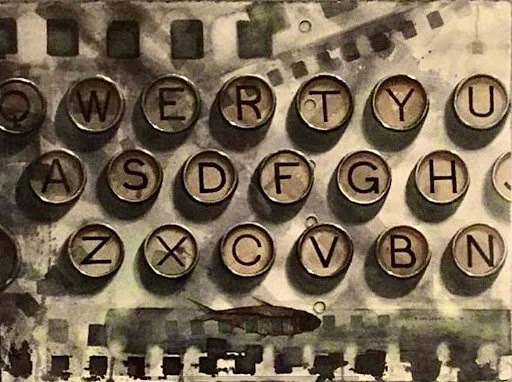
So many variables dictate my artistic focus. I took an interest in building tables after I started saving logs from fallen trees. I was commissioned to build one table per month for a client—prior to that I'd built for private individuals. Around then, I painted minimally. Sculpture is a pursuit that happens sporadically because it requires subjects that have to grab me. I'm inconsistent with that medium. My initial response to watercolor in general was that the work was often careless and even sloppy. I was so ignorant! But one day I saw watercolor paintings by a Crow guide at Little Bighorn's tourist center that featured incredible details and mirrored the way I like to work. That artist showed me what was possible and inspired me to take up watercolor painting. Since then I've gained appreciation for looser watercolor techniques.
What does watercolor bring to the table that the others don't?
My detailed oil painting style has drawbacks. If I leave an oil unfinished for an extended period (days or weeks), I find it difficult to blend fresh paint into dried areas, and it can be a real train wreck sometimes. With a watercolor I can pick up where I left off, and depending on my stopping point, it's so much easier!
Do you have any pet peeves about watercolor?
I have no hang-ups about my watercolor process. We all have our methods. Sometimes I struggle with the subject matter of other painters who lean toward cliched and quaint themes. However, my opinions stem from spending so many years working with students and non-art people whose tastes are often 'cliche'. I'm actually very humble and not judgmental, and I'm sure others have similar thoughts about some of my imagery.
When I was a teacher, my supply budget was ridiculously limited, and I had to get creative when sourcing supplies (mat board scraps from a frame shop, clay from the ground when people dug a foundation). Your use of black walnut juice seems like an ingenious way to make basically-free paint.
I remember scrounging for materials in my early days—clay from the local brick plant, newsprint from the Ft. Smith Times. However, as an art teacher for 24 years at Branson High School, my budget was embarrassing by comparison. When I lived with my grandparents in Arkansas, we picked up walnuts for extra income. The stains on our hands lingered for days. Here in Branson, I resumed the practice with my family—gathering walnuts so we could go out for pizza or buy a birthday present. That's when I began experimenting with creating a walnut painting medium. Process: Pack wet, gooey walnuts in a 5-gallon bucket, soak in water up to the top of the walnuts, mash with a hoe, strain the pulp several times, reduce on the stove until rich and almost thick like milk, pour into a brown glass jug or bottle, and add alcohol to prevent bacteria, lest it smell like horse shit! Then it's ready to use.
What's it like to work with? Does it behave like watercolor?
It reacts like watercolor except it tends to hold onto the paper fiber more readily, and this makes it harder to stretch into gradients. Within the umber color is a slight greenish hue. I like to add a bit of drawing ink to achieve a richer burnt umber tone.
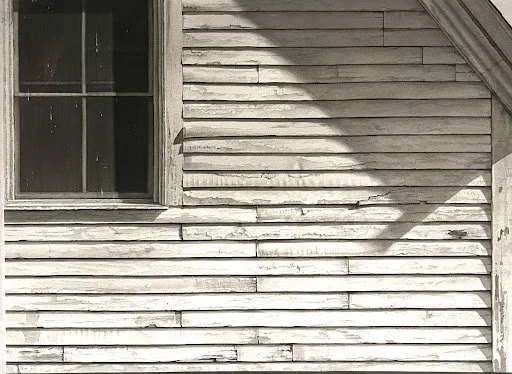
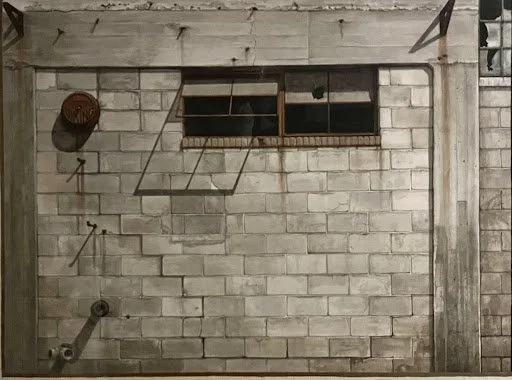
Your painting "Saturday Morning" is almost a portrait of the corner of a white house, and "Ground Floor of Wilson" is a sensitive meditation on concrete blocks and rust. Both feature grays with subtle warm and cool color shifts, and much of your work has an autumnal/wintry mood. Can you explain the appeal of working with a restrained color palette that reflects the colors of decay and age? And are you ever tempted to let loose with bright colors?
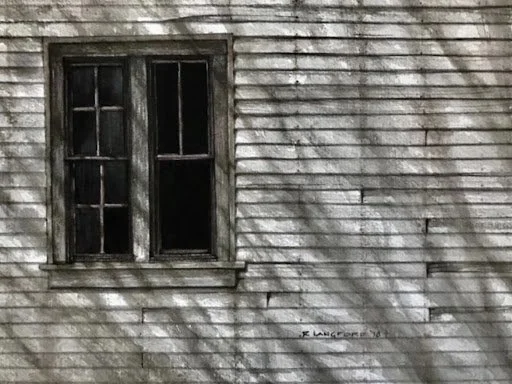
Within my dull, boring, omnipresent subjects, I like a more earthy color palette. Burnt umber and yellow ochre actually excite me! Weird, I know. It's linked to whatever it is that draws me to weathered textures and structures. Black and white film photography, which I still develop in my basement, has the same strong appeal. Any painting I've done that features vivid color appears to be a forced effort, so I keep color to a minimum.
On behalf of all of us who were inspired by an exceptional teacher, I'd like to thank you for bringing art to generations of students. Did you have a great teacher?
My high school art teacher, Mr. Gray, was a casual but serious young guy with long hair—a solid mentor. He always had a surrealist painting underway, such as a monkey smoking a banana and so on. He taught fundamentals and covered a lot of ground in what I recall was a short amount of time. As an art teacher, I strictly advocated fundamentals, as I should have. Some kids complained that this stifled creativity. But when you're building a house, you need a solid foundation. Then you can frame and dress it up to your heart's content. Make sure you have a well-stocked toolbox available.
After being away from the classroom for five years, what is your current schedule like?
I'm currently building houses for Eli and myself. My lumber supply is dwindling, and I'm dragging my feet milling the remaining logs...because milling them means building rather than painting. I want painting to become my routine. Once our houses get built, I'll—God willing—retire to my studio, if these old hands can still raise a pencil and brush.